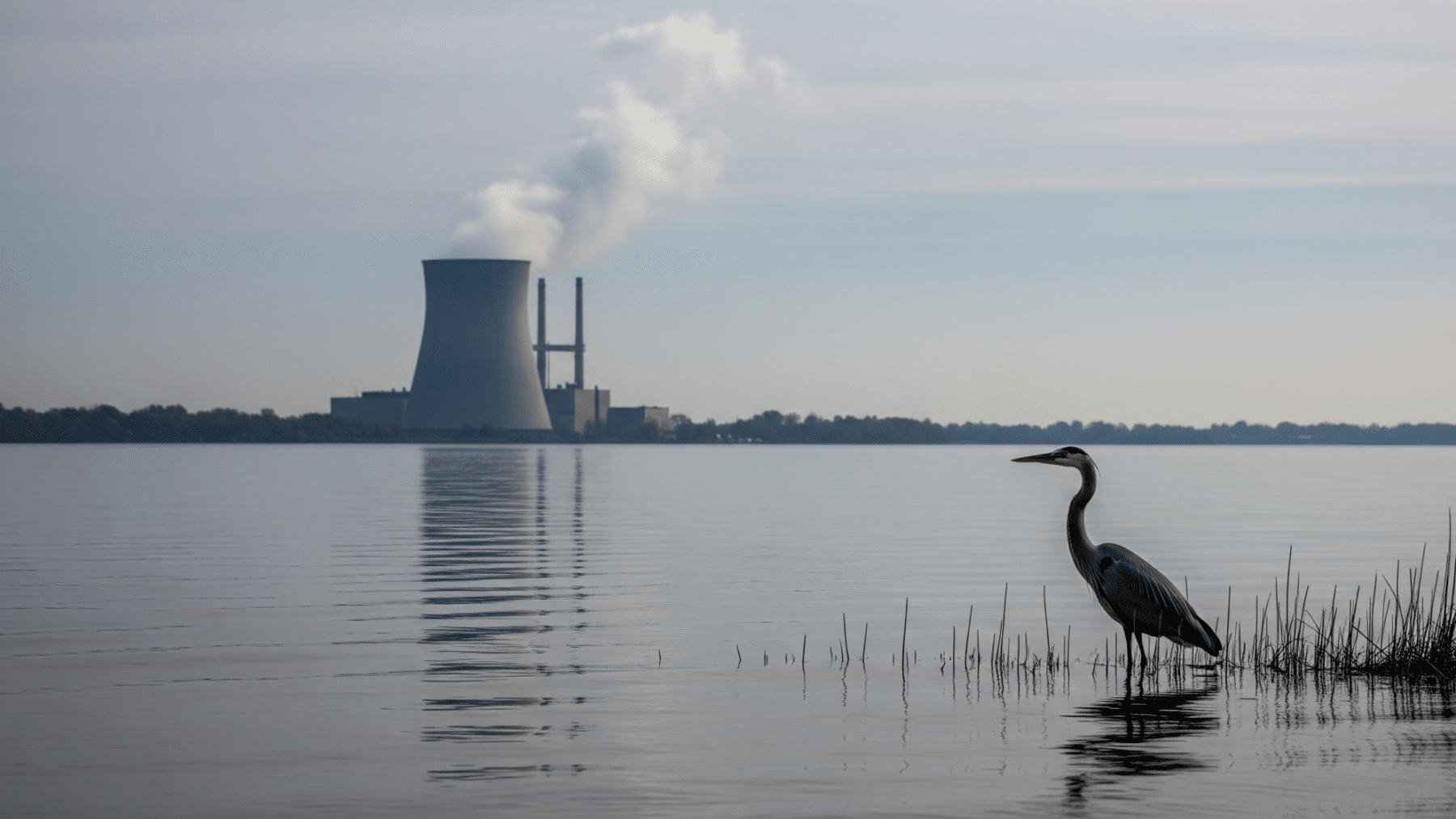
Every morning, an engineer badges through the security gate at a nuclear power station on the edge of Lake Erie and crosses a perimeter that almost no one else is allowed to pass.
What lives on the other side of that fence has nothing to do with reactor physics.
And the federal agency that just handed the plant another two decades of operation did not plan it that way, either.
A plant that almost closed is still running
The Perry Nuclear Power Plant sits on a 1,100-acre site on Lake Erie, 40 miles northeast of Cleveland in North Perry, Ohio.
A boiling water reactor produces 1,258 megawatts of electricity, enough to power about 750,000 homes.
Perry was expected to close in 2021 as it was no longer profitable running against natural gas plants, and Ohio House Bill 6 was signed into law in July 2019, adding a fee to residents’ utility bills to keep the plant operational.
The plant survived that crisis and kept generating.
The federal agency that just extended its clock
In July 2023, Energy Harbor applied for a license renewal for the Perry nuclear power plant, requesting an additional 20 years of operation, and that renewal was officially approved on July 7, 2025, extending the license to November 7, 2046.
That decision locks in two more decades of electricity for three-quarters of a million Ohio households.
It also locks in something else entirely, something the Nuclear Regulatory Commission’s paperwork barely mentions.
It is the kind of unplanned consequence that quietly changes what an energy site actually is, once the fence goes up and the years start passing.
And it connects, in a surprising way, to what researchers have been documenting at other energy sites around the country, including offshore wind foundations that became accidental marine reefs within months of installation.
What a security perimeter does to the land inside it
When a nuclear plant is built, engineers fence off a large buffer zone for safety and access control.
Vehicles, hikers, dogs, hunters, and the general noise of human activity are all kept out.
That exclusion, entirely unintentional as a conservation strategy, turns out to be one of the most effective forms of habitat protection a piece of Ohio land can receive.
Decades of forced stillness do what many formal nature reserves struggle to manage.
The structures create a small ecological footprint with little impact on their surroundings, and the land surrounding a plant provides a safe, ideal habitat for diverse and wide-ranging species of plants and animals to thrive.
The land was never set aside for animals. The animals moved in anyway.
The wildlife sanctuary hiding inside the reactor fence
Here is what no one outside the energy world tends to know about the Perry plant.
Eleven hundred acres at the Perry plant were designated in 1993 as an urban wildlife sanctuary by the National Institute for Urban Wildlife.
More than 850 acres of natural forests and marshes on the site provide diverse habitat for area wildlife.
The area has trees, shrubs, streams and ponds, and a habitat for heron, belted kingfisher, ducks and geese. The forested area is ideal for the crane-fly orchid, a rare species in Ohio. The site includes a wetland that contains spotted turtles, an endangered species in Ohio.
A reactor that generates over a gigawatt is also, quietly, the most protected woodland on its stretch of the Lake Erie shore.
The logic is the same one researchers found playing out beneath offshore wind turbine foundations off Long Island: energy infrastructure excludes human disturbance, and nature fills the gap faster than anyone expects.
Why the 2046 license renewal matters beyond electricity
When the NRC extended Perry’s operating license to 2046, it did not set out to protect a spotted turtle or a crane-fly orchid.
But that is the practical effect.
The security perimeter meant to keep people out keeps disturbance out too. Into that undisturbed space, wild things simply move in. Decades of forced stillness have done what many nature reserves struggle to manage.
The 2046 deadline now stretches accidental protection across every forested acre and every marsh pond on the site for another two decades.
It is an odd bargain: a machine built to split atoms ends up sheltering an endangered turtle simply because nobody is allowed in to disturb it.
As the country pushes to build more nuclear capacity to meet growing electricity demand, Perry is quiet proof that the fence the engineers draw for safety is, acre for acre, one of the most effective conservation tools the grid has ever accidentally deployed.
