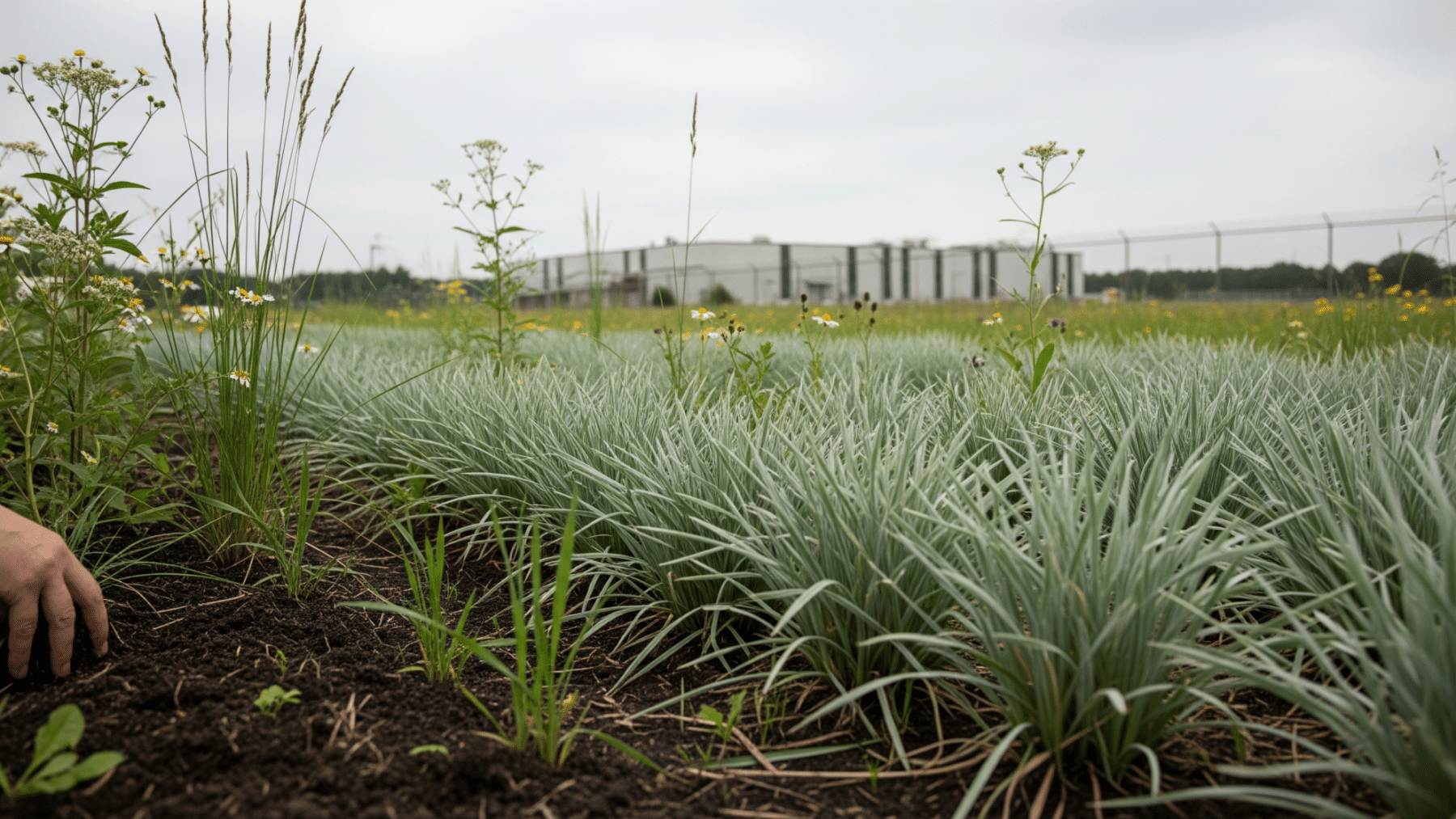
Something unusual is growing behind the fence of one of the most powerful computing campuses in the American South.
It is not a cooling tower. It is not a substation. It is a rare grassland that scientists say barely exists anymore anywhere on Earth.
And it is coming back to life because a server hall moved in next door.
A campus so big it needed its own announcement to announce the expansion
In Montgomery, Alabama, a data center campus that was already making headlines grew even larger in September 2025, when the company behind it revealed plans that would bring the facility to more than 1.3 million square feet and push total investment to $1.5 billion, almost double the original figure.
That is a building roughly the footprint of 22 football fields.
The sheer physical scale of modern AI infrastructure is easy to say in numbers and hard to picture in real life, but Montgomery is now a place where you can see it.
During peak construction the project supports a workforce exceeding 1,000 skilled trade workers, and once operational the facility is expected to create over 100 permanent jobs.
What the land looked like before the concrete crews arrived
Before any of this, the site was not pristine wilderness. It was not a forest anyone was rushing to protect.
It was a stretch of Alabama ground that had been losing a battle for decades, smothered by invasive grasses that had displaced whatever grew there before.
At the Montgomery data center, the company is working to restore the endangered Black Belt Prairie, a globally rare ecosystem. Prior to acquiring the site, it had been overtaken by those invasive species.
That detail, buried in a sustainability page, is the beginning of something much larger.
How a data center company ended up thinking about prairie ecology
The tech industry’s reckoning with land use has been building for years.
According to the company’s published sustainability materials, its standard design dedicates the vast majority of unbuilt outdoor spaces to restore native habitat, largely eliminating turf and exotic ornamental species. Qualified local native habitat experts perform evaluations at each stage, diligence, planning, design, construction and operations.
That philosophy meant the Montgomery site was never just about square footage. It was also about what grew between the buildings, and what had been lost.
Today, more than 50% of the company’s operational data center footprint, over 4,000 acres, has been planned, restored or preserved to support native habitats, with additional biodiverse acreage added as new campuses come online.
Those are numbers that would not be out of place in a conservation report. They are sitting on a tech company’s sustainability page.
The Black Belt Prairie: a grassland so rare that less than 1% of it survives
Here is the real payoff hiding behind the fence in Montgomery.
Stretching across 19 counties of central Alabama and neighboring states, the Black Belt Prairie is a historic native ecosystem named for its dark, fertile soils that once supported an abundance of wildlife, endemic plant species, and some of the most diverse habitat in the South before much of the region was converted to agricultural land.
It is not just rare. It is critically rare.
The Black Belt Prairie region remains the most degraded ecosystem in Mississippi and Alabama, with less than one percent of the ecosystem remaining.
Scientists working on prairie restoration are trying to coax native species back from existing soil seed banks, seeds that have waited underground, sometimes for generations, for the right conditions to germinate again.
The primary objective of restoration work in the region, as outlined by the USDA’s Natural Resources Conservation Service, is to establish and maintain native prairie ecosystems by restoring deep-rooted native prairie species from those existing soil seed banks.
Now one of the places giving those seeds a chance is a data center campus.
Why this pairing may matter more as AI demands more land
The story in Montgomery is not an accident of good intentions. It points toward a real question the industry is starting to answer in public.
The construction of data centers powered by the rise of artificial intelligence is booming globally, driving unprecedented demand for electricity and significantly contributing to habitat destruction and resource depletion.
But Montgomery shows the math can run the other direction. A site that arrived already degraded, stripped of its native ecology by decades of invasive growth, is being returned to something genuinely rare as a direct consequence of the data center moving in.
Researchers are starting to ask whether that model could scale. As GCN has reported, AI’s footprint reaches further into everyday life each year, and the land it sits on is part of that footprint.
The Alabama Soil and Water Conservation Committee received a $17.5 million grant through the USDA’s Regional Conservation Partnership Program to support a new five-year Black Belt Prairie restoration effort, with on-the-ground habitat work now beginning to move across the region.
The server halls in Montgomery are not the whole answer. But the grassland coming back to life behind their fence is, at minimum, a real and verifiable start.
