Every smartwatch owner has felt that small dread: a hairline crack crawls across the glass, or the battery just stops holding a charge. The standard answer from every major brand has always been the same. Buy a new one.
Until now, that was not a choice. It was the only option the industry gave you.
Something changed with one device, and the number that a respected repair authority put on it is the highest ever recorded for any wrist-worn gadget.
The small piece of glue that made every smartwatch temporary
For years, the dirty secret inside every premium smartwatch was adhesive.
Manufacturers sealed screens, batteries and sensors with glue so strong that any attempt to open the case risked destroying the components inside. Water resistance was the justification: break the seal, lose the rating.
The repair community accepted it as an engineering reality.
You cannot have waterproofing and replaceability at the same time. That was the accepted wisdom of the entire wearables industry.
It turned out to be wrong.
What happens when a tech giant rebuilds a watch from the inside out
Google’s engineers spent the development cycle of its fourth-generation smartwatch rethinking how the case itself closes and seals.
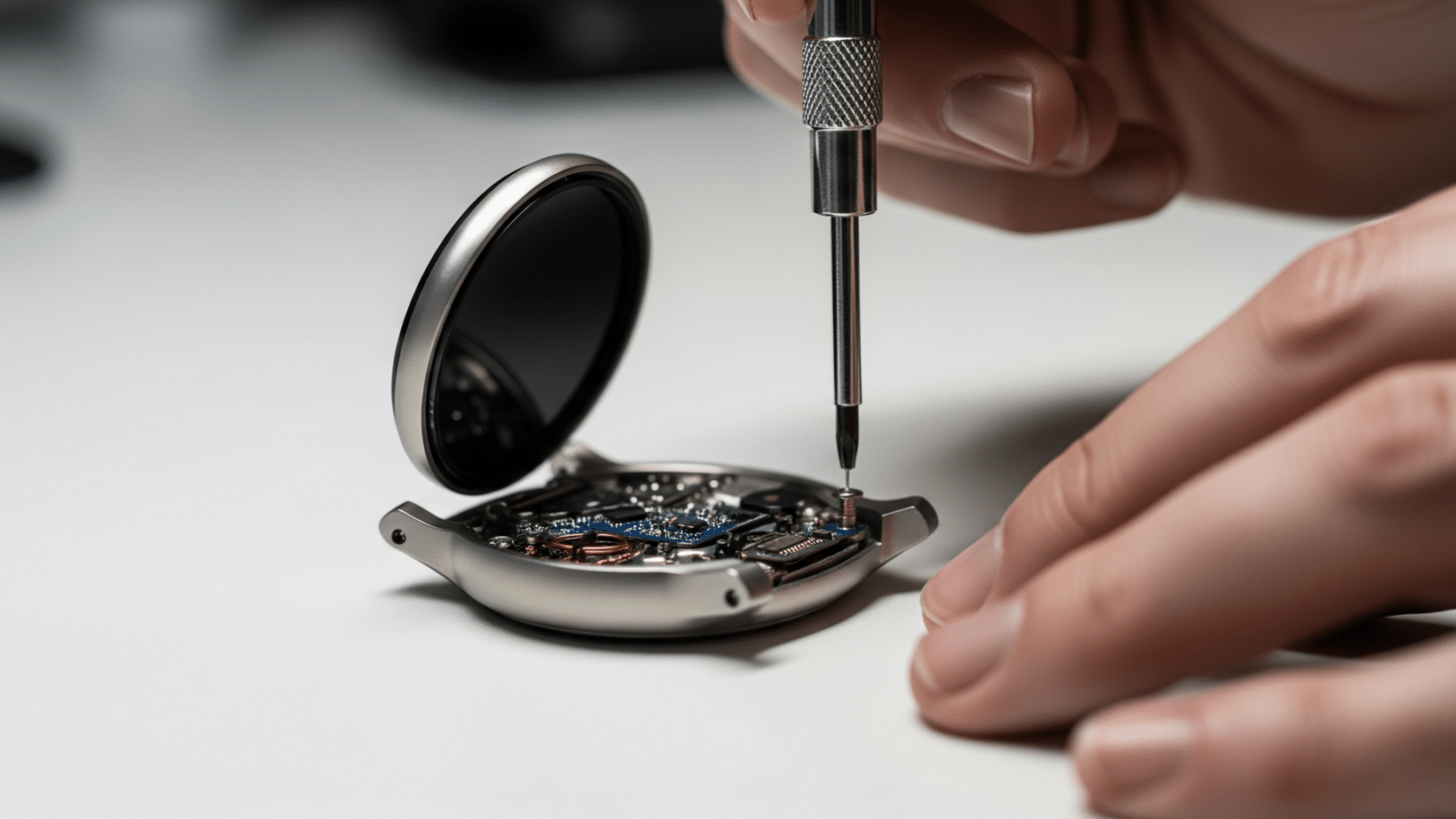
The back plate of the Pixel Watch 4 is held in place with just two Torx screws and without any glue, hidden under the watch band lugs, and can be opened by loosening those same two screws.
That sounds simple. The engineering behind it is not.
For a battery replacement, there is no need to heat up the device to soften glue or any other material. Google designed the back plate so that a pair of hinged arms compress and seal the case when the screws are tightened.
On the display side, Google uses a replaceable O-ring gasket instead of adhesive, so it maintains an IP68 rating even after you swap the screen out.
The waterproofing problem, the one the whole industry used as a reason to keep every watch permanently sealed, had been quietly solved.
How fast a repair actually goes when the design wants you to succeed
Speed matters to ordinary owners, not just professional repair technicians.
According to a pre-launch teardown published by Wired, removing the screen took just 13 minutes, demonstrating how accessible a Pixel Watch 4 display replacement can be for users with little repair experience.
That is less time than most people spend choosing a case for a new phone.
Google has made replacement parts available via iFixit throughout the Pixel Watch 4’s life cycle.
Google not only now offers smartwatch repair services but has also enabled home repairs for the battery and display by partnering with iFixit, just as it has done for phones.
The self-repair option means owners do not even need a service centre. A Torx screwdriver and a replacement part ordered online are enough.
And critically, doing so will not void your warranty.
The score no smartwatch had ever reached before this one
When iFixit tore down the Pixel Watch 4, the repair authority that sets the industry standard for these assessments, the verdict was clear and historic.
iFixit came away truly impressed, calling the Pixel Watch 4 the “Most Repairable Smartwatch on the Market.”
iFixit gave the Pixel Watch 4 a provisional 9 out of 10 for repairability, a score no smartwatch had reached before it.
The same organization gave the previous generation of Pixel Watch a score of 4 out of 10, typical of a category where, as iFixit notes, most smartwatches on the market have earned 3s and 4s out of 10.
Everything inside this watch points toward a repair-first design philosophy. Google released full service manuals for both the 41mm and 45mm watches on launch day.
The Pixel Watch 4 is much easier to repair than the Apple Watch, and even a little easier than the “repairable” Galaxy Watch Ultra, which itself earned a 7 out of 10, a direct challenge to both of the industry’s dominant players.
Readers who follow the broader shift toward Samsung’s hardware moves will recognise why this milestone puts immediate pressure on every wearable brand.
Why one watch’s screws could rewrite what the whole industry builds next
The Pixel Watch 4’s repairability makes it the first mainstream smartwatch built with user-serviceable parts, a move that could pressure the rest of the wearable industry.
For American consumers, the practical stakes are high. A smartwatch battery that degrades over two or three years no longer means a device that belongs in the bin. It means a straightforward repair and a parts order from iFixit.
The Pixel Watch 4 shifts smartwatches from disposable gadgets to long-term investments that owners can maintain, upgrade, and repair instead of replace.
The broader gadget world is watching. Right-to-repair legislation has advanced across several US states in recent years, and manufacturers have consistently argued that miniaturised, waterproof hardware simply cannot be designed for serviceability.
Google’s own engineers just proved otherwise, with two screws, an O-ring, and a 9 out of 10.
Developers already pushing software boundaries with open-source tools that challenge closed ecosystems will find a familiar principle at work here: the most durable platforms are the ones people can actually get inside and fix.
The next time a smartwatch maker seals its case with glue and calls it engineering, consumers now have a precise, verifiable answer for why it is actually a design choice, not a technical necessity.
