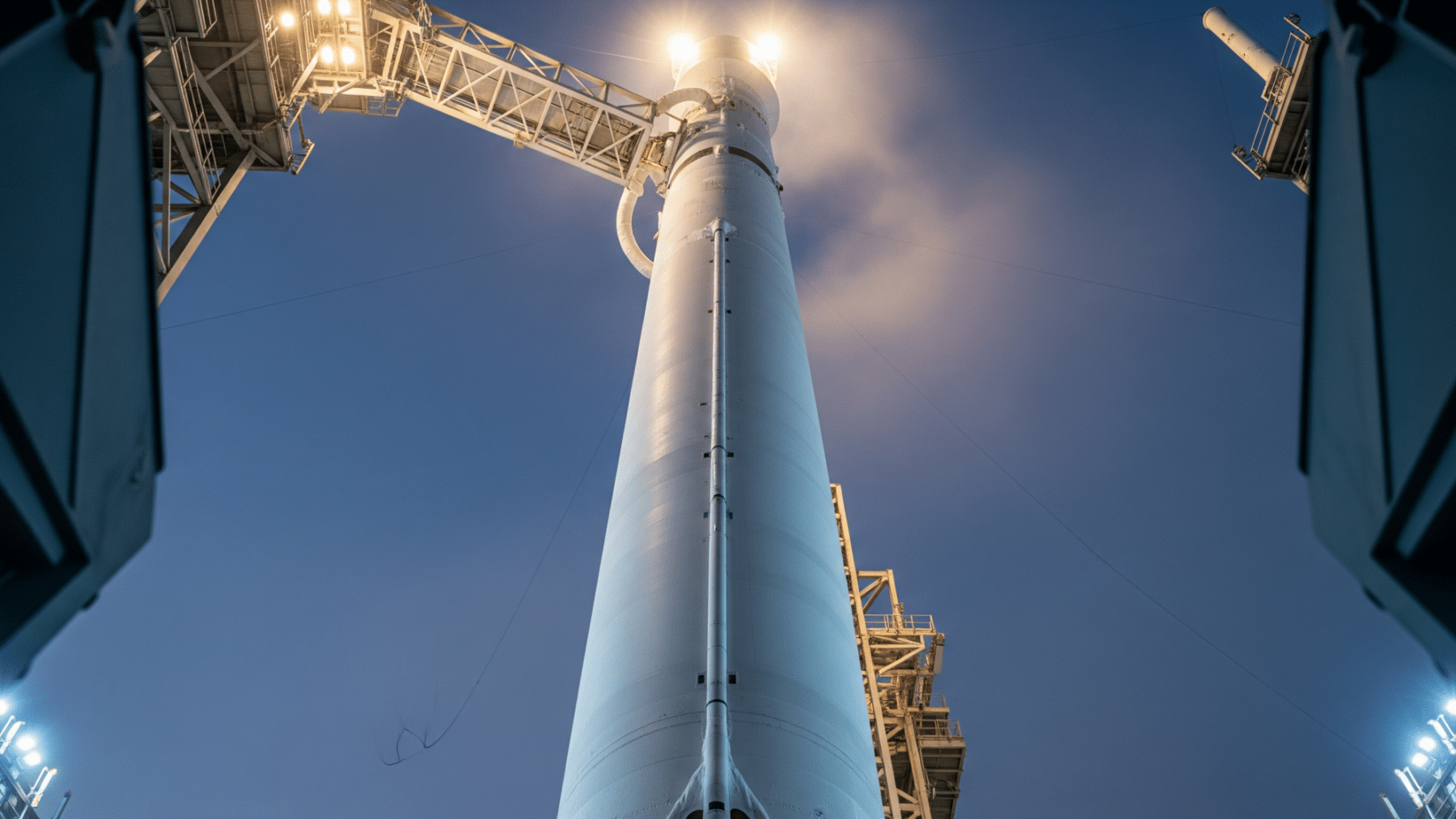
AST SpaceMobile announced the successful orbital launch of three more of its next-generation BlueBird satellites early Wednesday, clearing a milestone in the company’s push to deliver working cellular broadband service directly to standard smartphones from low Earth orbit.
Third batch of next-gen BlueBirds reaches orbit
The Falcon 9 rocket carrying the three satellites lifted off at 3:42 a.m. EDT on Wednesday, August 5, 2026, from Cape Canaveral Space Force Station.
The mission deployed BlueBirds 11, 12, and 13, following the earlier successful June 2026 launch of BlueBirds 8, 9, and 10.
The newcomers bring the total number of BlueBird spacecraft launched to 13, according to AST SpaceMobile. With BlueBird satellites 14, 15, and 16 already preparing for the next mission, and production advancing through satellite 42, the company continues to execute against its plan to deploy its constellation at scale.
BlueBird satellites 11, 12, and 13 will further expand AST SpaceMobile’s space-based cellular broadband network, supporting voice, data, and video services directly to standard, unmodified smartphones while also enabling a growing range of commercial and government applications.
Bigger antennas, stackable design
AST SpaceMobile began assembling its constellation with Block 1 spacecraft whose communications arrays cover 693 square feet when unfurled. The company upped the ante with BlueBird 6, launched aboard an LVM3 rocket from the Satish Dhawan Space Center on Dec. 23, 2025, the first next-generation BlueBird, a class whose antennas cover nearly 2,400 square feet.
The satellites incorporate AST SpaceMobile’s next-generation stackable architecture and advanced lightweight composite carbon structures, enabling efficient multi-satellite launches and accelerating constellation deployment.
BlueBird 7 was lost after a Blue Origin New Glenn vehicle placed it into the wrong orbit on April 19; the upper stage did not perform as expected, and the satellite was placed into a lower-than-planned orbit from which it could not sustain operations and had to be deorbited. The company has since maintained its cadence using Falcon 9, and production is well ahead of the current launch pace. With BlueBirds 14, 15, and 16 already preparing for the next mission, production has advanced through satellite 42.
Beta service planned for later this year
AST is targeting beta services later this year, although its initial US service with AT&T and Verizon will provide non-continuous coverage as the company continues to add satellites to the constellation. The network is designed to connect directly to standard smartphones without requiring specialized hardware on the ground.
Industry analysts have noted that connections will come and go as AST SpaceMobile satellites pass overhead, with gaps between passes possibly measured in hours rather than minutes at current orbital density, a reflection of current orbital density, not a product flaw, and coverage will improve as more satellites launch.
The company has stated that approximately 45 to 60 BlueBird satellites are needed to enable continuous coverage across key markets. AST SpaceMobile has indicated that timeline for reaching that threshold has shifted to early 2027, citing launch vehicle availability and manufacturing logistics.
In his post-launch statement, AST SpaceMobile founder and CEO Abel Avellan said the company is focused on scaling its cellular broadband network as it prepares for beta services, with each launch advancing its goal of delivering broadband integrated with terrestrial mobile networks across standard 4G and 5G devices.
The BlueBird phased arrays are described by AST SpaceMobile as the largest commercial phased arrays in low Earth orbit , surpassing the previous record held by the company’s first-generation BlueBirds at 693 square feet, a distinction the company says underpins its unique technical approach.
What’s next for the constellation
The pace of deployment matters commercially. The company’s AI-heavy ground infrastructure and signal processing stack are built to handle massive parallel connections, but that architecture only becomes commercially useful as coverage density grows.
With BlueBirds 14, 15, and 16 preparing for the next mission, AST continues executing its constellation deployment program at scale, progressing toward initial service activation and continuous coverage across key markets. The company continues to execute against its plan to deploy its constellation at scale.
The wider satellite connectivity race is intensifying: AST’s direct-to-cell approach competes with offerings tied to Amazon’s rapidly expanding infrastructure build-out and other LEO operators. Unlike those systems, AST makes no-hardware-required connectivity its core product claim. Whether the revised early-2027 timeline for continuous coverage holds will depend on how quickly the next cluster of BlueBirds, now already in launch preparation, can reach orbit.
