A cardboard box arrives at the door, heavier than expected.
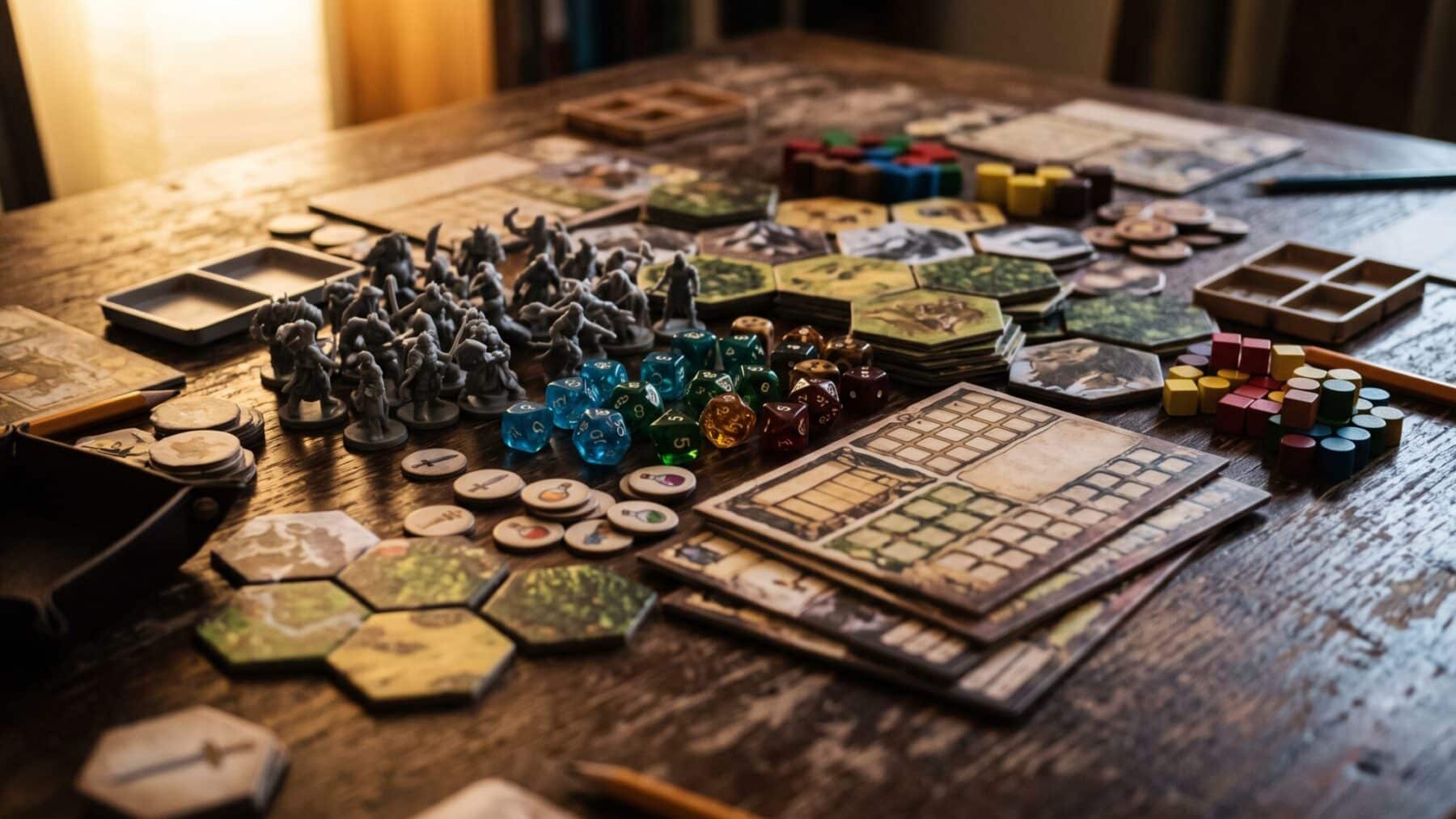
Inside: custom dice, illustrated cards, a mounted game board, painted miniatures, a rulebook thicker than a novel.
Most people assume a publisher in some office picked all of it.
They didn’t. A crowd of strangers did, months before the game existed.
And the machine that made those choices runs on a logic most hobbyists have never seen.
How a pledge unlocks a component the designer couldn’t afford to include alone
The central mechanism is called a stretch goal, and it works like a sliding price list in reverse. A game designer sets a funding target, enough to cover minimum print runs, licensing fees, and shipping, then publishes a public ladder of add-ons that unlock automatically as the total pledged crosses each threshold. Hit $50,000 and the wooden tokens become sculpted resin pieces. Hit $120,000 and a new faction joins the box.
Because the thresholds are tied to real unit economics, each unlock is pre-costed. A designer can promise the upgraded component only because the extra revenue per copy at that backer volume already covers the per-unit manufacturing increase. It is supply-chain logic running in public, in real time, dressed up as a reward system.
After the campaign closes, a pledge manager opens. Backers log in, choose expansions, confirm their address, and pay any balance. Optimization tools now let publishers adjust stretch goals and messaging based on live backer behavior, turning a static funding page into a live revenue instrument.
The table where these games actually get built
According to Kickstarter’s own reporting, the platform has hosted more than 93,756 game projects since launch, with over $2.6 billion pledged from a community of more than 23 million people. That figure dwarfs most mid-size entertainment sectors. The hobby is not a niche anymore.
In 2024, successful tabletop campaigns on that platform generated $220 million. The highest-funded games project in its history raised $15.1 million from over 55,000 backers in one campaign, funded within its first day and spent the rest of its run unlocking stretch goals.
A rival platform built specifically for tabletop gaming is closing the gap fast. Its crowdfunding funding soared 49% in 2024 to more than $85 million, and in July 2025 that platform announced its acquisition of a major general crowdfunding site, creating a combined entity with deeper campaign infrastructure and a community that skews toward high-value collectors.
What the numbers say about who is backing and why
In 2024, 83% of all pledges on the dominant platform went to tabletop games, with 5,314 of 6,646 campaigns successfully funded. That 80% success rate was the highest recorded in the platform’s history, and it signals something about demand: people are not funding long shots. They are funding games they already want.
Designers increasingly launch with pre-built email lists, Discord communities, and preview videos that seed backer intent weeks before a campaign opens. The crowd is warmed before the page goes live, and that preparation is reflected in funding outcomes across the category.
Cooperative titles have become a dominant growth category. Those games are expensive to produce because they require coordinated component sets, and the stretch-goal ladder is precisely how designers afford to include them.
Where the system breaks down and who carries the cost
The same mechanism that unlocks a deluxe miniature can trap a designer between an ambitious campaign and a manufacturer’s reality. Fulfillment is the pressure point. When a campaign overpromises and underestimates manufacturing costs, there is no investor to absorb the loss. The risk falls entirely on the backer.
One prominent cautionary case saw thousands of backers either never receiving their games, being asked for hundreds more dollars to get their orders shipped, or seeing the IP for the game they backed sold off to other publishers without receiving their pledge.
Established publishers have noticed the model’s power. Two of the largest traditional board game publishers globally have incorporated crowdfunding into their launch strategies, using platforms to test premium editions, with one launching three campaigns in a recent two-year span. For them it is not a lifeline; it is market research with a live funding meter attached. And as a single night out now costs $189 all-in, a $60 campaign pledge delivering months of tabletop play looks increasingly rational.
What the model is still figuring out, and where it goes next
Crowdfunding for board games has matured into something closer to a pre-order market with community input baked in. Designers use early backer data to adjust print runs before a single sheet of cardboard is cut, so the crowd calibrates production volume as well as funding the product. That is a meaningful shift from how consumer goods have traditionally been made.
Yet the model still has no clean answer for the gap between campaign close and delivery, which routinely stretches to 18 months or longer. One platform executive framed the challenge plainly: why should backers buy now and not wait for retail? That tension shapes every campaign’s reward structure.
Platform competition is sharpening the pressure to solve it. Creators are choosing between audience reach and backer-experience quality, and backers are reading that choice as a signal about which games will actually arrive. For a hobby built entirely on trust, the stretch-goal engine keeps running: every time a campaign crosses a threshold, a component unlocks, a factory adjusts an order, and a future player gets a better box without ever knowing the crowd decided what was in it.
