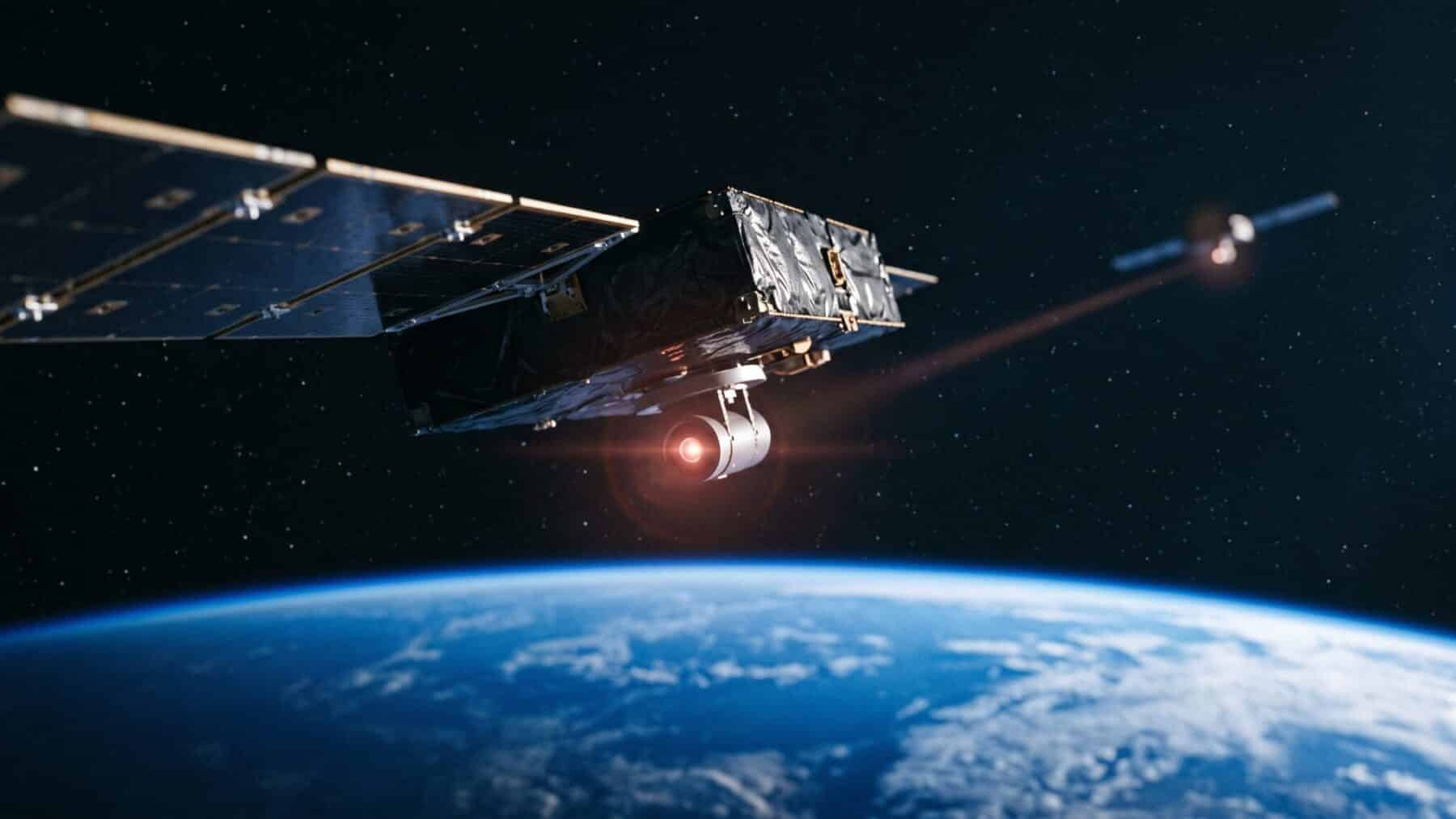
Somewhere 550 kilometers above your head, a satellite is pointing a laser at its neighbor.
The beam is invisible, infrared, and as thin as a pencil.
It carries more data than a small city’s internet connection, and no ground station is involved. The whole exchange takes a fraction of a second before data hops to the next node, threading halfway around the planet without once touching the ground. The question is how any of that is actually possible.
Why light works where radio runs out of room
Starlink satellites use laser inter-satellite links operating near 1,550 nanometers, the same wavelength used in undersea fiber cables. That wavelength is not an accident. It is the window in which glass fiber absorbs the least light, which means amplifier and detector technology developed over decades for undersea cables translates almost directly into space hardware, cutting development cost and compressing the timeline from lab to orbit.
Each Starlink satellite carries three optical terminals capable of up to 200 Gbps per link , letting satellites relay data to each other without ever touching the ground. A single satellite is simultaneously maintaining three laser handshakes at once, each running at a speed that would drain a standard laptop’s entire storage in under a second.
The beam has to stay locked on a target moving at roughly 17,000 miles per hour, from a platform itself moving at exactly the same speed in a slightly different orbital plane. The terminals use a fine-steering mirror inside the optical head to make tiny corrections thousands of times per second, compensating for spacecraft flex, drift, and platform jitter.
What the mesh looks like from inside the constellation
Laser crosslinks let a satellite hand traffic to a neighbor overhead instead of down to a ground station, so the network reaches oceans, poles, and remote regions with no local infrastructure. Think of it as a moving subway grid printed onto the sky, where every station is traveling at orbital velocity and the lines are redrawn every few minutes.
As of mid-2026, SpaceX has launched over 7,000 Starlink satellites, making it the biggest optical mesh ever built. That scale means redundant routing paths exist almost everywhere. If one laser link degrades because a satellite maneuvers for debris avoidance, the network software instantly re-plans the path through a different node, the way internet routing protocols reroute around a broken cable.
That software layer is in many ways harder than the optics. It is essentially running a dynamic map of thousands of moving nodes simultaneously, computing the lowest-latency path for millions of data streams at once, with no human in the loop.
The compact new terminal that opened the mesh to outsiders
For years the laser mesh was a closed system, able to communicate only with other Starlink satellites. That changed when SpaceX’s VP of Starlink Engineering, Michael Nicolls, announced a smaller terminal specifically designed to open the network to outside spacecraft.
The so-called mini laser is designed to achieve link speeds of 25 Gbps at distances up to 4,000 kilometers, and was successfully tested in orbit on a satellite launched on Starlink G10-20. That mission launched in August 2025. At shorter distances the terminals can push well past that baseline figure.
One orbital data center company signed a contract covering 50 or more terminals across 25 or more satellites, with each spacecraft carrying two terminals and the first hardware expected on orbit within a year. A separate satellite systems company became the first outside partner to adopt the technology, with its president comparing the shift to moving from dial-up modems to always-on internet access.
That is not hyperbole when the alternative is queuing data for a ground-station pass that might come once every 90 minutes. The mini laser eliminates that queue entirely, keeping the spacecraft continuously online. This matters for the record venture capital flooding into space startups right now, because persistent orbital connectivity was previously the single hardest infrastructure problem any new constellation had to solve independently.
Where the system hits its limits today
The 25 Gbps figure is real, but it applies to a single link at maximum range. Overall throughput a third-party spacecraft can extract is still bounded by how many mini laser units it carries and how the Starlink network prioritizes competing traffic from its own subscribers.
Weather does not block a laser in orbit the way it would on the ground, because the beams travel through vacuum. But orbital geometry still bites: a satellite in a very different inclination or altitude from the Starlink shells may drift in and out of laser range, requiring careful mission design.
Achieving stable links remains difficult because of limited pointing capability, platform jitter, and environmental disturbances, and those forces are amplified on smaller, cheaper spacecraft that cannot afford precision attitude-control hardware.
Amazon’s rival constellation has also demonstrated its own optical inter-satellite links as it scales up, which means the open-mesh model is unlikely to stay a single-provider story for long. Third-party satellite operators will eventually have choices about which orbital network to join.
What persistent orbital connectivity changes for anyone on the ground
The practical shift is fastest for users where ground infrastructure is thin or absent: maritime operators, polar research stations, and remote areas beyond any nearby gateway. For those users the laser mesh is not a feature. It is the only reason a connection exists at all.
As more third-party earth-observation satellites plug into the mesh, the data they collect arrives on the ground in real time rather than in batches. That latency reduction is measured in hours, not milliseconds, because the old alternative was a satellite storing its imagery and waiting for a single daily pass over a receiving dish.
Wildfire monitoring, disaster response, and maritime tracking all benefit directly from that compression in delay. Beyond connectivity, SpaceX has proposed an orbital data center concept that would use high-bandwidth optical links to connect dedicated computing satellites directly into the Starlink network, letting data get processed in orbit instead of only relayed through it.
If that architecture scales, the laser mesh becomes the backbone of a genuinely distributed computing system spread across thousands of nodes, one where the satellite above you is doing real work, not just forwarding packets. The mini laser is a small piece of hardware, but it is the connector that makes that larger idea physically possible.
