The sun drops past the treeline at 8 p.m. on a Texas July evening and the grid’s solar output falls off a cliff.
Demand keeps climbing. For years, that gap was filled almost entirely by gas turbines spinning up at a premium.
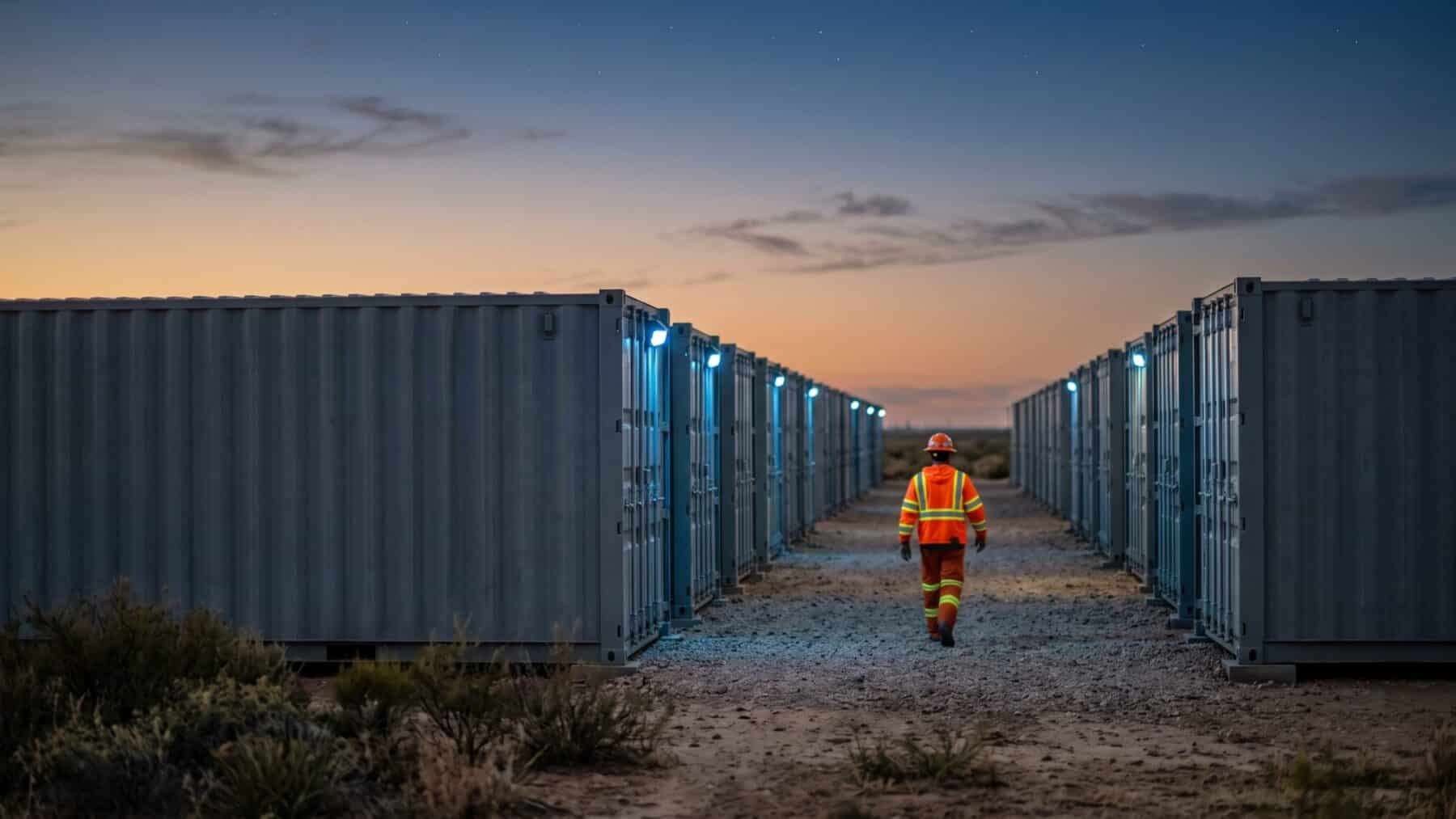
This summer, a wall of grid-scale battery containers did much of the work instead. The numbers behind what happened on July 22 are unlike anything the state has recorded.
How a battery earns its money on the Texas grid: charge cheap, discharge expensive
The Texas electricity market has no guaranteed revenue for simply being available. Prices are allowed to spike sharply when supply gets tight and fall below zero when solar floods the grid at midday. That structure is, by accident of design, almost perfectly suited to a battery.
During the day, when solar generation was pushing supply above demand, batteries across the state were drawing power off the grid at prices that sometimes went negative. Then, as the sun fell and demand held near its peak, those same units discharged into the market at the precise hour when electricity is worth the most. Grid analysts describe it as the textbook use case battery storage was built for.
Batteries store electricity when wind and solar output is highest, then return it when generation from those sources is declining, according to the US Energy Information Administration. The Texas grid ran that cycle at a scale no one had seen before.
A grid that looked almost nothing like itself just two years ago
When ERCOT set its previous five-minute demand peak two years ago, the state had roughly 6,000 megawatts of batteries deployed. By the July 22 heat event, that figure had more than doubled, with nearly 12,000 megawatts discharged simultaneously at the evening peak, a new all-time discharge record for the fleet.
The trajectory over four years is even sharper. ERCOT’s battery installed capacity stood at around 857 megawatts in 2021. By mid-2025, S&P Global confirmed ERCOT led all US grid regions with 14.17 gigawatts of operating battery storage, a position it had just taken from California. By August 2026, independent project-level tracking put the operating total above 17,000 megawatts, with the pipeline stretching far beyond that.
That is a roughly 20-fold expansion in under five years, a growth rate that grid analysts say has no precedent in US power infrastructure.
What the July 22 records actually showed, and where the numbers come from
In the span of just two days, ERCOT broke its existing solar, battery discharge, load, and net load records. The grid’s load reached 91.1 gigawatts, surpassing the previous all-time record of 85,508 megawatts set in August 2023. At the 6 p.m. peak, natural gas supplied 48 percent of generation and solar 32 percent, according to the EIA. During midday hours, solar at times supplied more than 40 percent of generation as batteries charged off the surplus.
Batteries set a new discharge record of nearly 11,980 megawatts during the evening ramp on July 22, a separate milestone that showed what the fleet could do at a genuine summer heat emergency. Prices barely moved despite the record demand, and that combination is the number grid planners had been waiting years to see.
For a broader picture, national battery storage additions set a quarterly record in Q2 2025, with ERCOT leading all US grid regions in new capacity added that quarter, according to S&P Global.
Where the Texas battery buildout runs into real limits
The same market structure that rewards batteries so richly is starting to create pressure on returns. As the fleet grows larger, the midday price crash that once let batteries charge cheaply is becoming shorter and shallower, because so many units are competing for the same low-price window.
Two-hour systems dominated recent additions, accounting for the large majority of the roughly 6 gigawatts added across 2025, but longer-duration units are now beginning to appear, because the evening spread has lengthened and short cycling no longer earns what it once did. New grid-connection applications from batteries fell roughly 50 percent in the second half of 2025 from the first half of the year, reflecting cooling investor appetite as merchant revenues declined sharply from their 2023 highs.
The buildout is still enormous, but the frenzy of the early years is cooling into something more selective. The same interconnection bottlenecks that slow batteries in Texas are a national problem, as federal backing for long-duration storage attempts to address the gap at the other end of the queue.
What comes next for the grid that proved batteries can handle the peak
ERCOT’s electricity demand is forecast to grow faster than that of any other grid operator in the United States. Data centers, industrial load, and population expansion are all pushing in the same direction, and further demand records in coming summers are widely expected.
The July 22 records showed that a large, well-timed battery fleet can hold prices stable even at 91 gigawatts of demand. Battery storage installations across ERCOT entered 2026 at roughly 14 gigawatts and are projected to keep climbing steeply, driven mainly by utility-scale solar-paired and standalone growth. That is the evidence grid planners and regulators in other states have been waiting for.
The open question is duration. A fleet built mostly on two-hour systems can handle a sharp evening ramp, but a multi-day heat dome with low wind would stress it in ways a single hot afternoon does not. Four-hour and longer systems are entering the pipeline, and the market’s price signals are already pushing developers that way. The grid that nearly failed in February 2021 is not the same grid that absorbed 91 gigawatts this July, and it is still changing faster than almost anyone predicted.
