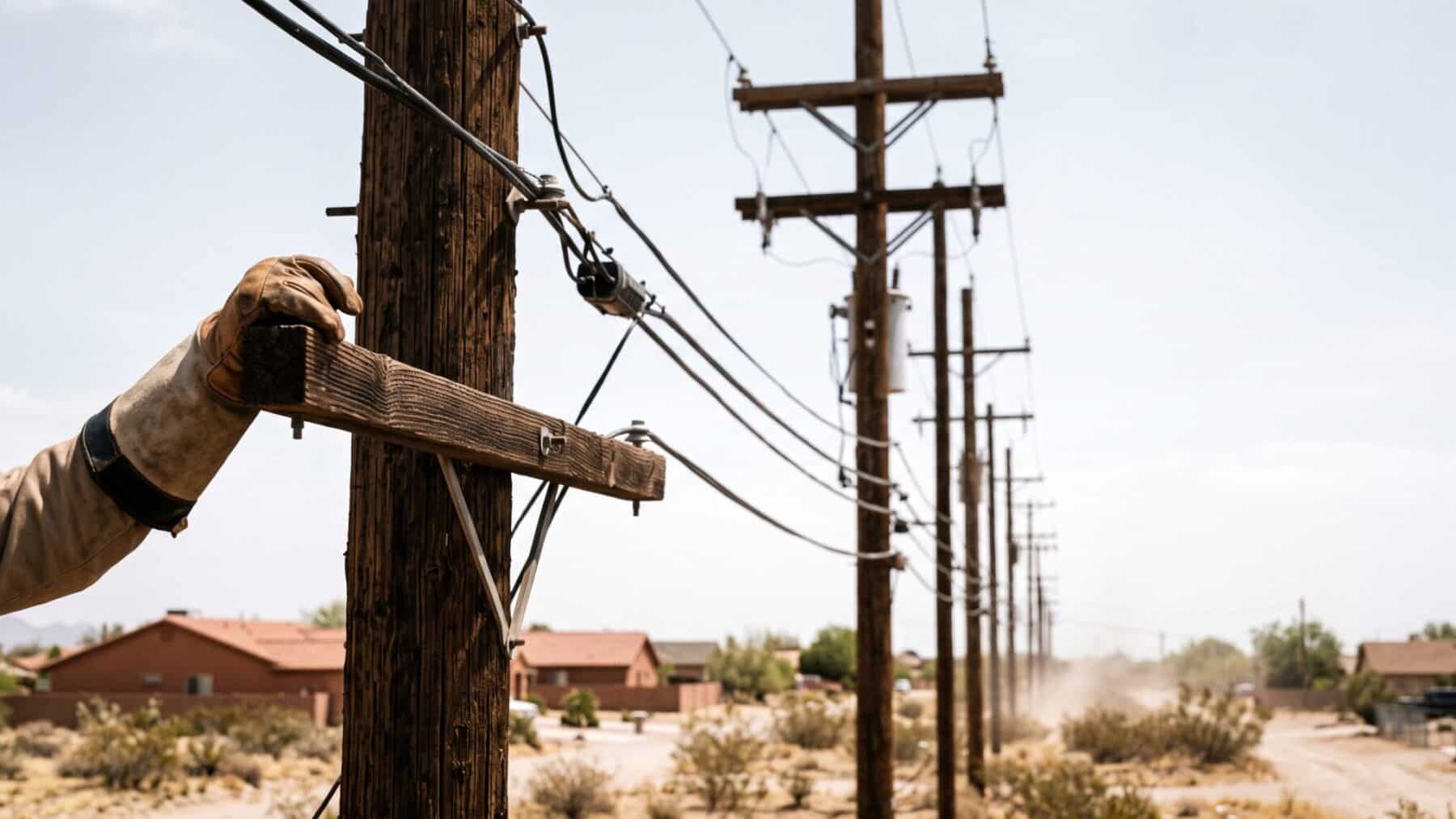
A Tucson utility pole sits in 110-degree summer heat, its wires strung and upgraded across several years of grid construction.
The bill for all of it has now landed on more than 452,000 households.
Regulators are still weighing how much of it is fair. And the state’s top law officer says a big slice of the ask has nothing to do with the wires at all.
So what turns a capital spending ledger into a monthly bill, and where does the $148 million gap actually come from?
How a rate case turns a capital spending ledger into a monthly bill
Every dollar a regulated utility spends on poles, transformers, substations and control systems goes into what regulators call the rate base, the pool of approved investment on which the utility is allowed to earn a return. When the utility files a rate case, it adds up those costs, applies a return on equity percentage set by the regulator, and presents the result as the revenue it needs to collect from customers each month.
The higher the allowed return, the larger the monthly bill, even if the physical infrastructure cost is identical. That mechanic is where the Arizona dispute turns sharp.
TEP states that the new rates are necessary to cover rising operational costs and to recover $1.7 billion invested in the local energy grid since 2021. The infrastructure spending is not in dispute. What is being contested is the profit margin built on top of it.
What the roughly $16-a-month request actually covers in Tucson
TEP’s proposal would increase typical residential bills by about 14 percent, adding about $16 per month, on average, for households with median usage of 638 kilowatt-hours per month. The month-by-month impact would be higher in the summer and lower in the winter, and customers who use more energy would see higher impacts.
The proposed rates are intended to recover investments in grid upgrades and new energy resources, and to reflect the impact of inflation on maintenance costs in the face of more extreme weather. The utility has also proposed an Annual Rate Adjustment Mechanism for automatic annual rate changes, governed by an Arizona Corporation Commission-approved formula. The mechanism can increase rates, but it can also decrease rates in the event of customer growth, sales growth, favorable weather, or interest or tax rate reductions.
So a Tucson household that absorbs the 14% increase could face further adjustments in subsequent years without a new full rate-case hearing.
The $148 million figure the attorney general’s office put in the record
The evidence base here is precise. Attorney General Mayes announced that her office has filed expert testimony with the Arizona Corporation Commission showing that Tucson Electric Power’s proposed 14% rate increase is unjustified and could be reduced to just 4% while still maintaining reliable service and a strong credit rating.
The expert testimony demonstrates that TEP is asking customers to pay shareholder profits that are significantly higher than what it actually costs the company to maintain reliable service, resulting in an unnecessary wealth transfer of approximately $148 million per year from Tucson families to TEP’s shareholders. The mechanism is the cost-of-equity assumption: when independent models are applied using reasonable market inputs, they produce a much lower figure than the utility proposes. TEP’s 14% rate proposal would produce a return on equity of 10.5%. The state Residential Utility Consumer Office recommended an ROE of 9.2%, and ACC staff recommended 9.75%, while the attorney general’s expert recommended 6.07%. The lower figure would still cover every wire, every substation and every lineman’s wage.
It would simply deliver a smaller profit margin to shareholders. That is the $148 million: not a safety cut, but a profit reallocation.
In response, TEP spokesperson Joseph Barrios said the AG’s proposal could not be implemented without impacting the reliability of TEP service and would damage the utility’s ability to raise money from investors that the company then would use, in part, to invest in the local energy grid. Regulators now have two sworn expert records pointing to numbers far apart on the cost-of-equity question.
Arizona is not the only front, and data centers are deepening the pressure
TEP is requesting a 10.5% return on equity, while APS is requesting 10.7%. Both cases are being examined in parallel proceedings before the Arizona Corporation Commission this year, making it harder for ordinary ratepayers to track both at once. New rates could take effect before the end of 2026, with an expected ACC decision in late 2026.
Meanwhile, a fast-growing new load is reshaping the underlying math. This connects directly to the surge in data-center and EV demand that federal forecasters have flagged as the dominant driver of US electricity growth through mid-century.
A 2026 report by the Electric Power Research Institute finds that Arizona is among six states that could see their data centers exceed 20% of the state’s electricity usage by 2030. Each of those megawatts triggers new infrastructure spending that lands, by default, in the rate base shared by every household on the system.
What the outcome means for ordinary customers and what stays open
The gap between a 14% hike and a 4% hike is not academic once it lands on a fixed-income household in a Tucson summer. In 2023, TEP increased rates by 10%, which raised the monthly cost of electricity by an average of $11 for Tucson consumers. TEP also increased rates by 6% in January 2021. Arizona regulators rarely grant a utility’s full request, and the outcome this time will likely land between the two expert positions, with the cost of equity argument as the decisive variable.
The automatic annual adjustment mechanism adds another layer. The director of the Residential Utility Consumer Office said her main concern was an ongoing rise in costs, noting that people are “having a difficult time managing bills today. Introducing potential increases on an annual basis is more than they think they can manage.” Several interveners have flagged the adjustment mechanism as the higher-stakes provision in the entire case.
The record of record rate-hike requests nationally suggests Arizona is not an outlier in the scale of its ask. But the size of the attorney general’s challenge, $148 million identified, named and placed in the official record, gives regulators an unusually precise target. Whether they use it is what the late-2026 decision will answer.
