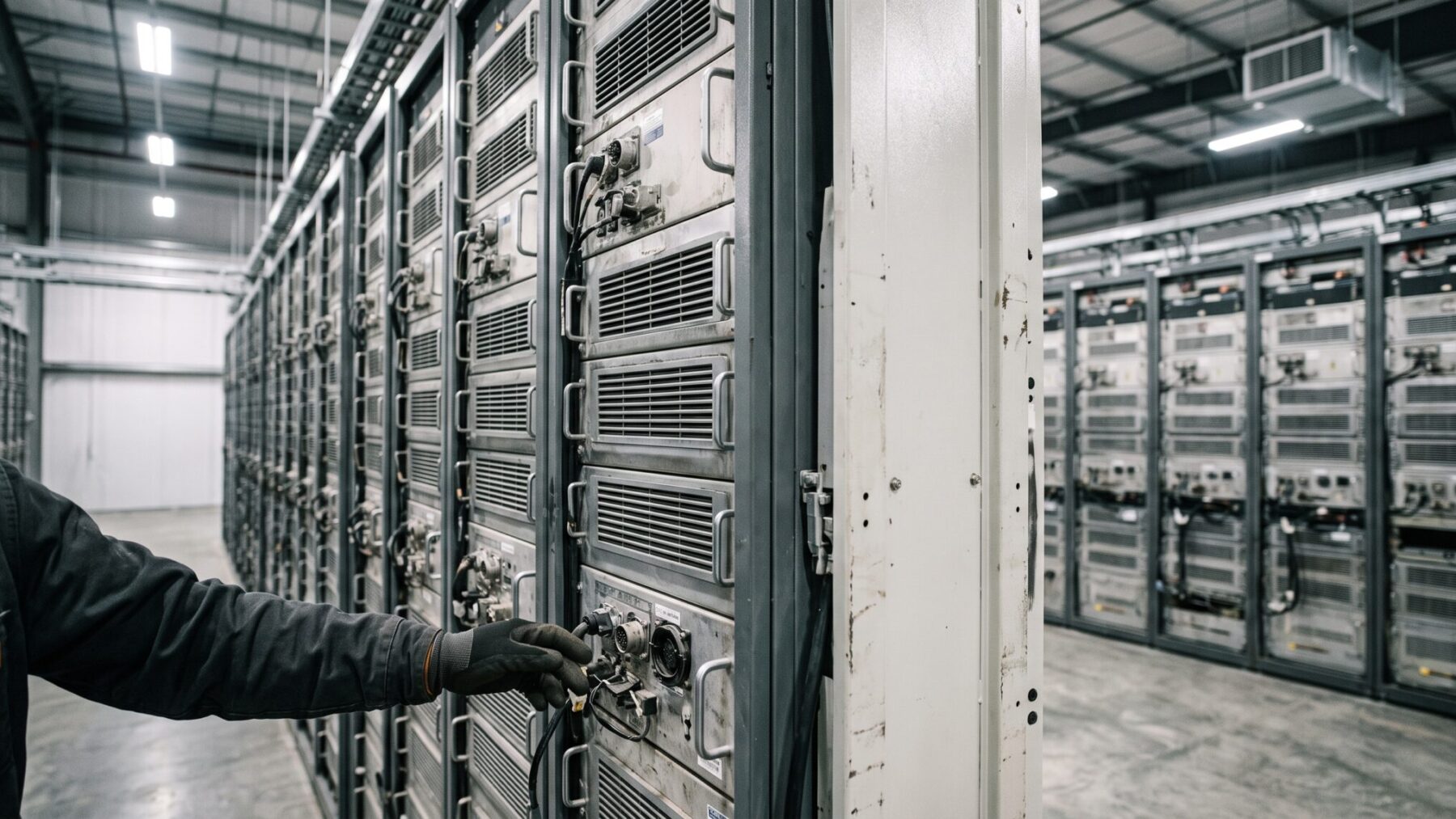
A single battery chemistry has quietly taken over the global grid storage market. Battery storage is the fastest-growing power technology today, with 108 GW of new capacity deployed worldwide in 2025, 40 percent more than in 2024, and installed capacity now eleven times higher than in 2021.
Driving that surge is one clear winner on chemistry: lithium iron phosphate, or LFP, batteries now account for around 90 percent of deployments, up from well below 50 percent just five years ago.
Why LFP won the chemistry race
LFP batteries are typically cheaper and better suited to more frequent cycling than rival chemistries more commonly used in electric vehicles, even though they are less energy-dense.
Those two traits, lower cost per cell and durability through daily charge-discharge cycles, make LFP the practical default for utility operators whose grid batteries may cycle once or more every day across a multi-decade operating life.
Around 80 percent of new battery capacity in 2025 was utility-scale, with the remainder made up of behind-the-meter systems installed by commercial and residential customers.
The IEA’s Global Energy Review 2026 also notes that battery storage durations are gradually lengthening across the sector, with an increasing number of projects deployable for four hours or more, reflecting the growing value of flexibility in systems with rising shares of solar PV.
US developers plan a record 24 GW this year
Inside the United States, the buildout is accelerating sharply. Developers plan to add 24 GW of utility-scale battery storage to the US grid this year, up from a record 15 GW added in 2025. Battery storage capacity has grown exponentially over the last five years, with more than 40 GW added during that period.
Three states account for about 80 percent of all planned US battery storage capacity coming online in 2026: Texas leads with 53 percent, or 12.9 GW; California follows with 14 percent, or 3.4 GW; and Arizona accounts for 13 percent, or 3.2 GW.
The concentration in those three states reflects both the depth of their wholesale power markets and the volume of solar generation that storage is increasingly paired with, a dynamic also shaping where US utility-scale battery capacity has grown fastest over the past 18 months.
Battery storage now represents 28 percent of all planned 2026 US capacity additions, second only to solar at 51 percent. The largest single solar-plus-storage project expected online this year is Tehuacana Creek 1 Solar and BESS in Texas, which will add 837 megawatts of solar capacity paired with an additional 418 megawatts of battery energy storage.
Data centers emerge as a new storage demand center
Battery-based uninterruptible power supplies in data centers saw capacity additions rise 30 percent to 45 gigawatts in 2025.
Data center operators and artificial intelligence companies are emerging as significant backers of longer-duration storage projects because of their increasing demand for reliable, around-the-clock electricity.
That demand pressure is feeding a broader grid interconnection crunch. The constraint on the American electricity system is no longer whether the equipment exists, it is how long it takes to get power flowing at a particular place.
Interconnection queue backlogs remain a structural bottleneck, an issue also affecting the nearly 52 gigawatts of battery storage already operating at mid-year and the 54 GW developers have on order over the next two and a half years.
What comes next
By the end of 2025, the US power system had operational battery storage capacity of 43.6 gigawatts. The EIA projects that total US battery storage capacity will rise to over 67 GW by the end of the first quarter of 2027.
The success of short-duration battery storage has helped establish confidence in the broader energy storage sector and created a pathway for long-duration technologies to enter the market, according to the Institute for Energy Economics and Financial Analysis.
Long-duration systems, which the Department of Energy defines as storage capable of delivering electricity for 10 or more hours, still account for a small share of the total fleet, but project pipelines are growing as grid operators seek overnight and multi-day reliability buffers.
The LFP-driven cost curve that reshaped short-duration storage is the template developers now hope to replicate at longer durations.
