The sun dropped below the hills and the demand curve spiked.
Millions of air conditioners ran hard. Gas plants spooled up. And then something else kicked in. A fleet of batteries scattered across California began pushing electricity onto the grid at a scale the state had never seen. The question is how, exactly, a collection of steel boxes manages to shoulder more than a third of a region’s power needs in a single hour.
How a battery fleet charges all day and delivers the grid’s most critical hour
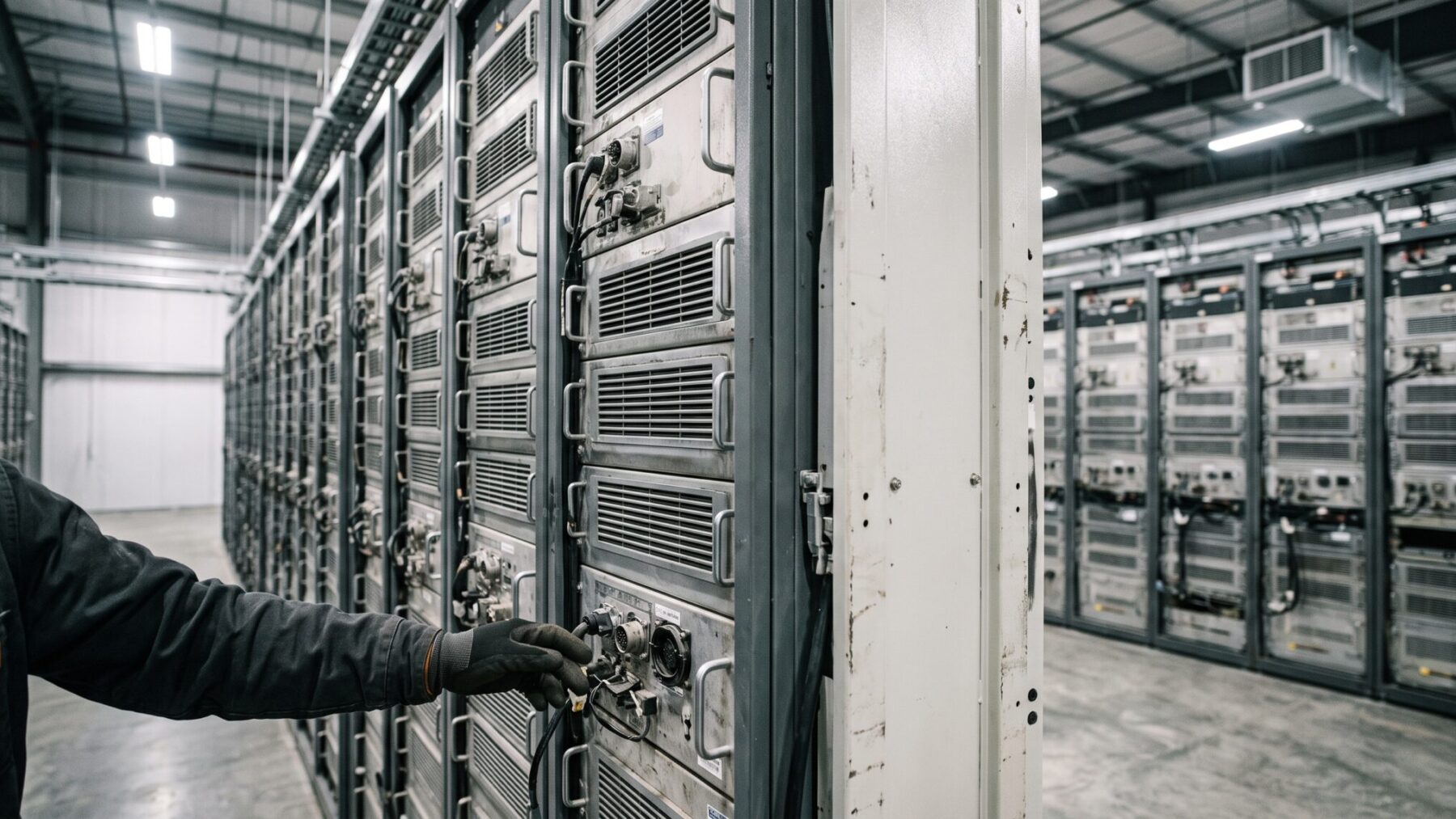
Lithium iron phosphate cells inside each cabinet absorb electrons during the midday hours when California’s solar farms generate far more power than consumers are using. That surplus would otherwise push wholesale prices negative and force solar plants to curtail output. Instead, it flows into the batteries.
As the sun sets and solar output collapses, the cells run the reaction in reverse. Stored electrons travel back through an inverter, emerge as alternating current, and feed directly into transmission lines. The entire swing from charging to discharging can happen in under two seconds, faster than any gas turbine can ramp from idle.
Grid operators manage this dispatch through a real-time market that sets prices every five minutes. When the price signal spikes, the automated dispatch layer responds instantly, committing megawatts without a phone call or a manual override. That speed is precisely what makes batteries indispensable at the moment the grid is most stressed.
What the July 9 record actually looked like on the California grid
On the evening of July 9, California’s battery fleet discharged a record 12.99 gigawatts of power, more than New York City consumes on a hot summer day, and at peak, batteries covered 36 percent of energy demand across the CAISO region, a figure that would have been unthinkable even three years ago.
The very next day, July 10, CAISO set another record, with solar generation reaching 23 gigawatts and supplying 72 percent of regional electricity demand, marking the third time since June 1 that California had broken its own solar generation record. The two days together illustrated the paired rhythm now defining the California grid: solar dominates the afternoon, batteries own the evening.
Evening hours have historically been the hardest moment for grid operators to manage. The July 9 discharge record is the clearest single data point yet that battery storage has moved from a supporting role to a primary one.
The national buildout that made a 12.99-gigawatt evening possible
The US energy storage industry installed a record 20.2 gigawatt-hours of new capacity in Q2, bringing first-half 2026 totals to 30.8 GWh, according to the US Energy Storage Market Outlook Q3 2026 released by the Solar Energy Industries Association (SEIA) and Benchmark Mineral Intelligence. Full-year 2025 set the prior benchmark, with the industry installing 57.6 gigawatt-hours, the largest single-year addition of battery storage on record.
Utility-scale energy storage capacity in the United States has nearly doubled, from 88 GWh to 165 GWh, in the first 18 months of the current administration, as grid operators, utilities and energy buyers turn to storage to strengthen reliability and meet rising electricity demand. That pace of commissioning is what filled California’s reserve deep enough to sustain the July 9 record. LFP chemistry now dominates new grid storage, and its lower cost per kilowatt-hour is why projects of this size pencil out at all.
A steep cost decline in lithium-ion battery cells since 2010 has fundamentally altered the investment economics of grid-scale storage. That collapse is the single biggest reason California now has enough cells in the ground to rewrite evening grid records.
Where the limits still show and what the fleet cannot yet do
A near-13-gigawatt peak discharge is impressive, but duration is the harder challenge. Most large-scale storage systems in operation have a maximum duration of four hours, which covers the evening ramp but leaves a gap if a heat event stretches past midnight. Long-duration systems accounted for only a small fraction of global energy storage installations last year.
Annual additions of long-duration storage, systems rated six hours or longer, remain a small fraction of total deployments worldwide. That growth is real, but it is still far short of what a California-scale grid needs to guarantee firm overnight power without gas backup. The four-hour ceiling remains the sharpest structural limit on what batteries can promise today.
There is also a manufacturing concentration risk. Domestic manufacturing capacity for battery energy storage systems is growing, but cell production is still concentrated in a handful of plants. Grid planners are watching the 54 GW pipeline through 2028 for any signs that supply bottlenecks are delaying commissioning dates.
What comes next as California and the rest of the grid push toward longer nights
Demand for energy storage is outpacing expectations, prompting a forecast revision through 2030 to 683 GWh, up substantially from earlier projections, according to the Q3 2026 SEIA and Benchmark Mineral Intelligence outlook. If that trajectory holds, the July 9 record will look modest within a few years.
Co-located solar-plus-storage projects now account for a growing share of new utility-scale storage, with 44 percent of new utility-scale capacity co-located with solar, continuing the shift toward storage as a default pairing rather than an add-on. Much of California’s battery storage capacity is co-located with wind or solar farms, where batteries can store clean electricity for later dispatch, and these co-located resources typically share a grid interconnection point or operate as a single hybrid resource. Each co-located project arrives pre-wired to run exactly the charge-and-discharge cycle that produced the July 9 record, compounding the effect every time a new heat wave arrives.
Gas peaker plants that run only during peak evening hours are among the most expensive electricity sources on the grid. Every megawatt that batteries displace during that window reduces the marginal cost of power at precisely the moment prices are highest.
The July 9 record was not just a technical milestone; it was also, in the language of the grid, a large price-suppression event, and the fleets growing across Texas, Arizona and beyond are set to repeat it on a larger scale whenever the next heat wave arrives.
