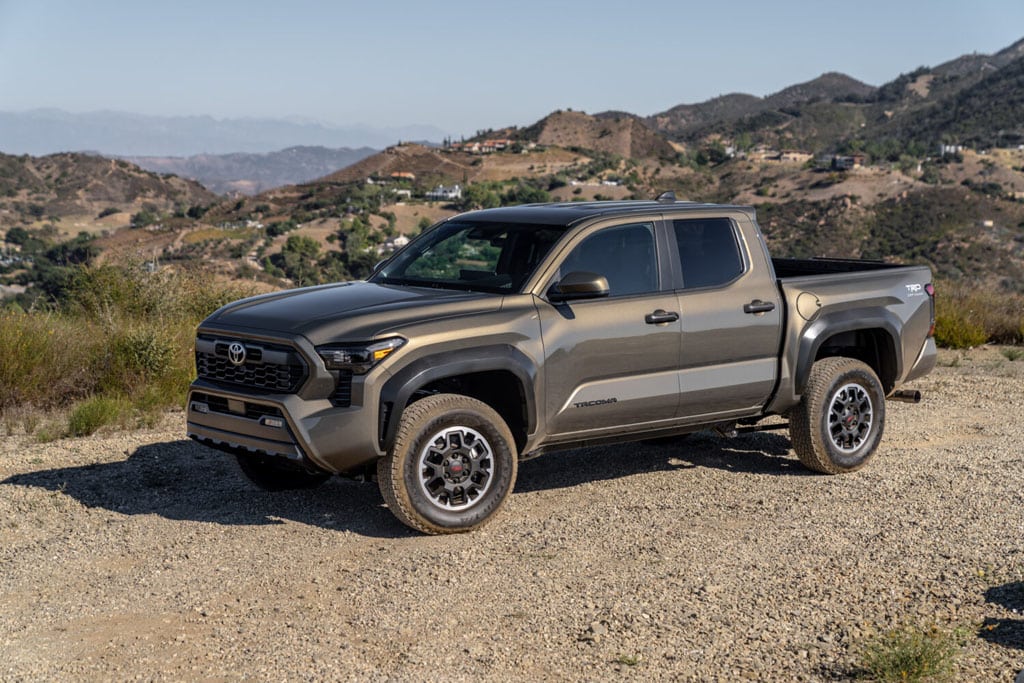
The truck sits in the dealer lot wearing a badge that says it was built for the trail.
The shocks are premium Bilstein units with a separate external reservoir, and the sticker price reflects all of it. But a federal safety recall now open across nearly 48,000 of these trucks says a hidden corrosion problem means that reservoir can leave the truck entirely while the vehicle is moving.
So what, exactly, happens at the joint that is supposed to hold it in place?
Why corrosion can break the connection between the shock body and its reservoir
Bilstein remote-reservoir shocks use a monotube design: a single cylinder in which a floating dividing piston separates the hydraulic oil from the pressurized nitrogen gas, keeping them from mixing while the piston stroke damps suspension movement. The external reservoir connects to the main tube to increase oil volume and help the assembly shed heat during hard use on rough terrain, exactly the performance advantage that makes the design worth fitting to an off-road trim.
A passage connects the reservoir to the main shock body, and a welded metal flange locks the reservoir to the shock body at a fixed mounting point. According to the NHTSA report for recall 26V514, moisture can reach untreated metal between the shock body, reservoir and that welded flange. Corrosion then builds enough pressure to damage the welds, and once they give way the reservoir separates from the assembly entirely.
The loss is not merely cosmetic. A detached reservoir could allow shock oil to escape, reducing damping performance, while the separated hardware drops into the lane behind the truck, creating a road hazard for any vehicle following close behind.
Which trucks are in the recall and what the sticker promised
The TRD Off-Road trim has long been the volume sweet spot of the Tacoma lineup, pitched to buyers who want genuine trail capability without stepping up to the full TRD Pro. The Bilstein shocks are a central part of that pitch.
The recall covers 43,827 non-hybrid 2024 to 2025 Tacoma TRD Off-Road trucks and 4,453 examples of the 2024 Tacoma Hybrid TRD Off-Road, plus two additional 2025 units carrying the same Bilstein hardware. Toyota lists internal campaign codes 26TB14 and 26TA14 for trucks built from early January 2024 through late November 2024, catching most of the first full model year of the redesigned fourth-generation Tacoma.
It is worth noting this is far from the only recent safety action across the truck segment. A separate F-150 recall over detaching fuel tanks shows how quickly a single component failure can balloon into a six-figure safety campaign.
How the investigation started and what Toyota found
Toyota’s investigation began in September 2025 after two reports of leaking shock absorbers. A dealer inspected one truck and found a leaking left-rear shock with its external reservoir missing. Toyota and Bilstein recovered parts for teardown, and the examination identified the welded flange as the weak point in both front and rear assemblies.
By late July 2026, Toyota had logged 20 field technical reports and 62 warranty claims from US sources tied to the condition. The company decided to conduct a voluntary safety recall on July 30, 2026, with NHTSA listing 48,280 vehicles as potentially affected under recall 26V514000. Owner notification letters are expected to go out beginning September 21, 2026, but owners can enter their VIN into the NHTSA recall lookup tool right now without waiting.
Where this recall has limits and what it does not cover
The recall is specific to the TRD Off-Road trim with Bilstein shocks. Tacoma buyers in SR, SR5 or TRD Sport configurations use a different shock setup and are not included. An owner cannot assume coverage just because the model year matches; both Toyota and NHTSA direct Tacoma owners to run a VIN check before drawing any conclusion.
This is a physical inspection and replacement campaign. It cannot be corrected with an over-the-air software update or a dashboard message. Every affected truck must go to a dealer, where technicians will inspect the front and rear shock assemblies and replace any affected units at no cost to the owner.
The recall does not carry a “Do Not Drive” advisory, placing the decision about urgency with the owner. Watching for oil stains under any corner of the truck, or a change in how it handles rough pavement, are the practical signals to act on immediately. Similar logic applied to the Hyundai Palisade seat recall, where owners were also advised not to wait for postal notification before checking their VIN.
What owners can do right now and what comes next
The fix is straightforward: Toyota dealers will inspect the shock assemblies on every included truck, and any affected unit gets replaced with improved hardware at no charge. The replacement parts are described as improved, suggesting a change to the flange treatment or weld process rather than a straight swap of identical components.
The broader lesson for anyone shopping a purpose-built off-road trim is that the premium components doing the hardest work are also the most exposed to the conditions that cause corrosion. Mud, water, road salt and the repeated flexing that comes with rough terrain are exactly what an off-road shock is designed to manage. They are also exactly what accelerates corrosion at the weld joint when the mounting point was not sealed against moisture from the start.
For current owners the path is clear: enter the VIN into the NHTSA lookup tool, book the dealer visit and collect the free repair. A truck that was genuinely capable before the recall will be just as capable after.
