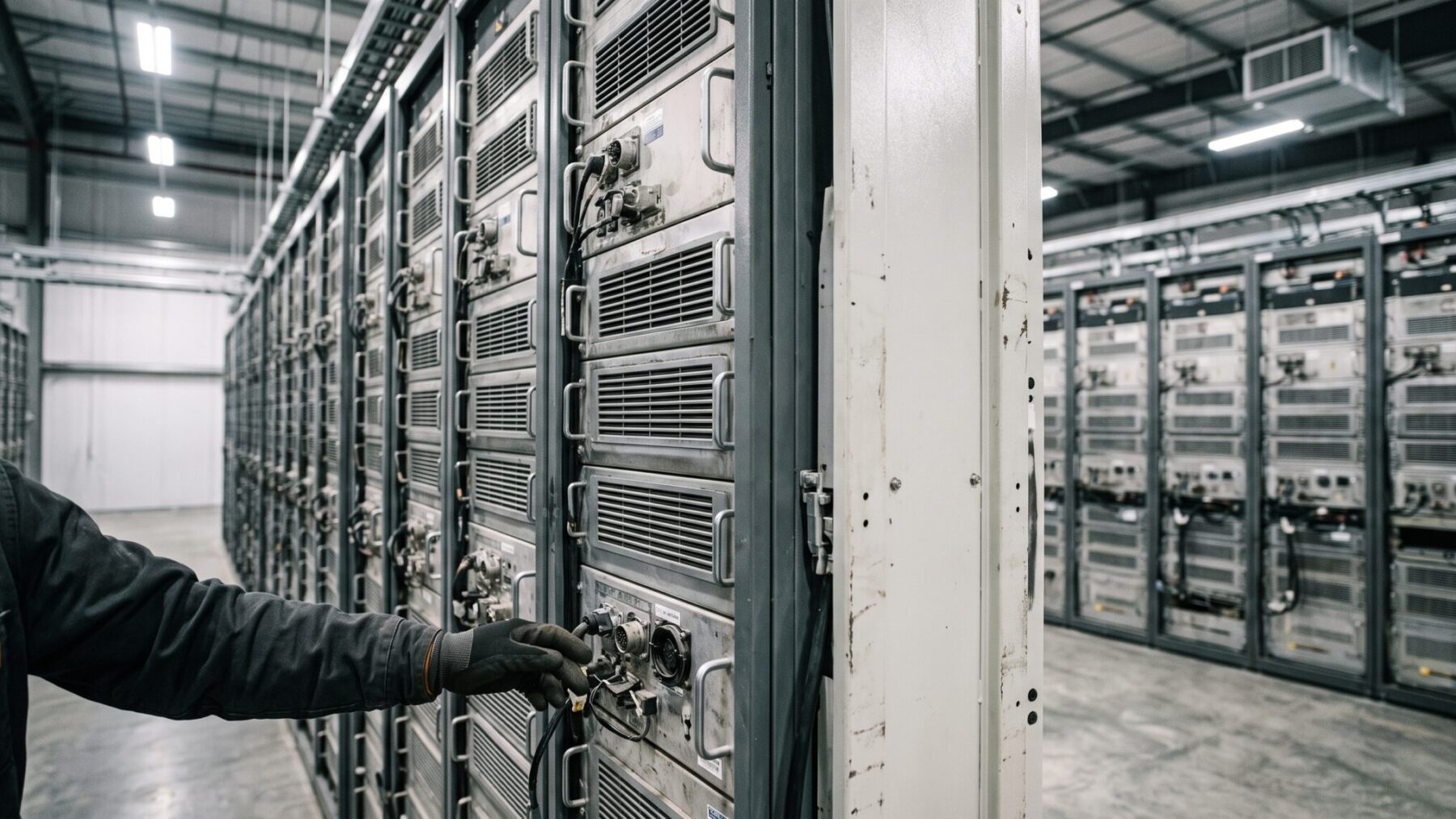
Steel cabinets stretch to the horizon, each one taller than a garage door and packed with cells.
There are hundreds of them on a single site. They hum rather than roar. Last quarter, fields of machines like these rewrote the record books. But not in the way most people would expect.
Why buying more hours matters more than buying more speed
A grid operator buys megawatts for the evening peak and megawatt-hours for the length of it. Last quarter the country bought fewer of the first and more of the second. The practical effect is immediate: a battery covering two hours of peak is useful, but one covering three and a half hours can carry the grid through the entire post-sunset danger window when solar drops to zero and air conditioners are still running hard.
Resource adequacy rules are the mechanism behind the change. Grid regulators in California, Texas and elsewhere force utilities to prove they can keep the lights on for a specific number of hours without calling on a neighbor. A battery rated at four hours earns a capacity credit that a two-hour machine cannot, so developers have been engineering longer runtime into every new project.
The physics inside each cabinet do not change. What changes is how many cells are stacked in series per unit of installed power. More cells per megawatt means more stored energy, a longer runtime and a bigger capacity credit on the utility’s books.
What the record numbers actually look like on the ground
The US storage market installed a record 18.9 GWh of battery energy storage in Q2 2026, driven by longer-duration systems and stronger residential energy capacity. The total, 18.9 gigawatt-hours, is enough stored energy to power roughly 700,000 homes through an entire day, added to the grid in a single three-month window.
Energy storage installations increased 17 percent year-over-year, while installed power capacity declined 7 percent year-over-year. The national average duration of installed battery energy storage systems increased from 2.8 hours to 3.5 hours, driven by resource adequacy needs.
That 0.7-hour gain looks modest on paper, but across thousands of individual projects it represents a fundamental rebalancing of how the US grid handles stress. Utility-scale deployments totaled 4.7 GW and 17.6 GWh in Q2, down 8 percent year-over-year in megawatt terms as key markets become increasingly saturated. Saturation here does not mean the build-out is slowing. It means the easiest short-duration sites are already filled.
Project durations continued to lengthen in the second quarter with the deployment of a long-duration energy storage project in California built to satisfy state mandates, alongside utility-contracted assets in Texas. Both states run parallel procurement programs that reward energy capacity over raw output. These grid investments carry real costs, something a Senate bill on grid upgrade costs is now trying to address directly.
The data behind the record and where it comes from
The quarterly figure comes from the Q2 2026 US Energy Storage Monitor, released by Wood Mackenzie and the American Clean Power Association. The Monitor is a quarterly publication gathering data on US energy storage deployments, prices, policies, regulations and business models, intended to provide the most comprehensive, timely analysis of energy storage in the US.
Battery storage capacity additions continued to accelerate through the first half of 2026. In the first half of 2026, installations were up 5 percent year-over-year, signaling that 2026 installations will remain on par with last year. This expanding role is directly tied to the record pace of battery capacity growth the EIA has been tracking over recent years.
Wood Mackenzie expects the national residential market to contract 4 percent across 2026 as tax credit headwinds bite. So the record is primarily a utility story. Utility-scale deployments drove the headline number even as the residential segment faced pressure, reinforcing that the all-time gigawatt-hour high was built on longer-duration grid-scale projects, not rooftop installations.
Where the duration shift runs into its limits
Longer runtime is not free. Every additional hour of storage requires more cells, more steel enclosures, more land and more cooling, all of which push project costs higher before a single kilowatt-hour is dispatched. Developers can recover those costs through capacity markets, but only in states with structured procurement rules that reward duration.
States with mandatory resource adequacy requirements are pulling in projects; states without them are largely sitting out the boom. The commercial and industrial segment is projected to grow 27 percent between 2026 and 2031, with deployment expected to expand beyond California into emerging markets such as Maryland and Texas. But data center load is relentless. A facility running around the clock creates a baseline demand that storage alone cannot easily meet without very long discharge durations.
What the duration milestone signals for the grid ahead
The market is projected to reach cumulative installed capacity of 207 GW and 715 GWh by 2031. The gigawatt-hour figure is the one that carries the duration story forward. A 715 GWh fleet designed around three-and-a-half-hour average discharge is a fundamentally different grid asset than the same capacity at two-and-a-half hours.
“Data center buildout strengthens the U.S. storage outlook across all sectors. Storage can provide needed capacity faster, cheaper and more reliably than gas alone,” said Allison Feeney, research analyst at Wood Mackenzie. That framing positions storage not as a bridge technology but as a direct substitute for gas peaker plants, the expensive fast-starting turbines grid operators have historically called on during the two or three highest-demand hours of a summer day.
As average duration climbs past three hours, then four, the overlap with peaker territory grows, and the case for retiring older gas units rather than keeping them as backup becomes harder to dismiss. The grid is not there yet. But last quarter’s numbers moved it measurably closer.
