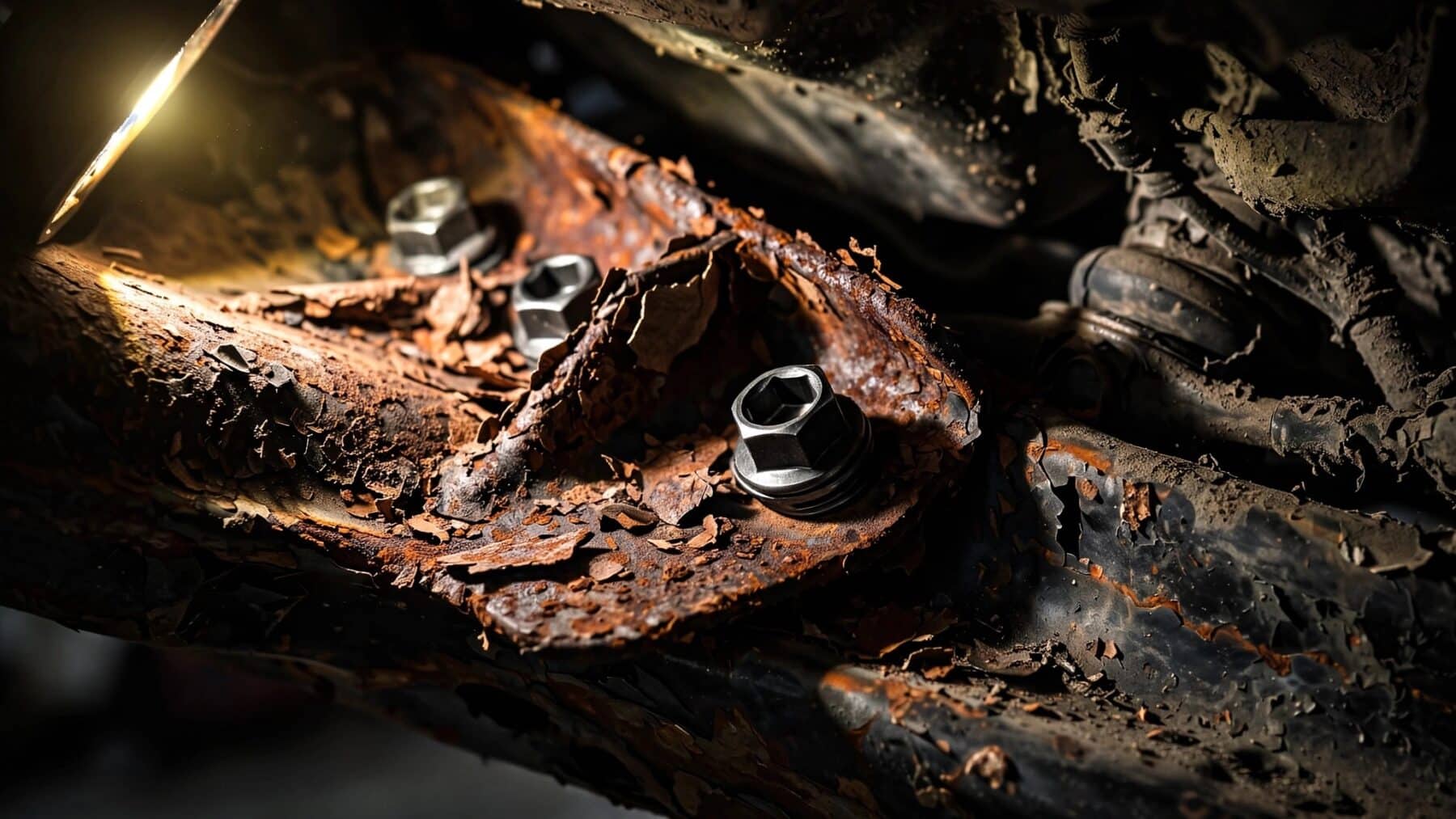
It sits about a foot below the cargo floor, invisible from the outside and invisible at the dealer lot.
It is a steel cradle, the structural platform the rear suspension bolts to. When it was built, a protective factory coating was sprayed on at the plant. That coating, on roughly 880,000 vehicles, did not hold.
After years of winter driving, the bare steel underneath is rotting. And the consequence is not cosmetic.
Why a thin layer of paint on a steel cradle becomes a safety problem under the car
The rear subframe is the structural cradle that the rear suspension bolts to. On these vehicles, the factory-applied protective coating can degrade in specific areas, leaving bare steel exposed to road salt, moisture, and the freeze-thaw cycles common in northeastern and midwestern winters. Road salt is electrically conductive, and once it contacts bare steel, it accelerates electrochemical corrosion dramatically faster than ordinary water alone would.
The defect allows paint to peel near the rear subframe’s arm bracket weld area. That is the worst possible location: weld joints concentrate stress, and the heat that joins the metal during manufacturing can leave microscopic inconsistencies in the surface that a thin coating struggles to bridge.
Where de-icing agents are heavily used, the exposed area may corrode prematurely. As the corrosion progresses, material thinning and driving vibrations could cause the mounting area to fracture and fail. The supplier corrected the pre-paint treatment process in August 2022 to improve consistency in production quality, and in January 2023 coating thickness was increased as part of a product improvement initiative, helping vehicles built after those corrections but leaving years of earlier production already sitting in driveways across the Salt Belt.
What the affected vehicles look like from the outside and where the damage hides
There is no dashboard light for a corroding subframe. Advanced cases may produce abnormal noise or vibration from the rear suspension and changes in vehicle handling, but those signs arrive late, and many owners will have no warning until the metal gives way. An improper coating may allow the rear subframe mounting points to corrode, which could lead to the failure of rear suspension components. A failure of rear suspension components, such as the rear control arm, can cause the driver to lose handling or control of the vehicle, increasing the risk of a crash or injury.
The recall covers four model lines built across two Honda brands: the 2017, 2023 Honda Ridgeline (110,070 vehicles), the 2016, 2022 Honda Pilot (463,253 vehicles), the 2019, 2023 Honda Passport (89,674 vehicles), and the 2014, 2020 Acura MDX (217,517 vehicles), for a total of 880,514 vehicles. The recall is limited to vehicles sold in salt-belt states, including Connecticut, Illinois, Michigan, New York, Ohio, Pennsylvania, and eighteen other states, plus Washington D.C. The defect is driven entirely by that chemical exposure, not by age or mileage alone.
For families who bought one of these vehicles as a dependable hauler, and new cars now average $50,000, the idea that a structural frame part was quietly degrading since the day it left the factory is unsettling. The vehicles look fine from the outside. The problem is entirely underneath.
The scale of the recall and where the official numbers come from
On June 4, 2026, American Honda filed a Part 573 safety recall with the National Highway Traffic Safety Administration covering 880,514 vehicles whose rear subframes can rust through at the suspension mounting points. The recall documentation is publicly searchable by VIN at NHTSA.gov, and the filing states that rear subframe corrosion at the suspension mounting points can result in component failure.
Honda first identified a difference in paint quality between the supplier’s process and its own test conditions back in December 2021. Honda determined a safety defect existed on May 28, 2026, and moved to a recall. In its recall filing, Honda stated the corrosion stems from improper coating specifications at the rear subframe mounting points.
Honda estimates about 1% of recalled vehicles have reached the corrosion level that poses real risk. That sounds small, but 1% of 880,514 is still roughly 8,800 vehicles whose rear suspension may already be structurally compromised. As of May 28, 2026, Honda had no warranty claims and no reports of injury or death related to this issue in the U.S.
The complication: not every affected vehicle qualifies, and geography is the deciding factor
Here is where the catch gets specific. The recall is specific to vehicles sold in salt-belt region states: Connecticut, Delaware, Illinois, Indiana, Iowa, Kentucky, Maine, Maryland, Massachusetts, Michigan, Minnesota, Missouri, New Hampshire, New Jersey, New York, Ohio, Pennsylvania, Rhode Island, Vermont, Virginia, West Virginia, Washington D.C., and Wisconsin. Vehicles sold in other states are not included, even if they have since been relocated.
That last clause matters enormously for used car buyers. This recall only applies to vehicles originally sold or registered in 23 states plus Washington, D.C. Where a unit spent its life changes the picture entirely. A Pilot originally sold or registered in Ohio and later purchased privately by a family in Arizona is still covered. But a Pilot that spent its whole life in Florida is not, even if it now lives in Michigan. Original sale location is the single factor that determines eligibility, not current registration.
For anyone shopping the used market, checking a VIN before signing paperwork is now a concrete step, not just general advice. Recalled suspension parts have a way of going undetected until a buyer is already holding the title.
And unlike a recall for a faulty sensor that throws a code, this one requires a physical dealer inspection. Dealers will inspect the rear subframe and install a rear subframe reinforcement kit and, as necessary, repair or replace the rear subframe components, free of charge.
What owners can do now and what remains uncertain about older vehicles
Vehicle Identification Numbers applicable to this recall became searchable on NHTSA.gov beginning June 10, 2026. Owners may contact Honda’s customer service at 1-888-234-2138 and reference NHTSA campaign number 26V367000. Owner notification letters are expected to be mailed July 7, 2026 , but owners do not need to wait for the letter to act.
Scheduling a dealer visit before winter road salt season returns is the most straightforward move an affected owner can make. Weld-area coating failures are notoriously difficult to catch during factory quality inspection because the surface looks uniform until road salt and temperature cycling reveal weak adhesion over several winters.
The broader question the recall leaves open is how far the problem extends into older production. Some vehicles are only now reaching the stage where risk becomes real. What is clear is that the improper coating specifications at the supplier level were the root cause, with the production line corrected in stages after Honda identified the discrepancy. For the roughly 880,000 vehicles built before those fixes, a free dealer inspection is the only way to know how far the damage has gone.
