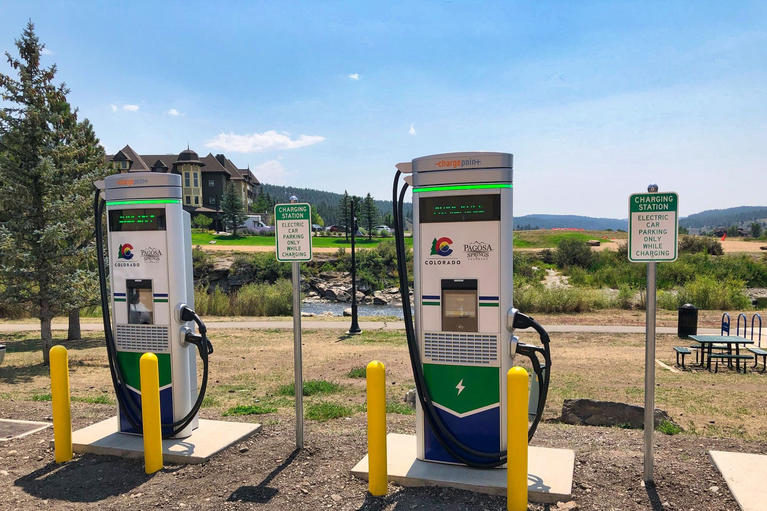
Pull up to a public fast charger today and the odds are better than ever that the plug will actually work.
Six years of failure data from the nation’s largest annual EV charging survey just produced a record low. The number that defines the charging experience for most drivers dropped again this summer. And the answer sits inside who builds and operates the hardware.
How automaker-built stations raised the standard for a fast charge
The underlying charging network is becoming more reliable, driven largely by new automaker-backed direct-current fast-charging operations. Newer, higher-speed chargers, larger charging sites, destination-style locations with more amenities, and more seamless payment options are reducing failed charging attempts and delivering a more reliable experience. The shift is not accidental. Automaker-owned networks are built to tighter hardware and quality standards than older commercial networks, which were installed under looser contract standards and mixed connector formats.
Three OEM-backed DC fast-charging networks that are award-eligible for the first time performed well in the study, with their largest advantages above the segment average coming in the areas that matter most to EV owners. Those areas include ease of charging, charging speed, and charger availability. In its first year of eligibility, IONNA topped the DC fast-charging index with a score of 807. The Mercedes-Benz Charging Network placed second at 797, followed by the Rivian Adventure Network at 755, all scoring well above the industry average of 666. In some cases, those advantages exceed 100 index points.
The gains in DC fast charging are unusually clean. Satisfaction rose across all ten index factors year over year. Those factors include charger availability, payment ease, charging speed, and site safety. Every single one moved in the right direction simultaneously, which has not happened in a previous edition of this study.
What the scene looks like at approximately 76,000 fast-charging ports across the country
Picture a traveler pulling off the interstate and finding a bank of tall chargers, open stalls, a working screen, and a payment tap that goes through on the first try. That scene is now common in ways it was not two summers ago.
As of September 1, 2026, there were 76,236 public DC fast-charging ports across the US, according to the Alternative Fuels Data Center, 23 percent more than a year ago. The combined number of public ports surpassed 200,000 in March 2026, and climbed higher in the months that followed, reflecting a pace of construction the industry could not sustain even three years ago. That buildout did not wait for federal money: the NEVI program, a five-year, five-billion-dollar federal program created to help states build EV charging stations, faced a series of setbacks, suspended in February 2025 and then reduced by more than $503 million in rescinded funding in January 2026, yet the private charging network continued to expand without federal assistance.
Satisfaction is highest among DC fast chargers located at hotels, scoring 692, followed by gas stations and convenience stores at 689 and restaurants at 688. Chargers located at dealerships, scoring 570, and stand-alone parking lots and garages, at 606, are among the least satisfying experiences for owners. Rural corridors remain the thinnest parts of the map.
The record number and where it came from
Despite slower growth in the EV market, the public charging experience continues to improve. Satisfaction with DC fast chargers has improved dramatically in the past three quarters, while non-charging visits, instances in which EV owners arrive at a public charging station but are unable to charge their vehicle, have fallen to the lowest level ever recorded in the study. According to the JD Power 2026 EVX Public Charging Study, released August 12, the public charging non-charge visit rate fell to 12 percent, down from 14 percent a year ago, the lowest level ever recorded in the study. Two years ago that figure stood at 19 percent, a 37 percent improvement in the failure rate over just two years.
Average satisfaction with DC fast chargers increased 12 points year over year to 666 on a 1,000-point scale, with gains across all 10 measured factors. Charger availability posted the biggest improvement, rising 27 points. Customer ratings for both location safety and charging costs each increased by 18 points. The top-ranked network, IONNA, scored 807 on that same scale.
The study was fielded between January and June 2026 among 6,594 battery-electric and plug-in hybrid vehicle owners. Those drivers still cite charging anxiety as a top purchase barrier, which is precisely why automakers backing these networks have skin in the reliability game. For context on how the industry is responding, see the September EV financing push that pairs with this infrastructure investment.
Where the gains do not reach and why that gap is real
The record applies to DC fast chargers. Public Level 2 charging, the slower kind common in parking garages and standalone lots, moved in the opposite direction: satisfaction there declined 12 points to 595, driven primarily by lower satisfaction scores for ease of payment and ease of charging.
The location gap is equally sharp. Chargers at dealerships scored lowest among all location types at 570, with stand-alone parking lots and garages close behind at 606. That gap means the places selling EVs are running some of the worst-rated charging experiences in the country. It is the clearest sign that reliability gains are uneven rather than universal.
And even the record-low 12 percent still means one wasted trip in every eight. JD Power has consistently found that public charging reliability is the top reason new-vehicle shoppers reject EVs. For buyers already navigating a market where new car prices crossed $50,000 for the first time this year, a one-in-eight chance of a dead stall remains a real barrier.
What this record changes for the next wave of EV buyers
JD Power data has consistently found that public charging reliability is the top reason new-vehicle shoppers reject EVs. Brent Gruber, executive director of EV solutions at JD Power, noted that the improvements now arriving will go a long way toward supporting the infrastructure needed to meet the rise in forecasted EV sales.
EV market share has declined sharply following the discontinuation of the federal tax credit program in September 2025, yet each improvement in network reliability removes one more friction point from the purchase decision. The mechanism that produced this record, automaker-controlled hardware built to tighter standards, is also the mechanism most likely to keep improving. The next frontier is not the highway fast charger but the neighborhood Level 2 plug that drivers use most often.
Six years of data now point in a single direction. The clean sweep across all ten measured dimensions is the detail that separates this summer’s result from every previous edition of the study.
