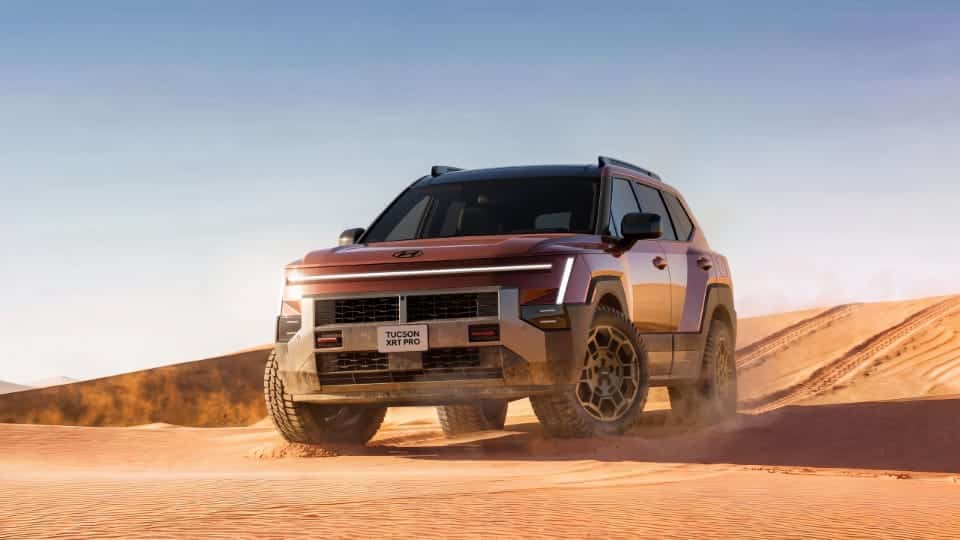
Hyundai Motor Company unveiled the all-new TUCSON in New York on October 1, 2026, during a world premiere in Long Island City, positioning the redesigned compact SUV around a next-generation hybrid powertrain and a new AI-driven infotainment platform. The reveal marks the fifth-generation TUCSON, the model’s first full redesign in approximately five years.
Next-generation hybrid powertrain
The next-generation hybrid system targets up to 42 mpg while delivering a 0, 60 mph time of 8.5 seconds. The hybrid variant uses a six-speed automatic. Hyundai says the combination demonstrates that leading efficiency no longer requires compromising driving performance.
The hybrid has a 13 kW electric motor bolted at the rear of the gas engine, directly to the crankshaft, which replaces the traditional belt-driven starter-generator but can also send power to the wheels during hard acceleration and send energy back to the high-voltage battery during deceleration. The hybrid’s main motor is sandwiched between that small electric motor and the six-speed automatic transmission, making 47.7 kW on its own and energized by a 1.49 kWh battery. Combined output is 233 horsepower for the US market.
When the TUCSON officially launches in the US, powertrain choices will be a turbocharged 1.6-liter inline-four or that same engine paired with the hybrid system. The plug-in hybrid will not be offered in the US market in this generation, though it remains available overseas.
A 1.6-liter turbocharged four-cylinder with 184 hp rounds out the US powertrain choices.
Design and cabin overhaul
Hyundai describes the all-new TUCSON as its “boldest SUV ever,” combining the “Art of Steel” design philosophy, hybrid performance enhanced by intelligent efficiency. The refined cabin is built around intuitive controls, flexible storage, and available relaxation features.
The Pleos Connect infotainment system introduces up to a 17-inch touchscreen, Gleo AI, and over-the-air updates, central to the new model’s technology pitch. Hyundai says the system’s user interface will evolve over time.
The system represents a shift toward software-defined vehicle features that can be updated after purchase, a growing priority for automakers competing in the compact SUV segment.
The TUCSON has been Hyundai’s best-selling model in the US, and the new model’s hybrid-first positioning reflects where that momentum is heading, as the market share of hybrid electric vehicles in the United States trends upward.
Trim structure and pricing
Hyundai has not yet announced US pricing or a final trim structure for the 2027 TUCSON. The outgoing 2026 TUCSON Hybrid carries an EPA-targeted combined fuel economy of up to 38 mpg. Official 2027 pricing is expected to be confirmed closer to the US on-sale date.
That positioning puts the new TUCSON in a segment where competitive pressure is intensifying. The compact SUV category has seen significant year-over-year price movement, making the hybrid powertrain’s efficiency credentials an increasingly important factor alongside sticker price.
What comes next
Hyundai confirmed it will expand production of the new TUCSON across three hubs: Ulsan, the United States, and the Czech Republic. The hybrid model, which is highly popular in the United States, will be built at the Alabama plant as part of a strategy to ease the burden of US tariffs.
The redesigned 2027 TUCSON and TUCSON Hybrid are expected to land in the fourth quarter. The recently redesigned Toyota RAV4 has gone hybrid-only, and the TUCSON will also compete against a refreshed Honda CR-V Hybrid. Hyundai’s decision to lead the reveal with hybrid credentials rather than a pure-electric pitch signals the brand’s read on where the mainstream compact SUV buyer sits in 2026: open to electrification, but not yet ready to leave the pump entirely behind.
Official details on the US launch timeline are expected in the weeks following the Long Island City reveal, according to Hyundai’s newsroom.
