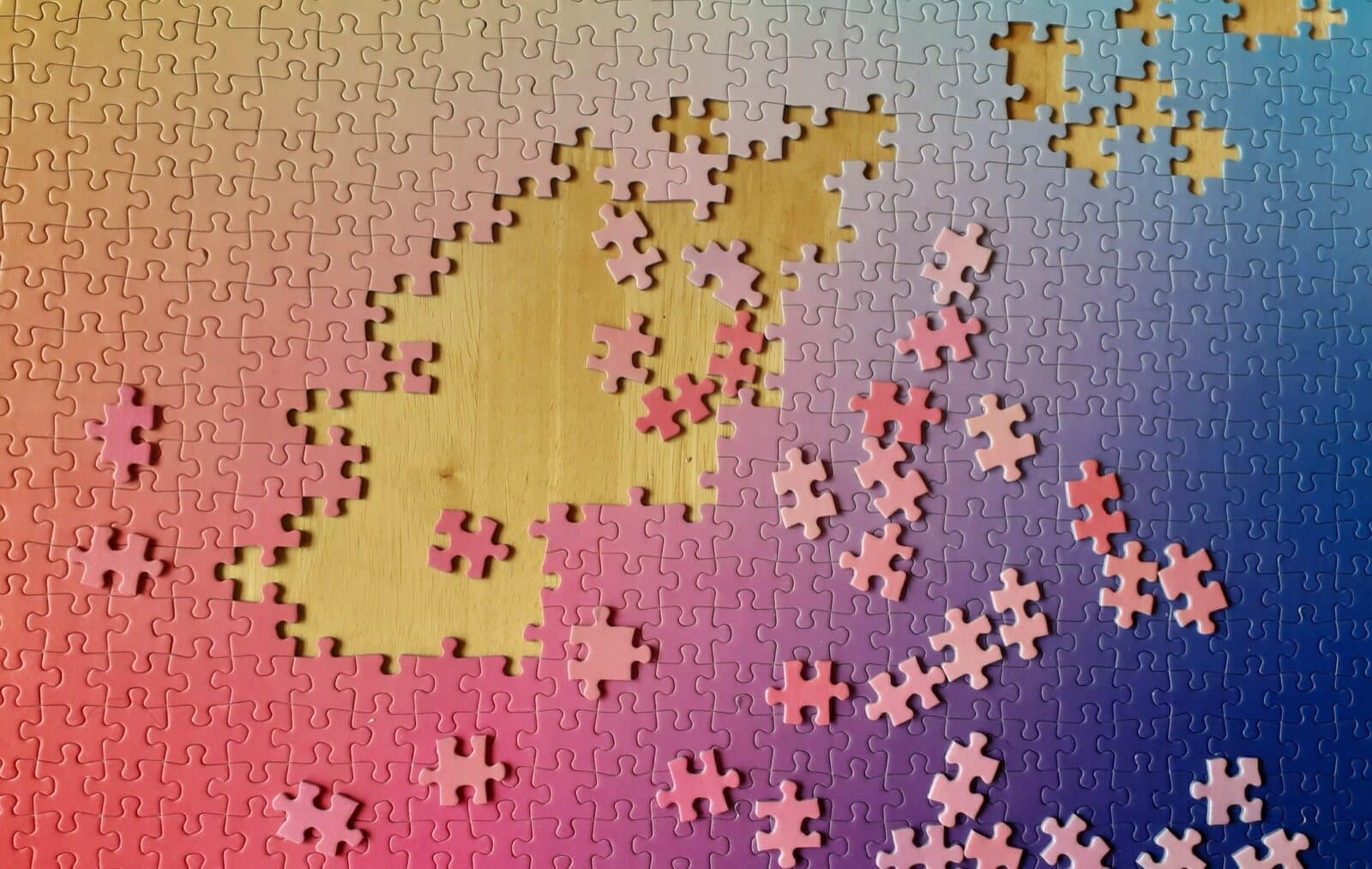
A finished puzzle sits flat and ordinary on the table, four straight edges and a picture nobody questions.
But before it ever reached that box, a single sheet of printed cardboard met a tool heavier than a car.
One stroke, and a thousand uniquely shaped fragments appeared at once.
No scissors, no saw, no two pieces quite the same.
That manufacturing trick has a quieter cousin: a small, carefully controlled version of the same puzzle format, researchers say, lines up with how sharply an adult brain performs on several different tests at once.
How one stamp creates a thousand different shapes at once
The tool doing the work is called a puzzle die, and it looks nothing like a saw despite the name on the box. It is built from long steel ribbons bent into the exact outline of every piece, then hammered into a wooden mount so the blades sit edge to edge across the whole sheet.
As one manufacturing writeup describes it, the puzzle die is a flat board, often made from plywood, with slots cut or burned in the shape of the knives, which sit in the slots and are covered in a compressible foam layer that ejects the cut pieces.
So the press does not cut pieces one at a time. Instead it drops the entire die onto the printed board in a single stroke, and the cutting process resembles making shaped cookies with a cookie cutter, though the forces involved are far greater.
One industry account puts a number on that force, describing a die that plummets down with roughly 700 tons of pressure, instantly splitting the board into every piece at once.
What makes the shapes feel endless is a deliberate choice called random cutting. Unlike the old grid style, where pieces share a similar basic shape, modern random dies scatter the tabs and blanks so irregularly that solvers rely more on shape than on color. That single design decision forces a solver’s brain to stop pattern matching and start genuinely reasoning in space.
Picture the table covered in identical cardboard confetti
Tip a 1,000 piece box onto a table and the chaos looks uniform, but it is not. Every piece carries one of a handful of roles: an edge with a flat side, a corner with two flat sides, or an interior piece built from interlocking tabs and sockets.
Because the die cuts the whole sheet in one motion, no single piece is cut in isolation, which is exactly why a random design guarantees a unique fit. When two pieces click together perfectly, the connection is correct, since every piece has at least one unique matching neighbor. That certainty is the entire appeal, a correct placement announces itself without needing the picture to confirm it.
Scaled up, this mechanical trick now runs an entire industry, though estimates of its size vary enormously depending on who is counting. Some market researchers put the global jigsaw market above $3.5 billion by the early 2030s, while others place the current market closer to $1 billion to $2 billion, a wide range that reflects how differently research firms define the category.
What researchers actually measured when they studied puzzle solvers
The cognitive claim behind all this is not folklore, but it is also narrower than the finished 1,000 piece box on a kitchen table. A team based at Ulm University in Germany ran a randomized trial, published in 2018, that recruited 100 cognitively healthy adults aged 50 and older.
Participants were split into two groups, one given a 30 day home based jigsaw puzzle routine of at least one hour a day plus cognitive health counseling, the other given counseling alone. To measure puzzle skill itself, the team did not use a factory-sized box at all: puzzle skill was assessed with an untrained 40 piece jigsaw, timed under test conditions, alongside a separate self-report of each person’s lifetime puzzling experience.
Published in Frontiers in Aging Neuroscience, the results held up across a wide battery of tests, though the strongest link was with lifetime puzzling habits rather than the short 30 day program itself. Puzzle-solving skill correlated with global visuospatial cognition, a composite built by averaging scores across eight separate abilities including perception, mental rotation, working memory, reasoning and episodic memory, and the link held strong across nearly every domain tested. The 30 day group did get measurably better at solving puzzles, but that short intervention alone did not produce a detectable gain in overall visuospatial cognition.
That breadth is unusual in psychology research, where most leisure activities tend to light up one narrow skill. A puzzle apparently exercises nearly all of them simultaneously, which may explain why the hobby has survived a century of competition from easier entertainment, the same curiosity that keeps readers checking how often adults are open to new friends through other everyday habits.
Where the puzzle habit runs into real limits
None of this means every puzzle buyer is training their brain on purpose. Market researchers tracking the category note it is also driven by plain stress relief, with adults turning to puzzles as a calming screen break that reduces digital fatigue. The cognitive boost and the comfort boost are tangled together, and most solvers could not separate the two if asked.
The manufacturing side has its own ceiling, too. Producing a finished puzzle from concept to shelf, including the die itself, remains slow and labor intensive, taking as much as 2,000 hours per puzzle, or around 12 months on average from start to finish. A single stamp finishes the cutting in a second, but the design and tooling behind that stamp can take the better part of a year.
Even the sales swings the hobby is famous for come with caveats. Puzzle makers reported sharp, short-lived sales surges in the US during the early weeks of 2020 lockdowns, a spike widely tied to a single unrepeatable event rather than steady year round demand, a pattern not unlike how checkout habits shift only when a crisis forces new routines, as seen in how shoppers juggle payments under pressure.
Why the mechanism still matters for anyone buying a box today
Strip away the marketing language and the appeal is mechanical, not mystical. A die built from bent steel guarantees that pieces only fit one true way, and that guarantee is what makes an hour at the table feel productive rather than random. The hobby works because the manufacturing choice and the mental payoff happen to line up, even if the research behind that payoff was built on a much smaller puzzle than the ones sold in stores, and the strongest results track years of puzzling rather than a single month.
That alignment is also why the category keeps growing instead of fading as a pandemic relic. Even outside crisis years, some researchers point to the jigsaw market expanding steadily, with one estimate putting a narrower slice of the category at roughly $500 million in 2025, as consumers increasingly seek out puzzles as relaxation.
So the next time a box of a thousand cardboard fragments gets dumped across a kitchen table, the shapes scattered there are not accidental clutter. They are the product of one heavy steel stamp engineered to make every piece unmistakably its own, and, if the smaller-scale data from Ulm holds up in future trials on full-sized puzzles, a genuine workout for the brain doing the sorting.
