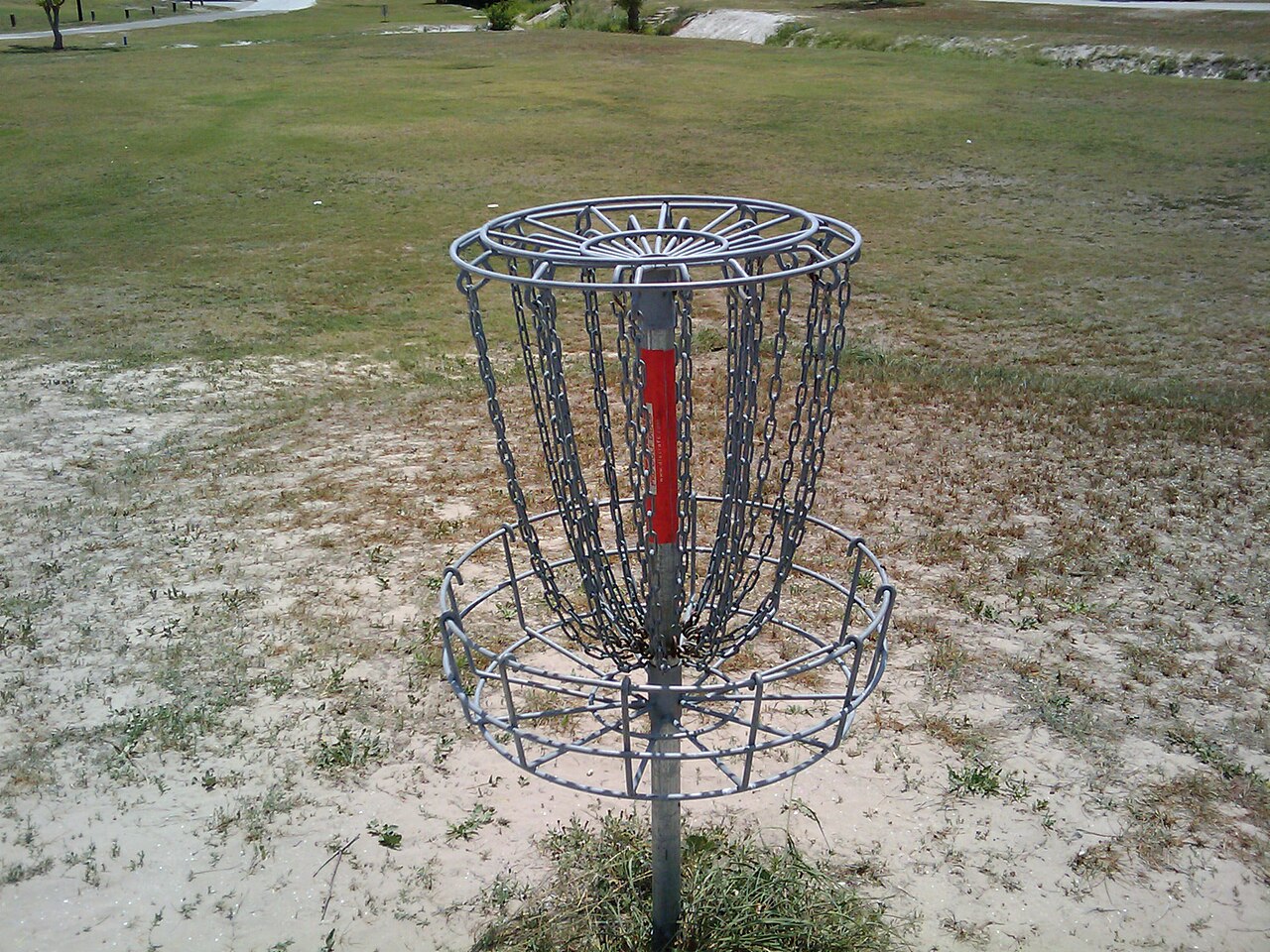
A metal basket with hanging chains sits at the edge of a public park, scuffed from thousands of plastic discs clattering into it since spring.
Nobody built a clubhouse here.
There is no green fee, no pro shop, no gate.
Just a tee pad, a fairway mowed between the trees, and a sign bolted to a post.
Multiply that scene by eleven thousand across the country and a strange thing becomes true, because the hobby quietly outbuilt a retail giant and almost nobody noticed it happening.
So how did a sport that barely needs equipment pull that off?
How a sport with almost no equipment outbuilt a coffee chain
The trick starts with what disc golf does not need. A regulation hole requires a disc, a basket, and a strip of open ground, which means a city parks department can carve a nine hole course into unused acreage for a fraction of what a baseball diamond or a swimming pool costs to install.
That low barrier is the entire mechanism behind the numbers. According to UDisc’s 2026 Disc Golf Growth Report, there are now more disc golf courses than Dunkin’ Donuts shops in the United States, with 11,165 disc golf courses compared with 10,014 Dunkin’ locations.
So while a coffee chain needs a lease, a kitchen, plumbing and staff before it opens a single door, a parks crew needs a mower, a handful of baskets, and a weekend. That gap in startup cost is why the newer sport caught up to a company that has been opening stores since the 1950s.
What a course actually looks like on the ground
Picture the typical build: a looping path through trees with nine or eighteen baskets, tee signs listing distance and par, and almost no maintenance beyond mowing. Nine hole disc golf courses are being built at twice the rate of eighteen hole courses, which tells its own story about who is building them and why.
Nine holes finishes in under an hour, fits a lunch break, and needs less land to clear. That makes it an easy yes for a town council weighing budget requests, since the course can slot into a strip of park nobody else wanted.
It also lowers the bar for a total beginner who has never thrown a disc before. That beginner math shows up again in the data: players who start on a short course are 10 percent more likely to come back for a second round, exactly the kind of retention number a parks department can point to when asking for more baskets next budget cycle.
The scoring app behind the numbers, and how fast the sport is moving
Most of this data comes from a single source worth naming plainly: the smartphone app players use to log their rounds and find nearby courses, which doubles as the industry’s unofficial census. UDisc, the world’s leading disc golf app with over 2 million players worldwide, released its 2026 Disc Golf Growth Report, which cites more than 17,000 courses worldwide and 21.2 million rounds played last year.
That scale did not happen overnight. The number of courses worldwide has almost tripled since 2015, and more than 1,100 courses have been built per year for six consecutive years, which works out to roughly three new courses finishing somewhere on the planet every single day.
Traditional golf, by contrast, saw only 17 net new courses built nationally from 2022 to 2024, while disc golf added 1,650 courses in that same stretch. Participation climbed just as fast behind that construction, with annual disc golf participation growing 86 percent since 2020, as measured in rounds recorded on UDisc.
That stretch covers the years when many Americans were hunting for outdoor activities that did not require a reservation or a membership fee. The timing lines up with a broader shift this desk has tracked toward hands-on, screen-free hobbies that do not require a subscription to enjoy.
Where the model runs into real limits
None of this means every town wants a basket in its park. Course density still varies enormously by state, and some regions have almost no infrastructure at all despite the national growth.
Even the sport’s own champions admit access is uneven. While the US dominates in raw course numbers, there are still large areas where access to disc golf could be greatly improved, a gap the Growth Report itself flags rather than glosses over.
There is also a ceiling on how official the hobby remains. The game is played in about 40 countries, and as of this year there are 330,400 total members and only 112,509 subscribed members of the Professional Disc Golf Association worldwide. Most players who walk a fairway on a Saturday never join the governing body at all, which keeps the official membership count far smaller than actual participation.
What the Dunkin’ comparison really tells us
The comparison to a coffee chain was never really about coffee. It is shorthand for how deeply a hobby can embed itself into ordinary American geography without most residents registering it as a trend at all.
That quiet spread fits a wider pattern in how Americans now spend free time on cheap outdoor activities that do not require booking a court or paying a hidden membership fee to show up.
A basket in the corner of a park asks nothing of a newcomer beyond a disc and an afternoon, and that ease is the whole appeal.
What happens next likely depends less on marketing and more on simple arithmetic. As long as a nine hole layout costs a city next to nothing and keeps a park busy, the baskets will keep going up, one quiet afternoon build at a time, long after the headline comparison to a coffee chain is forgotten.
