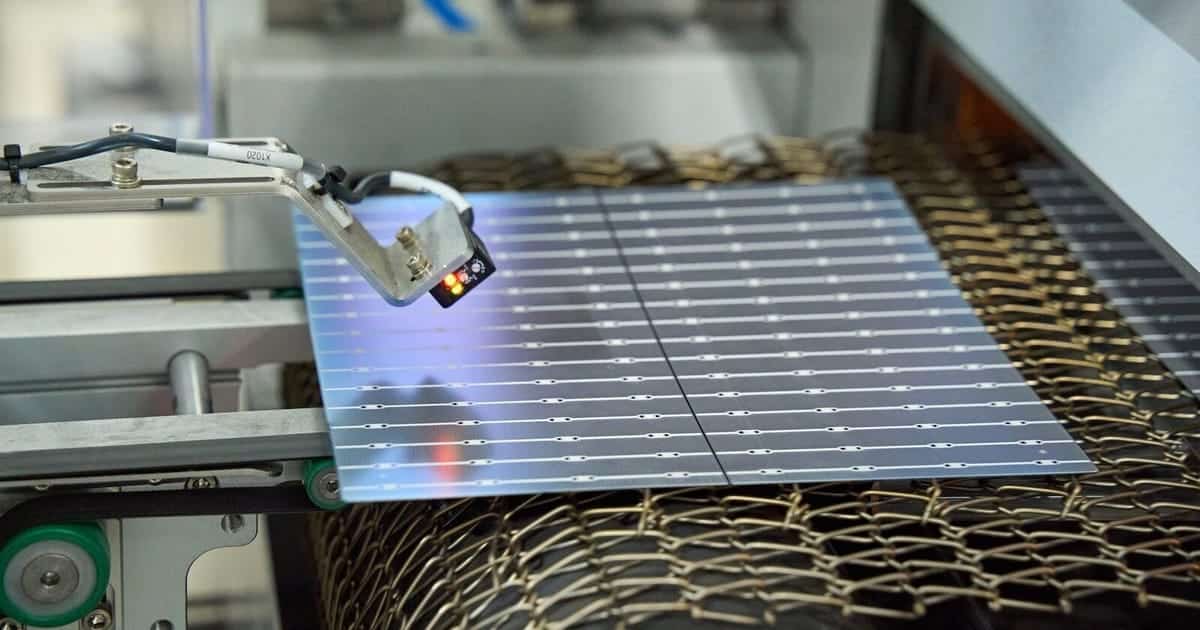
Inside a sprawling factory in Cartersville, Georgia, raw polysilicon enters one end of the building.
Panels roll out finished at the other, part of what the company building it calls the country’s first attempt at a fully integrated solar supply chain under one roof.
That ambition looks like proof America has solved solar manufacturing.
It has not, at least not yet.
Almost everything that panel needed to become working electronics, the thin silicon wafer and the crystal ingot it was sliced from, still mostly arrives from somewhere else first, and new industry tallies published this fall show just how lopsided that supply chain has become.
Why wafers and ingots are the chokepoint nobody assembles fast
A solar panel is not built in one motion. It moves through five distinct stages, starting with raw polysilicon, then an ingot, then a wafer sliced from that ingot, then a finished cell, and only at the end a module, and each stage demands different machinery, heat and precision.
Growing the ingot is the slow part. A molten silicon core gets pulled upward in a sealed furnace over many hours to form a single, nearly flawless crystal cylinder, a process that tolerates almost no contamination or temperature swing, then gets sliced into wafers thinner than a sheet of paper.
Module assembly is forgiving by comparison. Robotic arms place cells, machines solder ribbon between them, and glass seals it all, scaling with floor space far more easily than crystal growth does. That is why finished panel lines went up first, while the furnaces and saws that feed them lagged years behind.
What the factory floor actually looks like today
Inside plants like the one in Cartersville, Georgia, the gap is physical and visible. The site started producing modules in 2024, and it was supposed to produce ingots, wafers, and cells, the more complicated precursor steps, in 2025, but that build-out fell behind schedule , even as the module side kept running.
Elsewhere the pattern repeats. Heliene had wanted to build a cell factory to supply its 1.3-gigawatt module production in Minnesota, but it froze development amid the market turbulence when President Donald Trump took office in 2025 , then froze that build as the market shifted.
Meanwhile, Norway’s NorSun had planned a $620 million, 5-gigawatt ingot and wafer factory near Tulsa, Oklahoma, set to open in mid-2026 and supply Heliene and others, but the company’s website returns a 404 error code, and NorSun told Heliene that the Tulsa factory is not moving ahead .
So the finished panels piling up at the end of these lines are real and growing. But peel back one layer, and most of the crystal growing furnaces and precision wire saws that should feed them are still being imported, built late, or abandoned mid construction.
The numbers behind the imbalance
Trade group figures published in September put the mismatch in hard terms. The Solar and Storage Industry trade group reported 25 gigawatts of polysilicon manufacturing capacity nationwide, against 10 gigawatts of ingot and wafer manufacturing, with another 10 gigawatts under construction .
That same imbalance shows up further down the line, where battery cell manufacturing capacity of 63 gigawatt-hours trails battery module capacity of over 119 gigawatt-hours , echoing the shifting battery supply chain taking shape elsewhere. One industry commentator summarized it bluntly in a reply to the trade group’s own public post, writing that both chains are thin in the middle, pointing to 25 GW of poly against 10 GW of wafer, and 119 GWh of modules against 63 GWh of cells .
For solar specifically, other industry tracking this year has pegged solar cell output at 3.2 GW, with wafer manufacturing only now starting from a near-zero base . Put plainly, the country has plenty of raw material and plenty of places to bolt a panel together, but strikingly little of the delicate crystal growing equipment in between.
Why the squeeze is getting tighter, not looser
Federal trade policy is now pressing directly on that thin middle section. A proclamation signed August 6, 2026 imposes a 15 percent ad valorem tariff and minimum import prices on polysilicon and its derivatives, setting price floors of $21 per kilogram for polysilicon and $100 per kilogram for ingots and wafers , with the measures taking effect this December.
That structure rewards companies that control every stage under one roof. It also raises the bar for anyone trying to finance a standalone cell or wafer plant on its own, right as a federal trade panel found that imports from India, Indonesia and Laos had already harmed the domestic industry.
Even wafer size is shifting underfoot. A wider silicon wafer format has begun spreading across factory floors nationwide, leaving plants that bet on the older format facing costly retooling just as they try to catch up.
What it means for panels, prices and the next few years
None of this means American solar manufacturing is failing. The United States now has 75 gigawatts of operating PV module capacity, a 700% increase compared to August 2023, and ingot and wafer manufacturing was reshored for the first time in 10 years in 2025 , a real milestone reached only recently after years of relying almost entirely on imported finished panels.
But that milestone sits on a foundation still mostly built elsewhere. Until domestic furnaces and wire saws catch up to the module lines they feed, the country will keep depending on imported ingots and wafers to keep its own factories running, tariffs or not.
Industry plans call for roughly doubling wafer and cell capacity within a few years, layered on top of the 10 gigawatts running today.
Whether those new furnaces get finished on schedule, after so many recent delays and cancellations, will decide whether the middle of the chain ever catches up to the ends.
