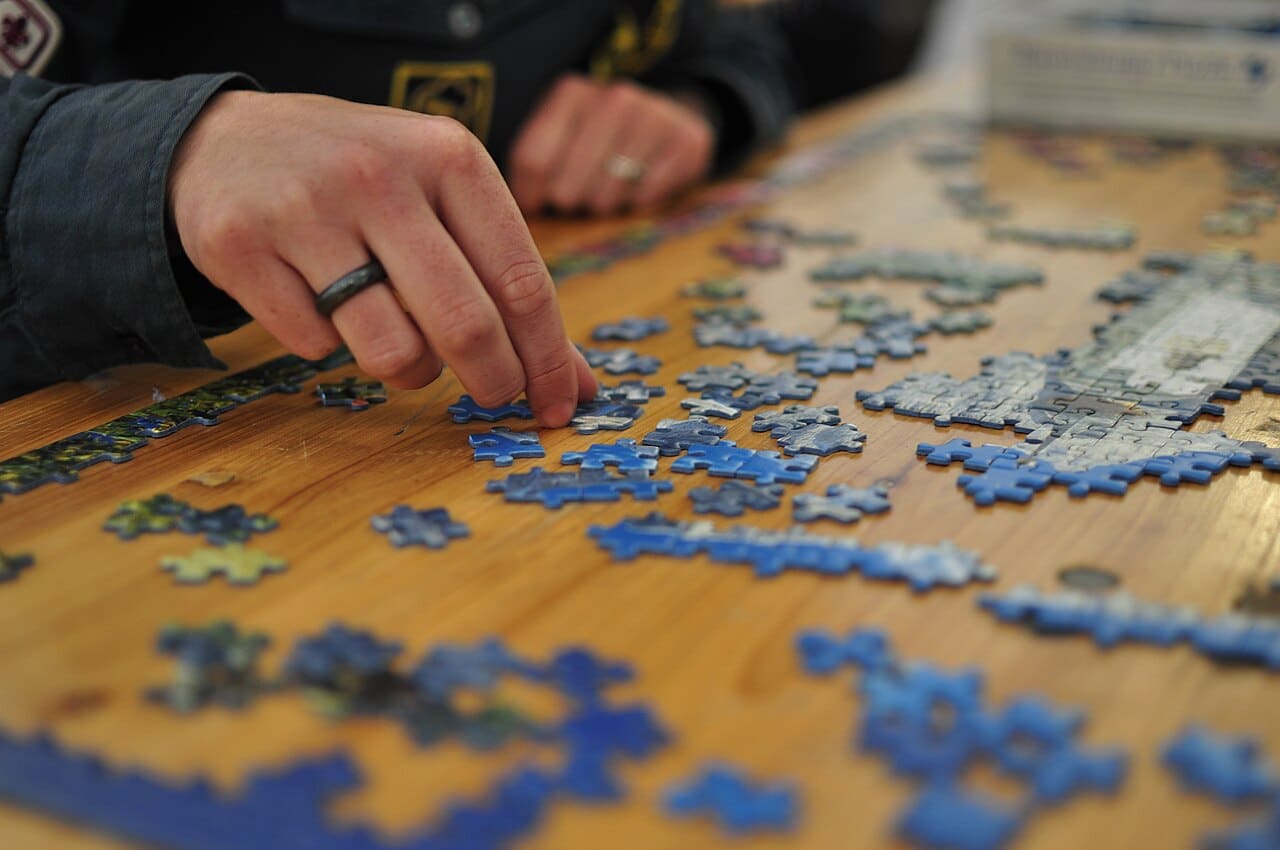
A cardboard sheet slides beneath a steel frame the size of a tabletop, and nothing about it looks like a toy.
Somewhere above it, hundreds of razor thin blades wait in a pattern nobody outside the factory ever sees twice. Then the press comes down, and in less than a second one flat picture becomes a thousand separate pieces.
The machine that does it owes almost nothing to a craft hobby and almost everything to industrial metalwork. So how does a picture turn into pieces that only fit one way.
The press that turns a picture into pieces
Most jigsaw puzzles sold today never meet an actual jigsaw. Instead they pass under a hydraulic die press that drives a custom steel template through printed board with a force of roughly 700 tons for a standard 1,000 piece puzzle, instantly splitting it into pieces.
Building the template that makes the cut is the slower half of the job. Manufacturers bend thin steel blades into the outline of every piece and mount them into a wooden backing plate, and for a puzzle of around 500 pieces it may take 400 hours to make a single die.
That die becomes reusable industrial tooling, not a one time stencil. Once it exists, workers can run sheet after sheet through the same press for years.
Cameras positioned over the belt do the last bit of quality checking no human eye could manage at that speed, since a missing corner piece only surfaces once a customer has already paid for the box.
Inside a factory floor built for one picture at a time
Before any steel touches cardboard, the image itself has to survive a printing process built for volume, not art. A printing plate gets treated so ink only grips the areas meant to carry color, with the artwork elements greased and the blank elements left wet, then the plate runs through a lithographic press that can turn out thousands of identical sheets an hour.
Most companies lean on this method for its cost efficiency, which is the only reason a 1,000 piece landscape puzzle can retail for under 20 dollars instead of costing what a framed print does.
Once the sheet is cut, a second machine takes over that has nothing to do with precision. A scrambling drum tumbles every piece so the box never ships assembled, mixing them before they are shot into a plastic bag ready for shelving.
Wooden puzzles for serious collectors skip this pipeline entirely. They still rely on scroll saw cutting or increasingly a focused laser, which cuts wooden sheets one piece at a time rather than in one giant stamp.
What the sales numbers actually show this year
None of this machinery would matter commercially if adults had stopped buying the finished product. They have not, at least not at Ravensburger, one of the category’s largest manufacturers. Even as its overall group revenue declined for the 2025 financial year, Ravensburger Group sales declined by 5.9% in the 2025 financial year, while the core business of games, puzzles, and books grew by 3% , as trading cards normalized after an exceptionally successful launch.
The clearest growth sits specifically in North America. Ravensburger benefited in particular from strong sales of adult puzzles and card games, with growth especially strong in North America, where sales were up 11% in the US and Canada , according to the company’s latest financial reporting.
That increase lands years after the pandemic era spike that first pulled puzzles back into American living rooms. Industry surveys taken before any of that still found a real baseline audience, with 48 percent of US adults puzzling at least once a year and 19 percent puzzling monthly or more often.
Manufacturers have noticed that puzzling now functions socially rather than just as solo downtime. The company is investing more heavily in experiences that bring communities together, such as live events, tournaments, and speed puzzling competitions , evidence the hobby is turning into something closer to a spectator sport, a shift that echoes how other hobby groups built around niche interests have grown in recent years.
Where the manufacturing math still runs into limits
The 700 ton press is fast, but it is not flexible. Every new image needs its own die, and a manufacturer cannot simply swap in a new photo overnight the way a printer swaps a file.
That constraint is exactly why collector lines tend to recycle a small set of die shapes across dozens of different printed images rather than cutting a fresh template for each one. The steel outline, not the picture on top, is the expensive part to replace.
Large format puzzles push the press itself to its limit, since oversized designs sometimes require two separate dies run in different directions, one for each axis of the cut. That doubles both the tooling cost and the time on the line.
Quality control also catches real failures, not just missing pieces. Patent filings on puzzle manufacturing acknowledge that sharp edges often appear on the second side of a piece because the board cannot always be completely cut through in a single pass.
A hobby that keeps finding new shelf space
What began as a wartime distraction and a rainy day pastime has turned into a steady line item for toy makers watching other categories cool. The machinery behind it, a 700 ton press and a die that took weeks to build, has not changed much in decades, but the appetite for the finished box clearly has.
That staying power says something about how people now spend unstructured time, choosing a screen free activity that rewards patience over speed. It fits a broader pattern of Americans returning to slower, tactile hobbies rather than abandoning them once the novelty fades.
Retailers expect the category to keep growing modestly rather than spike again, since the industry has already absorbed its pandemic bump and settled into a more durable baseline of regular buyers.
For now, the press keeps coming down, one steel die at a time, turning flat sheets into something that sells precisely because it takes real time to put back together.
