A gamer reaches toward the back of a tower case mid session and pulls his hand away fast.
The cable is already too hot to hold.
Inside, a single slim plug carries more electricity than almost anything else in the house.
It sits behind the most expensive graphics card most people will ever buy.
In test after test this year, that plug has been the part that fails first.
So what is actually happening inside that connector when a gaming session runs long?
Why one slim plug keeps overheating under full gaming load
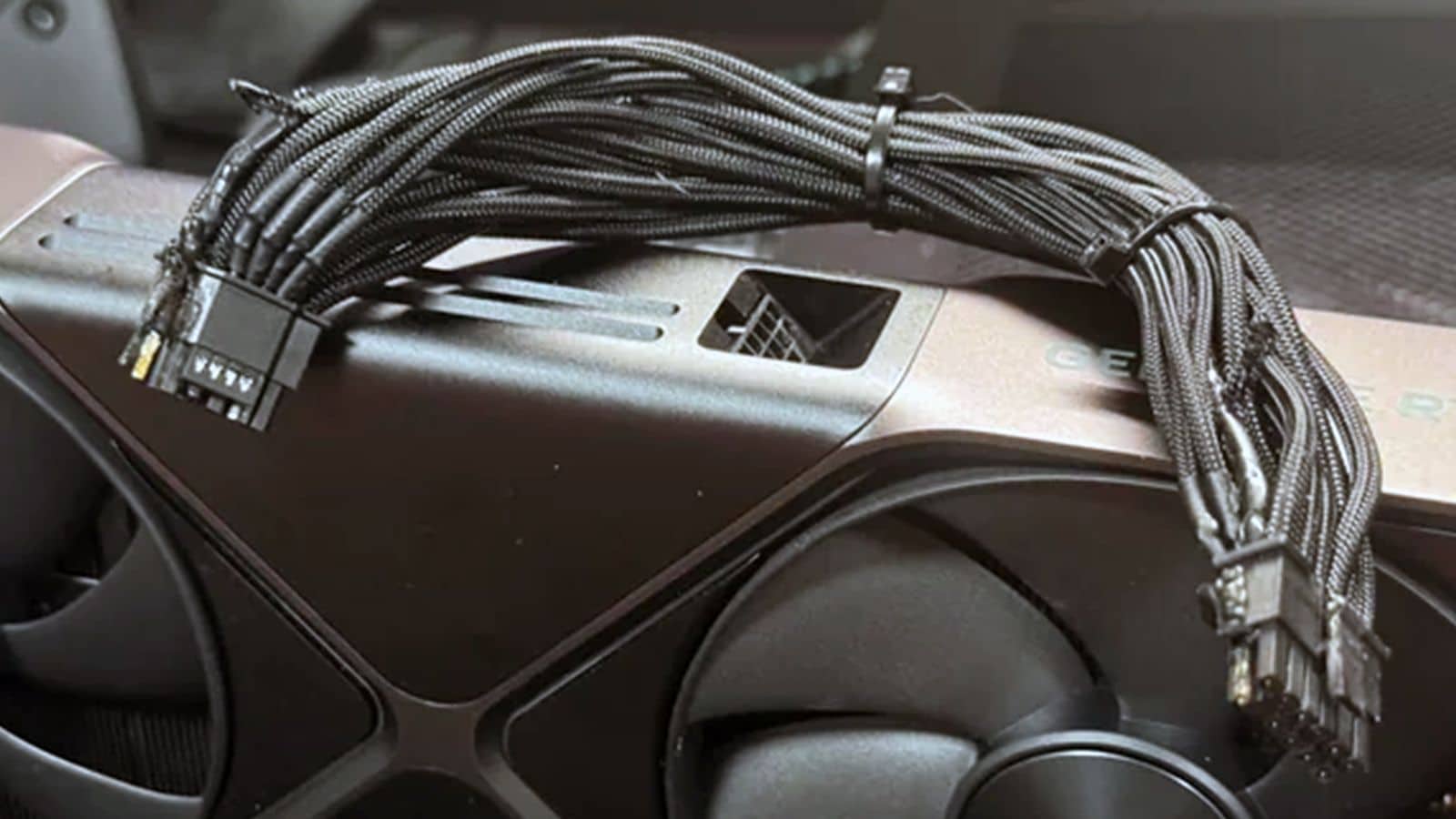
The sixteen pin connector at the center of this problem crams far more current through far fewer, thinner pins than the older style plugs it replaced. The 16-pin connector comprises twelve power pins arranged in two parallel rows, and four auxiliary sense pins that communicate the maximum allowable power draw. Each pin carries only a modest rated current, leaving almost no room for error.
That matters because the pins do not always share the load evenly. Independent testers using current measuring tools have found a severe current imbalance, where some pins carry almost nothing while a single wire pulls far more than its share. One widely cited measurement recorded over 22 amperes on a single wire against roughly 6 amperes expected, with other wires carrying as little as 2 amperes .
So instead of sixteen pins splitting the work, one or two end up doing most of it. That concentrates heat in a tiny patch of plastic never built to handle that kind of localized load for long gaming sessions. The imbalance has shown up on cable after cable, not just one bad batch.
Inside the test benches where cables have fused into their sockets
None of this is theoretical. Hardware reviewers have documented the failure repeatedly on their own benches, not just in scattered reader reports. Hardware Unboxed has become the latest hardware channel to watch a 12V-2×6 connector melt on an RTX 5090 test bench.
The setup paired an ASUS ROG Astral RTX 5090 and a be quiet power supply. A thermal camera later confirmed readings above 150°C, climbing to roughly 175°C under load, and the cable had fused inside the Dark Power 13’s connector and needed pliers to remove. You can see the full breakdown in TechPowerUp’s original report on the incident.
Other cases have gone further. One PNY RTX 5090 owner posted on Reddit about a burned connector on a Digital Storm prebuilt, with the plastic housing melted severely enough to fuse the cable into the card’s socket after roughly 15 months of use. That is a plug welding itself shut, not a loose connection.
Heavier software workloads have followed the same pattern. Builders running demanding modern games at maximum settings have reported power draw climbing well past the card’s rated figure, which pushes the same thin wires closer to their limit on cards that already run hot.
How reviewers traced the imbalance, and why undervolting has not fixed it
Reviewers did not stop at thermal cameras. Using current monitoring hardware built specifically for this connector, testers have repeatedly found that current flows unevenly between individual pins rather than splitting cleanly across all of them. That single measurement is among the clearest evidence that the fault sits in the connector’s pins rather than in any one card’s power draw.
The obvious fix sounds simple: tell the card to draw less power. Builders have tried exactly that, and it has not been enough on its own. According to the forum post about the incident, the top row of pins in a Gigabyte Aorus Master Ice RTX 5090’s GPU power connector has melted down, despite the user having implemented a steep undervolt and power limit , and the connector melted at the GPU side, not the PSU side . That undercuts the idea that only unrestrained, full power cards are at risk.
Safety features built into premium power supplies have not closed the gap either. Reports have documented RTX 5090 connectors melting even after users apply undervolts and power limits, alongside at least one instance where an ASRock PSU’s thermal cutoff saved a card from a similar fate. Other similarly equipped units have not always caught the fault before damage occurred.
Warranty disputes have followed closely behind. PNY denied an RTX 5090 owner’s warranty claim after a PSU-supplied 12V-2×6 cable melted, saying only PNY-branded cables or adapters are covered.
A redesigned connector was supposed to fix exactly this
This is not the first version of this plug to catch fire in public. Its predecessor caused a very similar wave of damage two product generations earlier. A proposed class action lawsuit filed in a federal court in California alleged that a prior flagship graphics card was sold with a defective power cable plug and socket. That case was voluntarily dismissed, so the design flaw it alleged was never tested in court, but the pattern of melting reports that triggered it was independently documented at the time by multiple outlets.
Industry engineers revised the design specifically to try to stop it happening again. January 2025 saw the RTX 50 series launch with the redesigned 12V-2×6 connector and recessed sense pins , and for a while the fix looked like it had worked.
Yet the flagship card built around that very fix has kept failing the same way. The newer 12V-2×6 connector replaced 12VHPWR with changes intended to reduce problems caused by incomplete insertion , but melting continued to be reported for GPUs with this new socket well into this year.
What the hidden catch means for anyone shopping for a gaming PC
None of this means every one of these cards is a hazard under a desk. Most units run without incident, but the risk is not zero. The failures form a real, repeated, independently documented pattern, yet they remain a minority of units in a market selling in large volume.
The honest takeaway is a maintenance habit, not a reason to avoid gaming hardware entirely. Even so, the fix available to most owners today is modest.
Builders are reseating cables carefully, avoiding sharp bends near the plug, and checking cable temperature by hand during long sessions. Cable manufacturers warn that to avoid such problems, it is not allowed to bend the cable closer than 30 mm to the 12VHPWR connector. This low tech precaution is the same one that caught several documented failures before real damage spread.
That is why this keeps resurfacing in hidden cost stories, where a sticker price never mentions the follow up habit it quietly demands. The same logic is spreading into other high power chip hardware, where squeezing more power through less space keeps running into the same basic physics.
For now, the flagship card remains among the fastest consumer graphics hardware sold today. It just comes with an unglamorous homework assignment attached: check the plug, feel the cable, and never assume a redesign closed the book for good.
