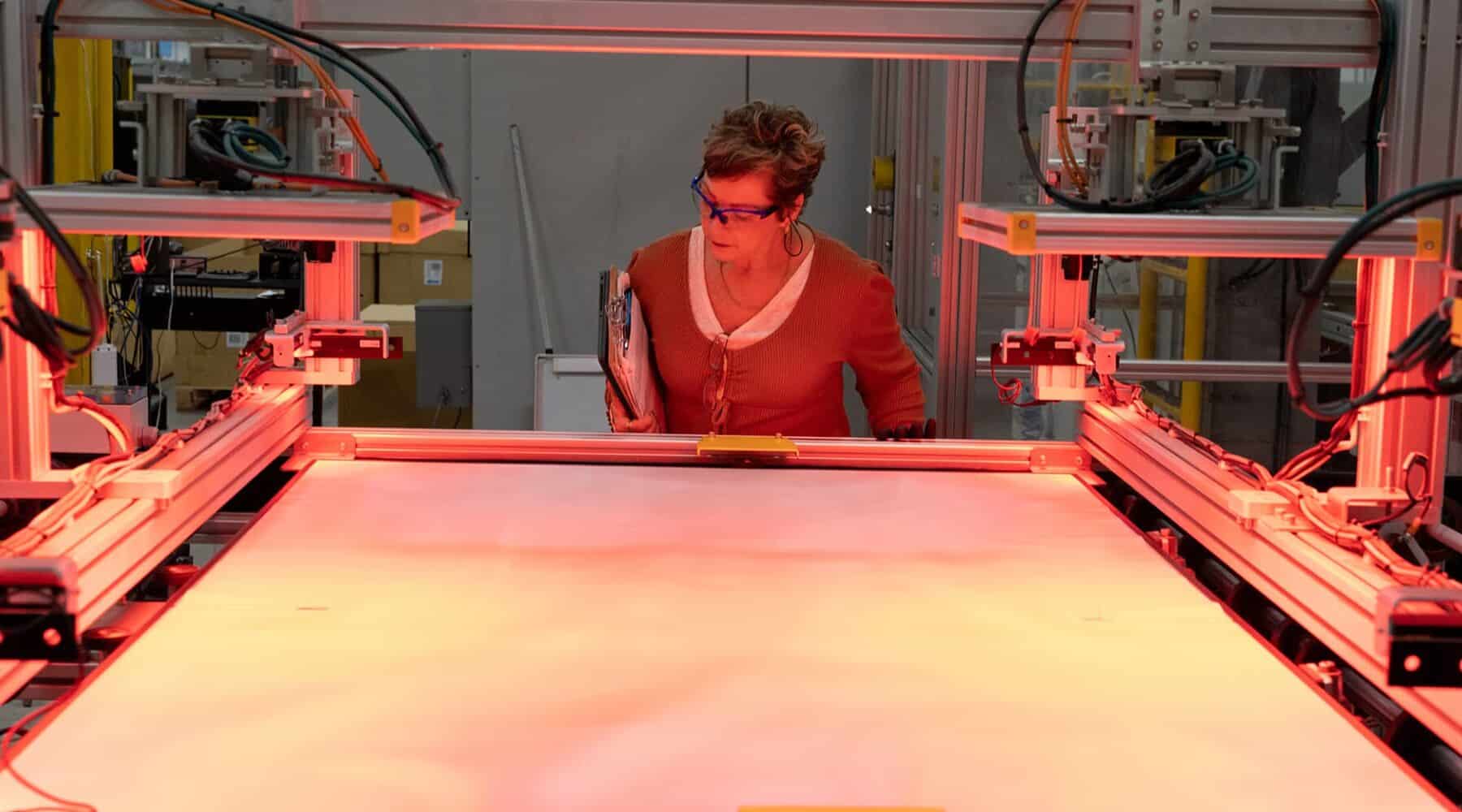
Miami-based NAED Energy Holding has unveiled a new vertical solar cell production platform that the company says is rated for up to 96,000 silicon wafers per hour across a six-line site, double the throughput of its previous equipment line.
The announcement, made this week, targets the fast-growing market for tandem solar cells that combine perovskite and silicon layers to push past the efficiency limits of conventional panels.
A vertical approach to cell manufacturing
NAED Energy Holding Inc. unveiled PV-1 PECVD-V, a vertical in-line deposition platform for high-volume solar cell manufacturing , in which wafers travel upright on a shared carrier through every processing stage.
The company describes the system as a vertical deposition platform that combines two deposition methods, plasma-enhanced chemical vapor deposition and physical vapor deposition, on a single production line, as independently reported by pv magazine.
The platform combines plasma-enhanced chemical vapor deposition (PECVD) and physical vapor deposition (PVD) on a single shared-carrier line.
A single PV-1 line is rated at 16,000 wafers per hour; a six-line site reaches 96,000 wafers per hour , which represents double the output of the company’s prior generation equipment.
NAED Energy Holding said its PV-1 PECVD-V, a vertical in-line deposition platform for solar cell manufacturing, is rated at 96,000 wafers per hour, double the 48,000 wafers per hour of its previous XL-class platform.
Targeting 30 percent efficient tandem cells
The line is built specifically for two-terminal tandem cells rather than being adapted from existing silicon-only equipment.
PV-1 was engineered from the start for tandem solar, and the full line, including perovskite top-cell process tools, is designed to produce NAED’s T2X two-terminal perovskite/heterojunction tandem cell, which targets 30% cell efficiency.
That approach mirrors a broader shift across the industry, where stacking a perovskite layer atop conventional silicon is seen as a path to capture more of the solar spectrum than silicon alone can convert, and where perovskite-silicon tandem cells have already exceeded NAED’s target in the lab, as Longi set a world record of 35.5% efficiency for a perovskite-silicon tandem cell in July.
Other US manufacturers have already begun commercial-scale production of similar hybrid-tandem modules, as seen when Heliene and Caelux began US production of modules the companies say exceed 27 percent efficiency, underscoring how quickly tandem technology is moving from laboratories into factories. Separately, Tandem PV launched commercial perovskite-silicon manufacturing in California in April and has since announced a 30.4%-efficient demonstration module.
A company representative framed the engineering choice as a deliberate break from retrofitting older designs.
” Going vertical let us double throughput and build the line around tandem cells from day one, rather than retrofitting tandem onto a platform designed for something else ,” said Malcom Longair, Media & Development Lead, NAED Energy Holding Inc.
Built and machined domestically
NAED is positioning the equipment itself, not just the solar cells it produces, as a domestic manufacturing achievement.
Every PV-1 tool is designed in-house by NAED and machined in its own aerospace-grade CNC shop in the United States , underscoring the company’s domestic manufacturing credentials at a time when supply chain sovereignty is a growing priority across the solar industry.
That distinction matters because most of the specialized tools used to fabricate solar wafers and cells, even at American-based factories, have historically come from overseas suppliers.
Despite the rapid expansion of module and, more recently, cell manufacturing capacity on US soil, domestically made upstream PV production equipment remains a relative rarity.
That gap has drawn attention as a polysilicon tariff pushes domestic content further up the solar supply chain, from assembly into wafers, cells and now production tooling itself.
NAED said pending US patent applications cover the production line, carrier-turning mechanism, wafer-retention carrier, and T2X solar cell.
NAED said it designs the tools in-house, machines them in its own facility in the United States, and is now taking reservations for production tool slots from manufacturers.
Plans for terrestrial and space markets
NAED says the resulting cells will not be limited to rooftop or utility-scale solar.
NAED plans to bring T2X cells to both terrestrial and space solar markets, alongside a family of glass-glass T2X modules starting at 600 W.
The company has also attached a financial figure to its intellectual property tied to the platform.
The company said the line, the carrier-turning mechanism, the wafer-retention carrier and the T2X cell are the subject of pending US patent applications, and that its intellectual property has been appraised at $179 million under an ASC 820 Level 3 fair-value methodology, an accounting standard that values assets using unobservable inputs such as management assumptions , and NAED did not name the appraiser.
As with any manufacturer-issued announcement, independent verification of the platform’s real-world throughput and the T2X cell’s efficiency will depend on third-party testing once commercial units ship. According to the company, six of the line’s 13 process tools are complete and the remaining seven are in production.
The company has not disclosed any customers or provided a timeline for completing the entire platform , data points that will determine whether the platform moves from engineering milestone to factory floor impact similar to the 2 GW solar cell plant being built elsewhere in the country.
