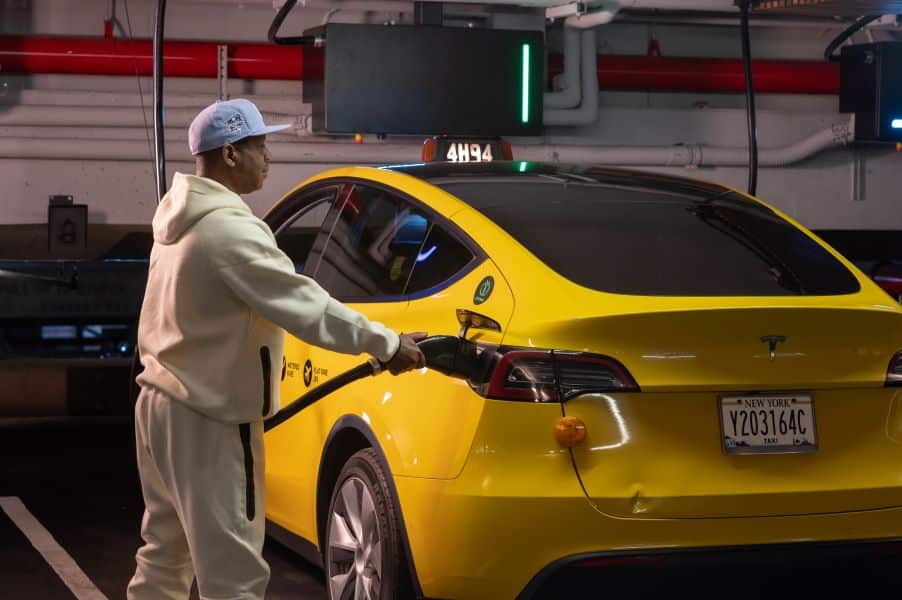
A plugged in sedan outside Boston now does something it never could before.
Its battery can get called on to help run the regional power grid.
The switch flipped at the start of this month.
It changes who gets paid for keeping the lights on.
For years, flexible power sat on the sidelines, outside the rooms where wholesale electricity gets bought and sold.
Now a car battery, a home battery or a smart thermostat can compete directly in that market, so what actually makes an idle car worth something to a grid operator?
How a parked car becomes a grid asset
A grid operator has to match supply and demand every few seconds, and it traditionally does that by paying power plants to ramp up or down. Small devices like EV chargers, batteries and thermostats were historically shut out of that market because they sit behind a household meter, not a power plant meter.
That changed when the regional grid operator finished building a bundling system that lets a company gather many small devices into one package large enough to compete. The minimum aggregation size is 100 kW, and a single resource or aggregation that is 5 MW or greater at a single node must participate as a standalone resource or through a more geographically limited aggregation. A single EV cannot bid into a wholesale market alone, but a fleet of EVs, batteries and thermostats, bundled by a software platform, can clear that bar and behave like a mid sized power plant.
Once bundled, those devices respond to the same signals a gas plant responds to. A charging session pauses for twenty minutes, a home battery discharges for an hour, and across a wide footprint that pullback can replace an expensive peaking plant on the hottest or coldest hour of the year.
That is the trade now open for business. It rewards flexibility over raw output.
What changed on the ground this month
The shift took effect as on November 1, the ISO allows distributed energy resource aggregations (DERAs) to compete with traditional resources in the capacity, energy, and ancillary services markets , letting aggregations of batteries, EVs and demand response compete for energy and ancillary services as deliverable capacity rather than settling only for retail rate credits. That detail comes from filings tracking the FERC order, which moved the region from years of paperwork into live operation.
Before this, a homeowner who let a utility manage EV charging times mostly got a flat monthly credit, a modest discount for giving up some control. That structure still exists elsewhere, including a Maryland program that recently grew its automated charging enrollment from 6,900 drivers to 30,000.
A wholesale market pays differently, rewarding real time value that spikes hard during the handful of hours a year the grid is tightest. A device that shows up during exactly those hours earns far more than one that simply shifts load every night.
Massachusetts has already tested a cousin of this idea. A pilot there began paying EV owners directly for power pulled back out of car batteries, and the state already counts well over 100,000 EVs that could eventually join in.
The numbers behind the new market
The underlying federal order traces back to a vote in 2020, when on September 17, 2020, the Federal Energy Regulatory Commission issued Order No. 2222 to allow for the greater participation of distributed energy resource aggregations in organized wholesale markets, passing on a 2-1 vote , and later signed off on the region’s plan to implement its distributed energy resource rules. Energy and Ancillary Services participation begins November 1, 2026, while Capacity Market participation follows in Commitment Period (CP) 2028/2029 , ending years of compliance filings without an operating market.
Under the new structure, an aggregator can mix technologies freely inside a single bundle. Battery storage, rooftop solar, EV chargers and conventional demand response can all sit inside the same package, competing for the same contracts gas and nuclear plants bid into.
That matters because EV batteries alone rarely clear a wholesale auction. Paired with stationary batteries and smart thermostats, the pool gets deep enough to bid seriously, the same logic that let fleet charging depots add a measurable 22 megawatts of grid load across four cities this year.
Federal data show why timing matters. Light-duty electric vehicles in the United States consumed 8% more electricity during the first six months of 2026 than in the last half of 2025 (2H25), down from the 13, 24% growth seen in six-month periods in recent years , the slowest pace the Energy Information Administration has recorded in its Today in Energy series in years.
Where this market still runs into limits
None of this means every EV owner in New England is suddenly earning checks from the grid. Participation depends entirely on whether a driver’s utility, charger brand or car model has signed onto an approved aggregation platform, and plenty have not yet.
Even where the technology exists, uptake has been underwhelming elsewhere. A California utility once offered EV owners forty dollars a month just to let it manage charging times, and fewer than 5 percent of eligible drivers signed up, pushing utilities toward automatic price signals instead.
Winter complicates the math too. A car unplugged during a cold snap cannot be counted on the way a dispatchable gas plant can, and that unpredictability caps how much any single bundle can bid.
So the market is real, but it is young.
What it means for drivers and the grid ahead
For an ordinary driver, the practical upside is still modest today. Most benefit indirectly, through a utility program someone else designed, rather than by bidding into markets themselves, though that will likely shift as automakers build in the communication standards these markets require.
Because the region’s grid operator built this system years ahead of demand, it now has a head start other regions lack. The mid Atlantic grid is still working through its own aggregation rules on a slower timeline.
Even so, the direction is consistent everywhere. Grid planners keep finding that flexible, software controlled loads are cheaper to tap than new power plants, and EV batteries are the newest and fastest growing pool of that flexibility.
That is a quietly encouraging story for a technology often framed only as a drain on the grid. The same battery pack that worried planners a few years ago is now, in at least one region, getting paid to help keep the system steady.
