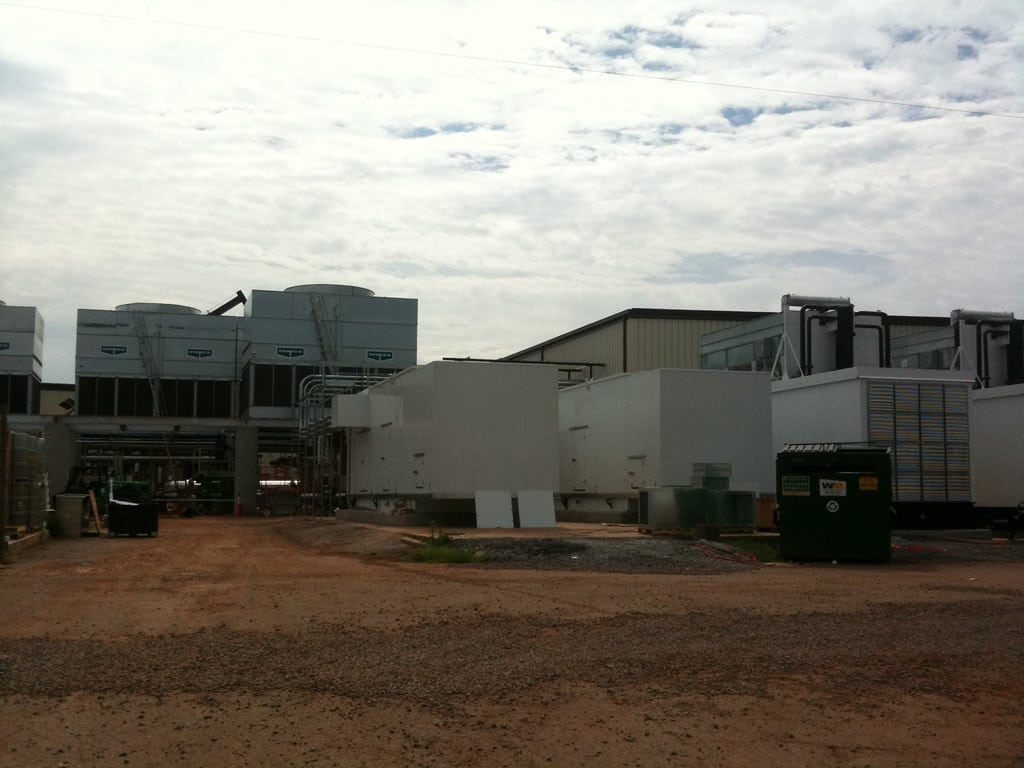
Amazon Web Services has agreed to sell a majority stake in 13 newly built data centers to a Blackstone investment trust for roughly $5 billion, then lease the entire portfolio back for up to 32 years.
The deal, announced by Blackstone Digital Infrastructure Trust on November 16, marks the first acquisition for the newly public real estate trust. It signals how hyperscale cloud providers are turning to outside capital to fund the buildout of AI infrastructure.
Inside the sale-leaseback structure
Blackstone Digital Infrastructure Trust is acquiring a 75% majority stake in two joint ventures with Amazon Web Services to acquire 13 newly constructed powered shells across two AWS campuses in a deal valued at $5B , the investment management giant announced. The inaugural acquisition for the REIT comes at a 7.0% capitalization rate.
The joint ventures own 13 newly constructed powered-shell facilities across two AWS data center campuses, with AWS retaining roughly a 25% interest in the businesses. BXDC will own a majority interest of 75% and AWS will retain 25%, leasing back the portfolio with an initial 12-year term, extendable to 32 years, the companies said in a statement.
Under the triple-net lease structure, AWS keeps roughly a 25 percent interest in the joint ventures while leasing back the facilities. Amazon will lease back 100% of the portfolio from the REIT, which trades under the ticker BXDC, on a triple-net basis with an initial term of 12 years and an option to expand the length to 32 years. Rent payments are guaranteed by AWS, according to a presentation published with the announcement.
Nine buildings are located in northern Indiana, within the greater Chicago data center market, while the remaining four are in Mississippi.
“The quality, basis and tenant profile of these assets make this an attractive match for the deployment of our IPO proceeds,” Nick Pell, Chief Executive Officer and President of Blackstone Digital Infrastructure Trust, said, adding, “We are thrilled to announce BXDC’s inaugural investment and our partnership with Amazon, a leading global technology company with a long-term commitment to innovation.”
Why Amazon is bringing in outside capital
The transaction is one of several recent moves showing AWS turning to external financing to keep pace with surging demand for cloud and AI computing capacity, as part of a broader $33 billion Amazon data-center program across Northern Indiana.
AWS broke ground on its $7 billion data center project in Northwest Indiana, with construction beginning on Project Rise in Wheatfield, Jasper County, on Thursday, Nov. 12 , days before the Blackstone announcement.
Analysts have noted the scale of Amazon’s capital commitments company-wide. On its second-quarter earnings call, the company said it now expects 2026 capital expenditure of approximately $220 billion, up from about $200 billion, with higher memory costs pushing spending above earlier expectations.
Sale-leaseback deals like the Blackstone transaction let AWS keep operating the facilities while shifting the upfront construction cost and asset ownership to an outside investor.
A new vehicle built for this exact kind of deal
For Blackstone, the deal represents the debut transaction of an investment trust purpose-built to buy data centers leased to major cloud tenants. The business is seeking newly constructed but stabilized data centers occupied by “top investment-grade hyperscalers” valued between $250 million and $1.5 billion.
Pell said the structure could extend beyond this one deal. “This direct deal with Amazon creates a roadmap to do more such deals with hyperscalers or developers,” Pell said in an interview.
The joint venture has a debt commitment to borrow 50% of the purchase price at close, according to Pell. The transaction is expected to be completed this year.
The arrangement follows a pattern already established in the industry, where other operators have built facilities on behalf of cloud giants under similar long-term lease arrangements.
As cloud providers race to add capacity for AI workloads, similar infrastructure financing strategies are playing out elsewhere in the industry, including efforts such as Google’s push to expand AI agent tooling for enterprise customers and Microsoft’s continued build out of international cloud regions to meet growing regional demand for data residency and AI services.
