Pick one up and it feels almost too light to be serious.
The ball makes a sharp pop that carries across the whole park. Rallies last three times longer than most people expect. Something about the geometry of the game keeps bringing players back.
The question nobody stops to ask is what, exactly, is happening inside the paddle itself.
How a grid of hollow hexagons turns a light paddle into a precision machine
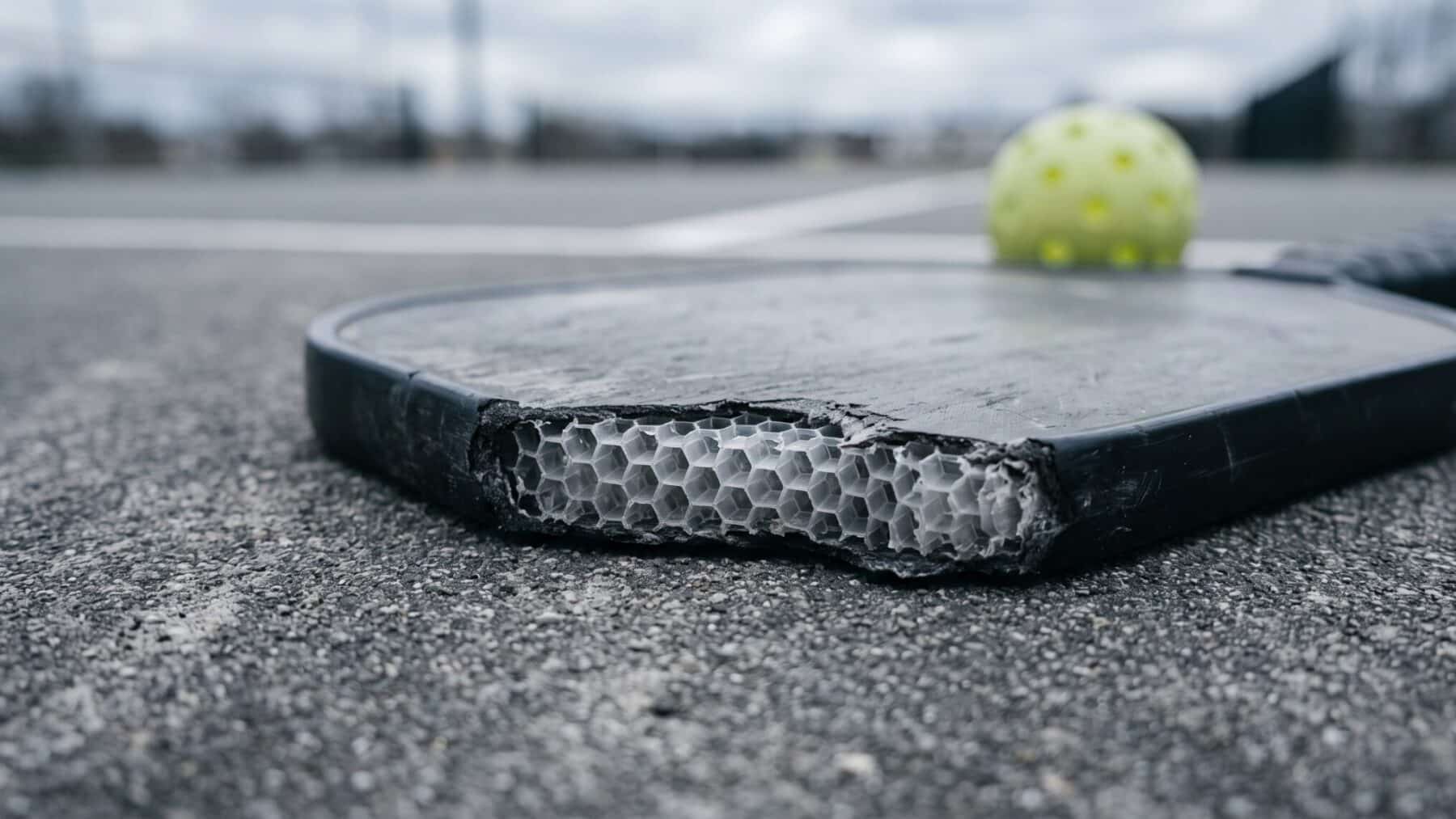
Every modern pickleball paddle is built around a principle borrowed straight from aerospace engineering. A thin, stiff composite face sheet, carbon fiber, fiberglass, or Kevlar, is bonded to a honeycomb core of hexagonal cells that can be made from aluminum, extruded polymer (polypropylene), or Nomex. Honeycomb core composite sandwich panels are extremely lightweight yet have high strength: upper and lower fiber-reinforced laminates are separated and stabilized by a honeycomb core that serves as a shear web, giving the panel high bending stiffness and compressive strength. Together, face sheets and core resist buckling or twisting under a hard strike without adding meaningful weight.
The open-cell geometry keeps total paddle weight low while maintaining enough structural stiffness to transmit energy efficiently. When a ball contacts the face, the hexagonal walls flex slightly and then spring back, that spring is what players describe as a lively or responsive feel. This efficient energy transfer means players can generate more speed and spin without exerting extra force. That stored-and-returned loop is the reason a paddle weighing under eight ounces can feel far more responsive than a heavy racket.
Polymer (polypropylene) is a very popular core material with the newest core technology on the pickleball market; it is lighter and less expensive than Nomex. Polymer cores command the dominant share of the US paddle market. The cell geometry is not decorative: the honeycomb structure distributes impact evenly across the paddle, enhancing both power and control rather than concentrating force at a single point.
What 82,000 courts and 24 million players actually look like on the ground
Drive past almost any park on a weekday morning and the sound gives it away before you see a single player. Approximately 24.3 million Americans played pickleball in 2025, up from 4.2 million participants in 2020. Participation rose 22.8 percent from 2024 to 2025, extending a multi-year streak of rapid growth. That figure exceeds the combined population of New York City and Los Angeles.
Pickleball grew 171.8 percent over the three years from 2022 to 2025, making it the fastest-growing sport in the United States over that period. Teens and young adults ages 13 to 24 posted the highest participation rates of any age segment. Women now account for 42.9 percent of all pickleball players, up from 38.6 percent in 2020.
Courts have struggled to keep up. The USA Pickleball court location database added over 2,300 new locations in 2025, bringing the total to 18,258 locations nationwide, with the Pickleheads database now including 82,613 courts. That works out to roughly 39 courts added per day. Thousands of tennis courts have been fully or partially converted to pickleball in the US; a pickleball court fits inside a tennis court footprint, making conversion a common, cost-effective way to add capacity. Research on how shaping a hobby changes behavior suggests this infrastructure pull is not accidental: when access is engineered deliberately, participation locks in.
The hard numbers behind the paddle’s physics and the sport’s economics
Cell size and wall thickness are the variables paddle engineers tune most obsessively. Bigger cells of around 10 millimeters give more power and bounce, while smaller cells of around 6 millimeters give more control. For polypropylene cores, manufacturers use smaller cells to achieve higher bulk density, producing a firmer and more durable paddle.
The material science extends to how the paddle ages. Heavy play compresses the cell walls progressively, and a paddle that feels crisp at six months can feel noticeably deader at eighteen months. Thicker polymer cores of 16 millimeters and above distribute impact across more cell volume and hold their feel longer.
That degradation arc has become a real consumer issue, because serious players replace paddles every one to two years. Industry estimates suggest roughly 855 million dollars in investment are needed over the next five to seven years just to meet demand.
Where the paddle’s design breaks down and what players are spending to fix it
The same geometry that makes the honeycomb core so effective has a structural vulnerability. Face-sheet/core debonding is a critical damage mode in sandwich panels. At the edge of the paddle face, where the sandwich panel meets the side wall, de-bonding is the most common failure mode under repeated off-center impacts. No amount of marketing copy fully resolves it.
A newer approach tries to close that gap. EVA foam cores have emerged alongside polymer honeycomb, with cells bonded between two face plates to form a rigid, lightweight sandwich construction. A solid foam core replaces the hollow grid with a unified support structure. The tradeoff is weight: foam cores run heavier than hollow equivalents, which can load the wrist across a two-hour session.
Casual players, those playing one to seven times per year, reached 16.8 million people, while the 7.48 million core players who show up eight or more times annually climbed 20.4 percent from 2024. The paddle is, in that sense, two different products inside the same shell.
What comes next for the sport and the engineering inside every paddle
Racquet sports participation has climbed steadily, with seven of eight racquet sports tracked posting year-over-year growth, and pickleball remains the primary driver. The Sports & Fitness Industry Association has described the sport’s multi-year run as evidence that players it recruits convert into habitual participants at a strong rate, rather than cycling out like solo fitness trends.
Unlike gym memberships, a sport built around social doubles play creates a built-in accountability loop that drives regular attendance without requiring willpower. Consider how proximity shapes who we play with: courts in a neighborhood become a social infrastructure all their own.
Participation increased from approximately 4.2 million players in 2020 to over 24 million players in 2025, reflecting rapid expansion in community programs, facility development, and recreational play. That sustained jump in engaged players is what separates a trend from a durable habit, and engineers are responding with textured carbon fiber faces and foam cores as the player base demands more from the object in their hand.
