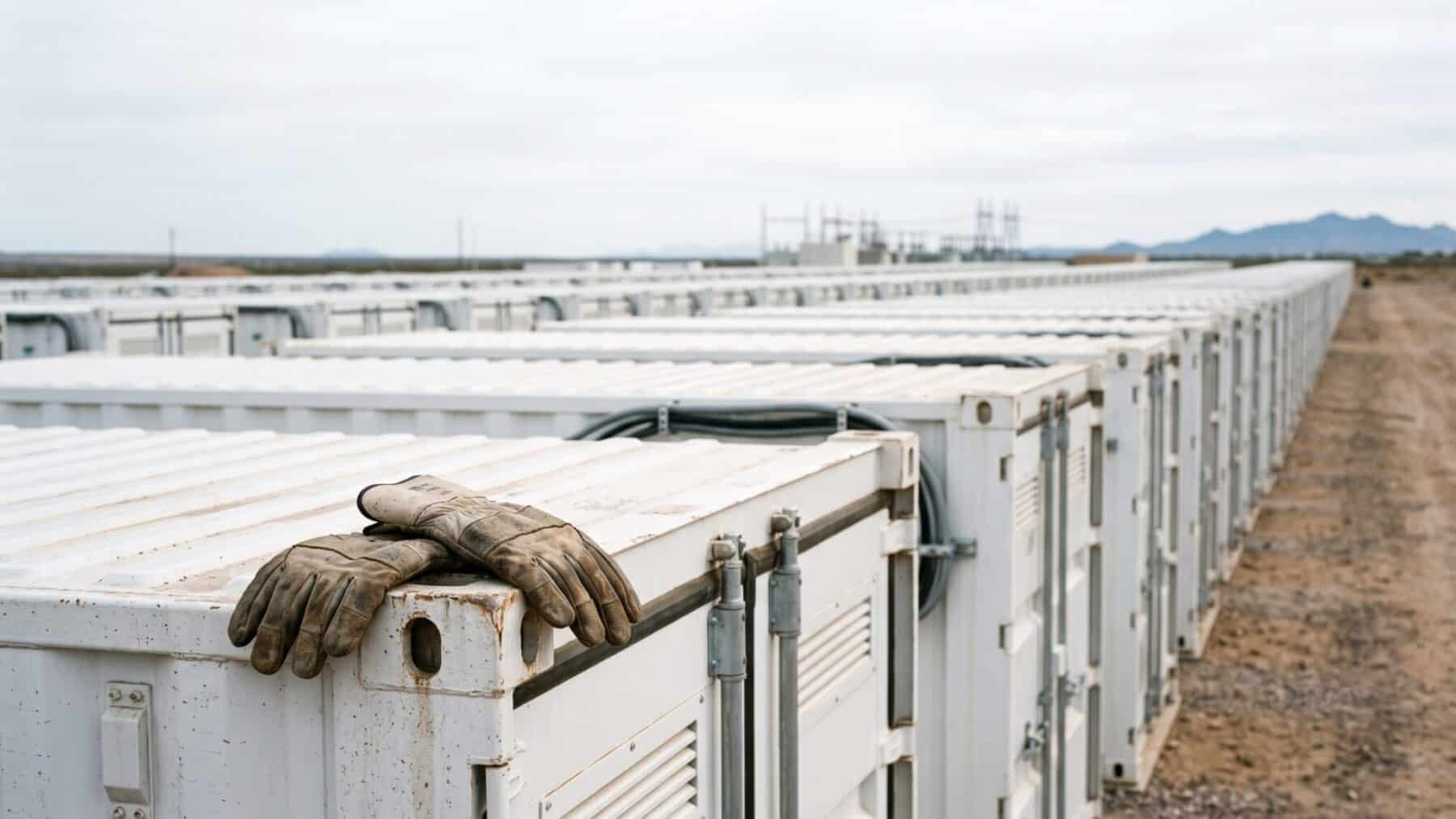
A desert state more famous for blazing summer heat than battery factories just rewrote the national record book.
Crews brought online container after container of grid-scale lithium cells across Arizona scrubland. Seven gigawatt-hour-scale projects came online across the quarter, four in Arizona, two in California, and one in Utah. And the number that came out was one nobody had seen from a single state before.
How a grid battery physically moves power from noon to nightfall
A utility-scale battery does one thing: it shifts electricity through time. Cells charge when supply is high and prices are low, typically midday when solar floods the grid, then discharge that stored energy when demand peaks in the late afternoon. The physics are the same as a phone battery, scaled by roughly a million.
Each project connects rows of steel enclosures, each holding stacked battery modules, to a power conversion system that switches between charging and discharging in milliseconds. The grid operator sends a dispatch signal and the batteries respond faster than any gas turbine can spin up.
Arizona sits in one of the sunniest corridors on the continent, so its midday surplus solar is both enormous and predictable. Without storage, that surplus gets curtailed or sold at near-zero prices to neighboring markets. With storage, it gets captured and sold back at peak rates. The economics close quickly.
What the quarter actually looked like on the ground
The US battery storage market posted its biggest quarter ever, adding 20.2 GWh of new capacity in Q2 2026, bringing total installations for the first half of 2026 to 30.8 GWh, up 23 percent year over year. Utility-scale projects accounted for about 18 GWh of Q2 installations, supported by seven gigawatt-hour-scale projects, four in Arizona, two in California, and one in Utah. Arizona alone added a record 6.2 GWh, the strongest quarter ever recorded by a single state. To put that in perspective, the entire country installed a record-shattering 57.6 GWh across all of 2025, itself four times what the industry installed just three years ago, meaning the annual total from just a few years earlier was a fraction of what Arizona alone managed in a single quarter.
Utility-scale projects accounted for about 18 GWh, largely supported by seven gigawatt-scale projects. Texas added 3.8 GWh, and California installed another 3.6 GWh. Arizona’s number dwarfed them both.
Of the utility-scale capacity installed during the quarter, 44 percent was paired with solar, while 56 percent was standalone storage. That split matters: standalone projects are built purely to arbitrage the grid, charging off the cheapest electrons at any given hour. They signal that storage has become a primary grid asset, not just an accessory bolted onto a solar farm. Our earlier look at surplus midday solar siting shows how that pairing logic works in practice.
The numbers behind the record and where they come from
The figures come from the largest quarter on record press release published by the Solar Energy Industries Association and Benchmark Mineral Intelligence alongside the US Energy Storage Market Outlook Q3 2026. The record quarter more than doubled Q1’s 9.7 GWh, itself the strongest first quarter on record at the time.
That back-to-back acceleration, two consecutive record quarters, is something the industry has not seen before. In the first half of 2026, just under 31 GWh of battery energy storage systems entered operation across the utility-scale and behind-the-meter markets, a year-over-year increase of 23 percent, with ten states each bringing more than 500 megawatt-hours online. The breadth is as striking as the headline number.
Those results prompted an 11.5 percent forecast increase through 2030, lifting the outlook to 683 GWh. Mid-cycle revisions that large are rare and signal a structural shift, not a one-quarter blip. The grid-connection backlog that could slow some of that pipeline is what a federal software program is working to address, covered in our report on stations waiting up to two years for a grid connection.
Where the record does not hold and what is still missing
Arizona’s quarter looks dominant. The state increasingly pairs its abundant solar resources with storage to capture renewable generation, meet rising demand, and manage electricity costs. As of March 2026, Arizona ranks fourth nationally in total installed solar capacity. States without that solar base face weaker revenue stacking and slower project economics.
The residential segment moved in the opposite direction, adding just 657 megawatt-hours in Q2 2026, a 27 percent fall year on year and the only segment to shrink. The report attributes the decline partly to the removal of the federal 25D residential clean energy tax credit and partly to homeowners rushing installations into 2025 ahead of the incentive change.
Duration is also a constraint. Most record-setting projects deliver power for two to four hours before cells are depleted. Longer-duration systems remain far more expensive and represent only a small slice of what came online this quarter.
What a landmark full year would mean for the grid
According to the US Energy Storage Market Outlook Q3 2026 from SEIA and Benchmark Mineral Intelligence, the US market expanded 11 percent year-on-year in Q2, bringing H1 2026 installations to around 31 GWh, up 23 percent year-on-year. With 30.8 GWh already installed through June, the US is on pace to comfortably exceed 2025’s record annual total of 57.6 GWh, making this the largest annual storage buildout the country has ever completed, by a margin too wide to close even if the second half slows.
The country’s utility-scale storage capacity nearly doubled from 88 GWh to 165 GWh in the first 18 months. Battery energy storage supplied more electricity to the grid in the first eight months of 2026 than in all of 2025, helping provide power to states during periods of extreme heat.
As Shan Tomouk, BESS and Energy Lead at Benchmark Minerals, put it: “Energy storage is no longer just a California and Texas story anymore. We’re seeing strong pipeline growth in Arizona, Nevada, Oregon, Colorado and several other states.” The practical result for the average electricity customer is a grid that can absorb cheap renewable power and release it precisely when demand, and bills, would otherwise peak.
The record Arizona set in one quarter is the clearest sign yet that the technology has moved well past its proving-ground phase.
