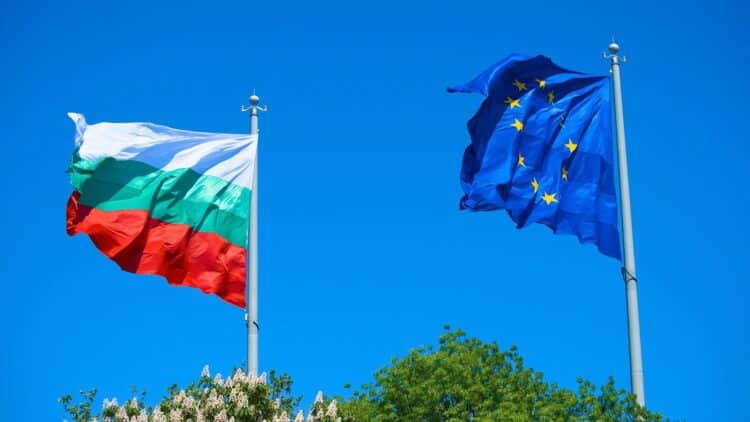
The year 2026 began with a politically and financially impactful development in Bulgaria: the adoption of the euro as its official currency. The country, which has been part of the European Union for almost 20 years, has only now managed to update its currency to the bloc’s standard currency. This news brought celebrations from local European authorities, but also a wave of dissatisfaction and internal protests criticizing the transition the country will undergo.
Bulgaria completes European integration with entry into the eurozone
On the very first day of 2026, Bulgaria became the twenty-first member country of the Eurozone. This change adds a considerable number of people under the European currency, exceeding 350 million individuals, thus expanding the reach of the European monetary bloc. Christine Lagarde, president of the European Central Bank, celebrated the country’s inclusion.
“The euro is a powerful symbol of what Europe can achieve when we work together, and of the shared values and collective strength that we can leverage to confront the global geopolitical uncertainty that we face at the moment,” she said.
A decision that was made without effective public participation
The transition to the euro was also celebrated by Bulgarian President Rumen Radev, who stated that adopting the currency represents a final step towards the country’s integration into the European Union. Alongside the celebration of the change, the president lamented the fact that the population did not actively participate in the decision, since there was no referendum to consult public opinion. According to the leader, the absence of this consultation further increased the distance between the political class and society.
Before Bulgaria, the last country to adopt the currency was Croatia in 2023, and with this year’s update, only six countries in the European Union bloc remain without using the euro as their official currency. To ensure a stable transition in the country, the euro was fixed at 1.95583 levs.
Public reaction reveals concerns about the population’s purchasing power
According to the most recent Eurobarometer survey, 49% of people were against the monetary transition, fearing that the change could bring a considerable increase in the cost of living in the country, which has the lowest minimum wage in the entire bloc, around 1300 euros per month.
One piece of news that contributed to worsening the feeling of financial insecurity was the announcement by the National Institute of Statistics of a 5% increase in food prices in November. However, part of the population views this favorably, arguing that the euro symbolizes closer ties with Western Europe, while others believe it increases the risk of loss of purchasing power and consequently exacerbates inequality.
A series of false claims was also spread by pro-Russian groups about the transition, to increase public fears about the negative aspects, thereby weakening support for the European Union and NATO by encouraging polarization and distrust in the process.
Daily challenges and political instability
In addition to economic concerns, merchants also report difficulties in obtaining initial euro packages, with delays impacting their businesses, something that is expected to last during these first days of the transition. In the political sphere, uncertainties are also generating tensions in the current context, since the previous government lost a vote of confidence in December 2025, leading to the eighth election in the country in 5 years.
Bulgaria’s entry into the eurozone, while representing an important step towards strong integration into the European Union, has also brought internal concerns about the increased cost of living and political and logistical impacts during the transition, intensified by the use of disinformation. The success of the transition will depend on the level of stability and impact that the change brings to daily life in the country.