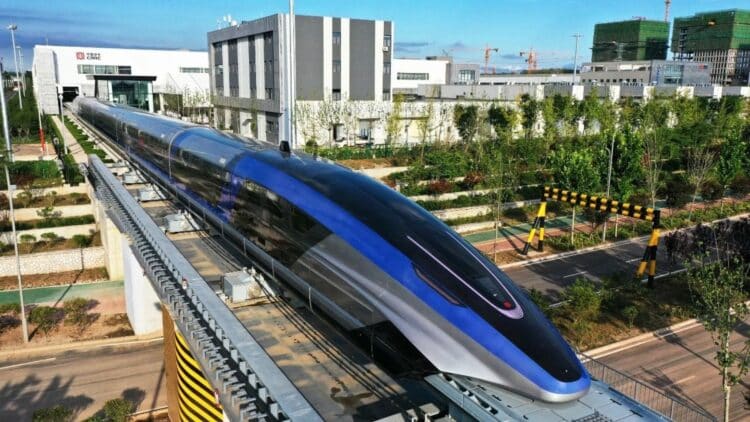
On a short stretch of track in northern China, a heavy block of engineering briefly moved with the urgency of a launched projectile. In a test that prioritised hardware limits over passenger comfort, a 1.1-tonne superconducting maglev rig accelerated to 700 km/h (435 mph) in two seconds—then stopped within the available distance. The run, conducted on a 400-metre test track operated by the National University of Defense Technology (NUDT), is being framed as a milestone for the technology stack often associated with hyperloop-style transport.
Why this test is turning heads
The headline number—0 to 700 km/h in two seconds—is eye-catching, but the real story is what had to work simultaneously for the sprint to succeed. Extreme acceleration demands tight synchronisation between propulsion, levitation and guidance; any lag can destabilise the vehicle’s position relative to the guideway.
In this run, engineers used a superconducting maglev chassis and a linear motor system to generate highly controlled thrust. The objective was not to create a passenger-ready ride, but to probe how the electromagnetic systems behave under harsh, high-load conditions.
Inside the 700 km/h sprint on a 400-metre track
According to the report, the NUDT team placed a 1.1-tonne test chassis on the guideway and executed an extreme speed profile: accelerate to 700 km/h in two seconds and then brake hard enough to stop within the short track length.
The acceleration involved is far beyond what human passengers could tolerate for routine travel. The source notes it corresponds to roughly 10 g—useful for stress-testing hardware, but not a target for commercial operations.
What engineers were trying to prove
The interest for future high-speed systems lies in showing that core subsystems can remain stable under violent loads, including:
- Producing large, precisely timed thrust using linear motors
- Keeping magnetic levitation stable at extreme acceleration
- Managing guidance forces to prevent lateral vibration
- Stopping the vehicle using non-contact braking
The outcome suggests the electromagnetic components stayed coordinated despite the brutal demand profile—an important signal for designs that aim to operate at very high speed with tight safety margins.
How this fits into maglev history and hyperloop ambitions
Magnetic levitation has been pursued for decades as a way to reduce friction by removing wheel-to-rail contact. Germany and Japan began developing maglev concepts as far back as the 1960s, chasing higher speeds than conventional rail can sustain efficiently.
From Transrapid and SCMaglev to today’s test rigs
Germany’s Transrapid programme demonstrated high-speed maglev performance, surpassing 430 km/h in tests, but wide deployment proved difficult due to infrastructure costs and corridor constraints. Japan’s approach evolved into SCMaglev, using superconducting magnets cooled to extremely low temperatures; in 2015, a manned SCMaglev reached 603 km/h on the Yamanashi test track.
In parallel, the “hyperloop” idea gained attention in the 2010s after being promoted by Elon Musk: capsules travelling through low-pressure tubes, using magnetic levitation and linear motors to target speeds around 1,000 km/h or higher. Many early commercial efforts stalled under cost, regulation and safety challenges, but the enabling technologies continue to be developed through experiments and test tracks.
Why China’s extreme acceleration matters even if passengers never feel it
China already operates the world’s largest high-speed rail network and has commercial maglev experience, including the Shanghai airport connection. The NUDT run sits at the frontier between established rail expertise and more experimental tube-transport research.
What a “too-fast-for-humans” test can still teach
Engineers often push prototypes beyond realistic operating limits because it exposes weak links early. Even if passenger systems would use far gentler acceleration, testing at extremes can help validate:
- More compact linear motor designs for constrained environments
- Control systems that keep levitation and guidance synchronised
- Emergency braking approaches that don’t rely on wheel friction
- Structural and material behaviour under rapid magnetic force changes
For hyperloop-style concepts that envision travel in low-pressure tubes at very high speed, small control errors can quickly become serious. Data produced under hostile conditions can help define safer operating envelopes later.
The big obstacles still facing hyperloop-style transport
Even with striking test results, major hurdles remain before any commercial system carries passengers between cities. Tubes designed for very high speed typically require pressures far below normal atmospheric levels, which implies long-distance sealing, continuous pumping, and high confidence in structural safety.
Comfort is another barrier: at high speed, routes need long acceleration and deceleration zones and tight limits on “jerk” (the rate of change of acceleration) to avoid unpleasant or unsafe forces on riders. Energy demand also remains a core question: while low pressure reduces drag, maintaining low pressure and cooling superconducting equipment requires substantial power.
What this record could mean for the next decade of fast ground travel
The test does not indicate that commuters will soon travel on routes that accelerate at extreme g-forces. Instead, it points to progress in the fundamentals of ultra-high-speed maglev: high thrust, stable levitation, reliable non-contact braking, and precise system coordination.
In practical terms, the nearer-term future could lean toward less extreme but still transformative upgrades—such as faster regional maglev corridors, hybrid approaches that blend conventional high-speed rail with specialised segments, or freight-focused tube systems that mature before passenger services.
Claves
- A 1.1-tonne superconducting maglev test rig reached 700 km/h in two seconds in China.
- The run took place on a 400-metre track operated by the National University of Defense Technology (NUDT).
- The acceleration is estimated at around 10 g, positioning it as a hardware stress test rather than a passenger scenario.
- The test focused on synchronising propulsion, levitation, guidance and non-contact braking under extreme loads.
- Commercial hyperloop-style systems still face major challenges in low-pressure tube engineering, safety and passenger comfort.