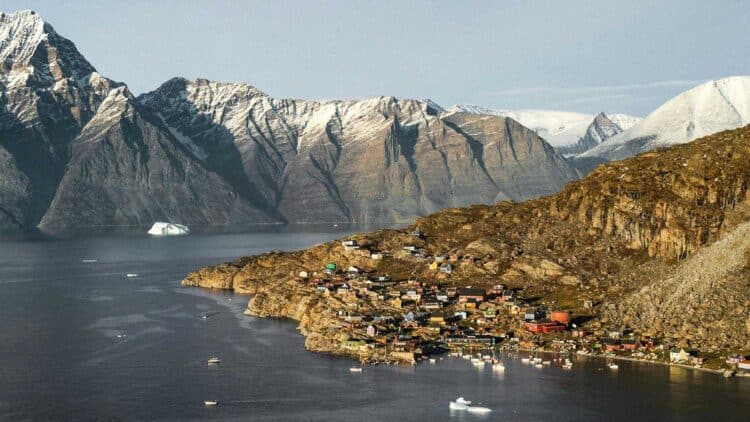
With a military threat looming large over Greenland, there are many questions about Denmark’s ability to protect its interests and/or if it relies solely on collective defense through NATO’s presence in the region. There is some disagreement between President Trump and Denmark regarding the role of NATO in protecting Denmark from the “spillover effects” of the most powerful country in the world, as a result of an attempt by President Trump to buy Greenland from Denmark.
The Danish government referred to the idea as “absurd”
When President Trump expressed his interest in purchasing Greenland from Denmark in 2019, the Danish government referred to the idea as “absurd.” Subsequently, many other European leaders voiced concerns regarding what they refer to as Trump’s aggressive language directed at Denmark and Greenland and the actions he has taken, as they believe he is violating one of NATO’s core principles of being respectful and supportive to fellow NATO countries.
Danish Prime Minister Mette Frederiksen said the current situation is “a critical juncture” for Denmark and the Western community, and that she was asking, “Why is the U.S. threatening a NATO member?”
“And if that happens,” Frederiksen added, “the very foundations of the alliance will collapse.”
Due to climate change and the melting of the Arctic Sea Ice, Greenland has evolved into a global battleground
As the Arctic Circle becomes a major hub for significant naval traffic and precious materials due to the increasing number of new shipping routes developing as the sea ice melts, the Arctic Circle is going to be increasingly important to the United States as well as other countries seeking access to these regions.
As previously noted, the United States has been operating the Thule Air Base in northern Greenland since the end of the Second World War. While Denmark believes that Trump’s comments about the expansion of U.S. control over Greenland are related to a much broader effort to strengthen Arctic security for the United States, Denmark has said that the U.S. will need to confront the consequences of unilaterally invading Greenland because such actions are illegal based upon the international law principle of the balance of power and Article 5 of the NATO Treaty.
Denmark has requested emergency consultations with the U.S. to try to lower tensions
Denmark’s Foreign Minister Lars Løkke Rasmussen confirmed that Copenhagen and Nuuk, Greenland’s capital, are engaged in talks with U.S. officials to reaffirm Denmark’s sovereignty over Greenland and to prevent further escalation of the situation.
Prime Minister Jens-Frederik Nielsen of Greenland echoed the sentiment of his Danish counterpart, stating that Greenland’s security is part of NATO and therefore should be addressed by all NATO partners, including the U.S. He, however, did not believe that a U.S. invasion of Greenland was imminent at present. Nielsen acknowledged the seriousness of Trump’s comments, but said that he had no reason to believe they were serious or that the U.S. intended to invade Greenland.
In addition to testing the unity and credibility of NATO, the Greenland crisis demonstrates the rising importance of the Arctic in global politics
The opening of new opportunities for economic development due to the melting of the polar ice cap increases the stakes for NATO’s ongoing role in the Arctic.
Mette Frederiksen’s reference to the conflict over Greenland as a “crucial moment” reflects the gravity of the dispute. Trump’s past threats to acquire Greenland via force have elevated what had previously been a longstanding territorial dispute into a wider test of NATO’s ability to maintain unity and to display solidarity with other Western countries.
Over the coming weeks, Copenhagen will continue to seek dialogue with Washington, while additional European leaders will likely continue to urge the U.S. to show restraint. If NATO can resist the pressure created by Trump’s aggressive rhetoric, Greenland may not become the dividing line between the transatlantic relationship as we know it today and a new transatlantic relationship.