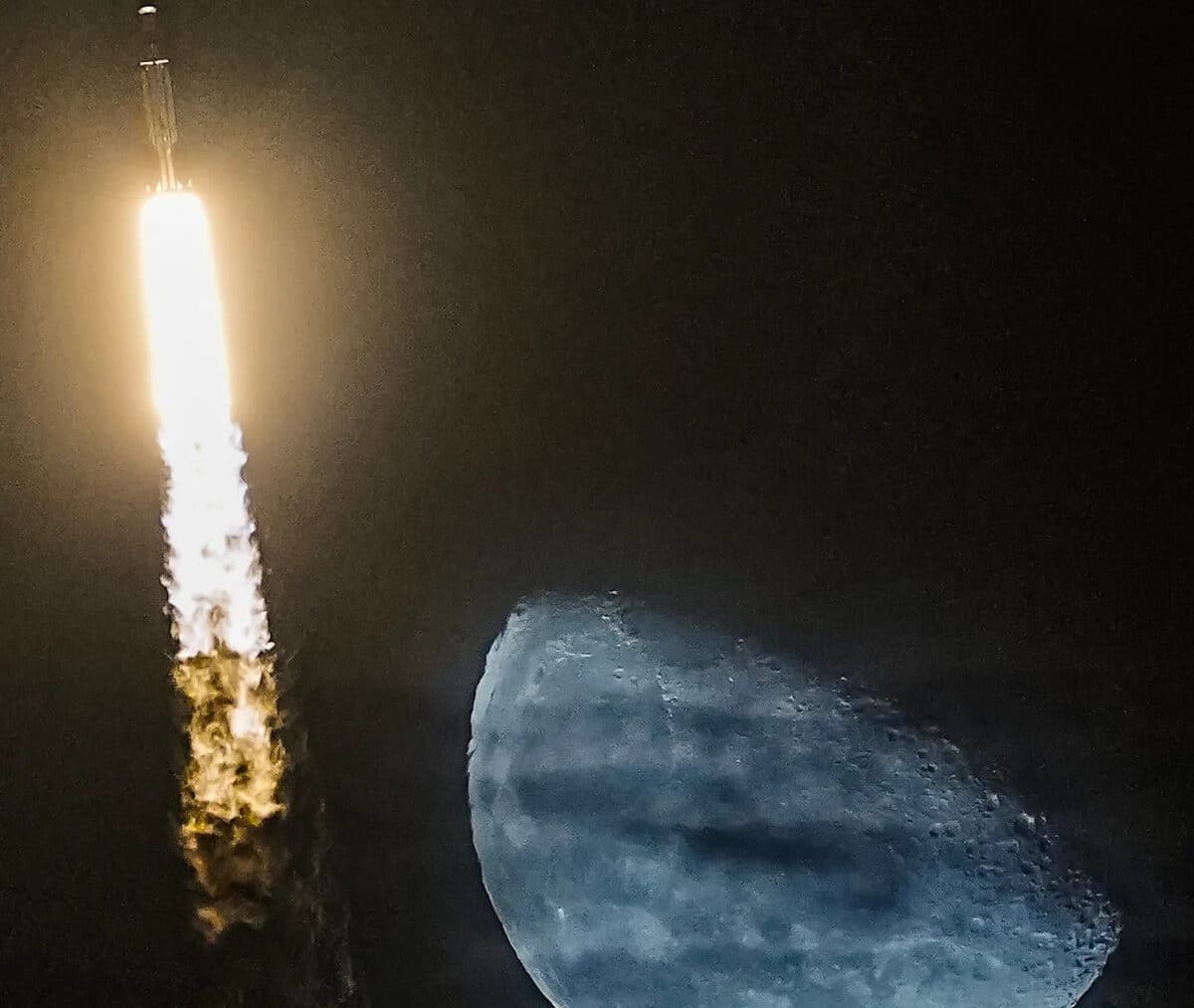
SpaceX launched a Falcon Heavy rocket on its first mission for the National Reconnaissance Office, carrying a classified payload designated NROL-97 into orbit from NASA’s Kennedy Space Center in Florida.
The late-night flight on October 1 marked the first time the spy satellite agency has flown its heavy-lift vehicle after more than two decades of relying on the smaller Falcon 9.
A new rocket for the spy agency
A SpaceX Falcon Heavy rocket launched from Florida Thursday night on a classified mission for the National Reconnaissance Office, America’s spy satellite agency.
Codenamed NROL-97, the mission blasted off from Launch Complex 39A at NASA’s Kennedy Space Center at 11:54 p.m. EDT (0354 UTC).
The NRO has previously flown payloads on 22 Falcon 9 rockets but this is the first time it has used the heavy-lift Falcon Heavy, which consists of three Falcon 9 boosters and an upper stage, topped by a payload fairing.
For the National Reconnaissance Office, which operates the nation’s spy satellite fleet, the launch breaks a long-standing streak of relying exclusively on the smaller Falcon 9 vehicle.
The Falcon 9’s payload limit to low Earth orbit sits at roughly 22,800 kilograms, while Falcon Heavy more than triples that capacity.
As with nearly all NRO launches, the agency has not disclosed what the satellite does or where it is headed. According to this Spaceflight Now report, the fact that a Falcon Heavy was the rocket of choice suggests that the payload that went up on Thursday night is quite heavy, and/or is headed for a relatively distant destination.
Part of a $13.7 billion contract
The flight was the first NRO mission to fly after being procured in 2025 through the competitive National Security Space Launch (NSSL) Phase 3 Lane 2 contract.
That framework is a $13.7 billion deal that formalizes SpaceX as a provider for the United States government’s national security payloads through fiscal year 2029.
Falcon Heavy itself is a familiar workhorse for high-priority government missions. The powerful rocket, which lifts off under the power of 27 Merlin 1D engines, was introduced to great fanfare in 2018 and made its 14th flight Thursday night.
Despite that history, this was its first outing for America’s reconnaissance satellite operator, a milestone that underscores how classified payloads are increasingly demanding more lift capacity than a single Falcon 9 core can provide. The scale of national security space work also echoes how data center operators have been racing to secure ground infrastructure, as seen in reporting on Texas’s data center boom.
Boosters set a recovery record
The mission also doubled as a quiet operational milestone for SpaceX’s reusability program. The Falcon Heavy core stage, serial number B1106, was brand new and was expended on this mission.
The rocket’s side boosters both flew just a month earlier to launch NASA’s Nancy Grace Roman Space Telescope, with B1104 making its second flight and B1072 its fourth.
Side boosters B1104 and B1072 landed at Landing Zones 1 and 2 at Cape Canaveral, both having last flown on August 30 for the Roman telescope launch, a 32-day gap that made NROL-97 the quickest turnaround between Falcon Heavy missions to date.
The NRO said the payload fairing was previously used on the NROL-95 mission in July. The two landings brought SpaceX’s single-day booster recovery total to four, a company first.
The NROL-97 launch rounded out an unusually busy 24-hour stretch for SpaceX. NROL-97 was SpaceX’s third Falcon launch of the day, following the Crew-13 astronaut mission to the International Space Station on Thursday morning and the 130-satellite Transporter-18 rideshare flight that afternoon, with both of those earlier missions flying on Falcon 9 rockets.
Why the shift to Falcon Heavy matters
The move to a larger rocket signals that the intelligence community’s satellites are growing heavier or need orbits that smaller vehicles cannot efficiently reach, a trend that mirrors how commercial satellite operators have been scaling up constellations, including Google’s own orbital computing experiment detailed in coverage of Project Suncatcher’s chips in orbit.
With the Phase 3 Lane 2 contract now active, industry watchers expect more national security payloads to migrate toward Falcon Heavy and competing heavy-lift vehicles over the coming years as the government diversifies its launch providers while expanding satellite capability in orbit.
