Every weekday, the buses are back in the depot by mid-afternoon, batteries fully charged, doing nothing.
Summer arrives, school ends, and the buses stop moving entirely for weeks.
That is exactly when the grid needs power most.
A parked school bus is becoming a power plant. How does it actually put electricity back onto the grid, and why does the timing matter so much?
Why a school bus battery is worth more to the grid when the bus is doing nothing
Vehicle-to-grid technology, or V2G, allows a bidirectional charger to reverse the flow of current. Instead of drawing power from the grid to fill a battery, the system pushes stored energy back out onto the distribution network when a utility calls for it. The charger acts as a two-way valve, controlled by software that reads grid conditions in near real time.
School buses fit that model almost perfectly. They operate on predictable schedules and carry large battery packs, large-frame electric buses typically carry well over 100 kilowatt-hours of usable capacity. That predictability is what fleet software needs to make reliable commitments to grid operators.
A peaker gas plant fills the same seasonal role, but it burns fuel and takes minutes to spin up. A bus battery responds in milliseconds.
What an Oakland depot with 74 buses is already feeding into California’s grid
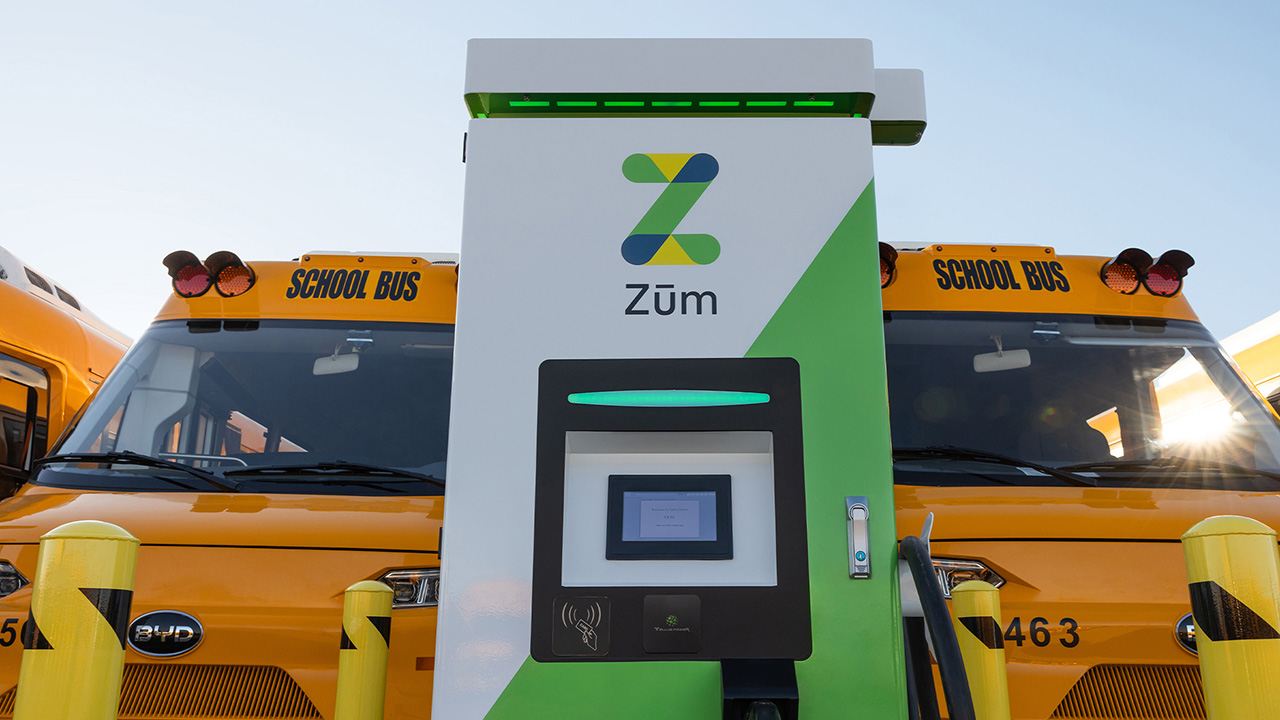
The most concrete proof of the shift is already running in northern California. Oakland Unified School District operates what the World Resources Institute’s Electric School Bus Initiative identifies as the largest V2G school bus deployment in the country, with 74 buses designed to return up to an estimated 2.1 gigawatt-hours to California’s grid each year, managed through fleet operator Zum. That is roughly the annual electricity use of around 200 typical US homes, returned not from a power station but from a school parking lot.
Some of the earliest V2G fleets in California generate revenue through demand-response programs such as the California Public Utilities Commission’s Emergency Load Reduction Program, a pilot that pays for electricity supply pushed back to the grid to avoid summer outages. The structure matters: the school district earns money for what was previously idle battery capacity.
A McKinsey analysis projects that heavy-duty vehicles, including school buses, in Southern California Edison’s service area have the potential to generate $7,000 to $12,000 in annual revenue per vehicle across V2X use cases. Analysts have noted that V2G income can meaningfully shorten the payback period on a large standard-frame bus. Multiply that across even a modest fleet and the math starts working.
The federal program that has placed approximately 8,700 electric buses across nearly all 50 states
What changed the scale of this story is a federal funding stream. The EPA Clean School Bus Program has funded approximately 8,700 school bus replacements, roughly 95 percent of which are zero-emission battery-electric, across nearly all 50 states and Washington D.C., creating a large latent potential V2G resource. Those buses were purchased primarily to cut diesel exhaust near children, but each one carries a battery that can, with the right bidirectional charger and software, feed power back to the local distribution grid.
The gap between what exists and what is actively doing V2G work is still large. Around 230 buses run in fully deployed V2G projects against a national fleet of roughly 500,000. But bidirectional capability is increasingly written into procurement specs rather than bolted on after the fact.
Manufacturers are moving toward production-level V2G commitments on major school bus platforms, a signal the market has crossed a threshold rather than remained in one-off pilot territory. For context on how utilities are building tools to absorb this new kind of load, see GCN’s coverage of the DOE-supported EV load forecasting guide setting 20 best practices for grid planners.
Where the economics break down and which districts are being left behind
The revenue picture is not uniform. A bus depot in a grid territory with robust demand-response markets, California, PJM in the mid-Atlantic, parts of New England, can access the ancillary-services payments that make V2G pencil out. A district in a region with flat, regulated rates and no real-time market faces a far thinner revenue case.
Charger costs are the other stubborn barrier. A standard Level 2 charger might cost a few thousand dollars per port. A bidirectional charger capable of feeding power back to the grid currently runs significantly higher, and the gap narrows slowly.
Districts that received EPA grants for the buses themselves often did not receive enough to cover bidirectional-capable infrastructure. Some utilities have not yet filed the tariff structures that would allow them to compensate a school district for power pushed back onto the distribution system. This mirrors the broader challenge that active managed charging programs are working to resolve at the residential scale.
What has to happen before idle school buses become a reliable grid resource at scale
Turning the opportunity into a reliable national grid resource requires three things to move in parallel: standardized bidirectional hardware, utility tariffs that actually compensate fleet operators, and software platforms that can aggregate hundreds of buses into a single dispatchable block.
A fully electrified large district fleet aggregated as a virtual power plant could, in principle, rival a small peaker plant in dispatchable capacity, one that costs the grid operator nothing to fuel and is already paid for by education budgets. The aggregation piece is closing fast.
Worldwide, the V2G market is forecast to grow substantially over the next decade. School buses represent the most structurally predictable share of it: fixed routes, fixed schedules, and a built-in reason to be parked exactly when summer heat pushes the grid to its limits.
