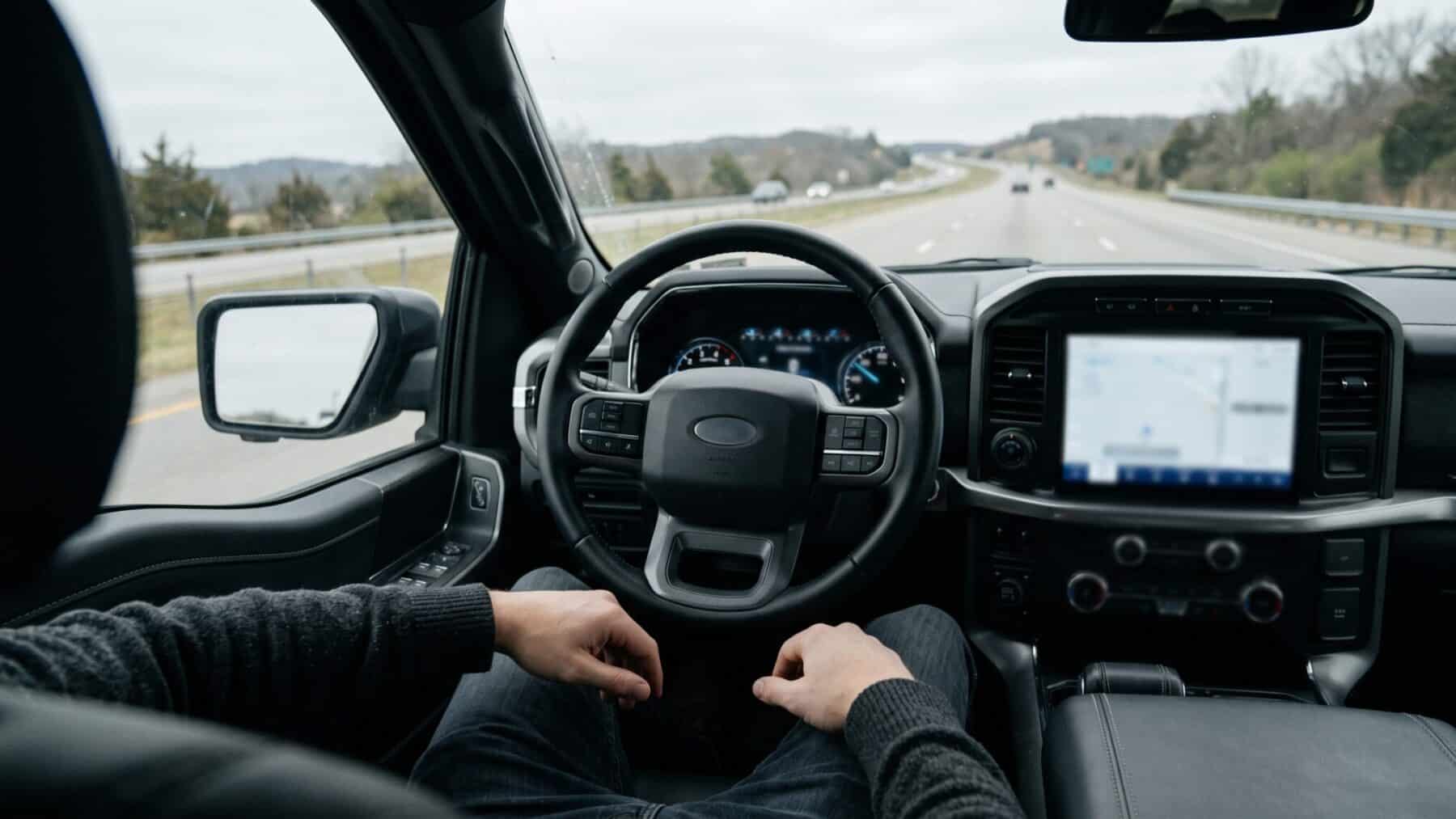
The ad makes it look simple: drop your hands, let the truck steer itself, relax across five hundred miles of open interstate.
Millions of buyers have already said yes. The feature is installed in roughly 1.2 million vehicles worldwide. But a 90-day clock is running from the moment the dealer hands over the keys. And somewhere on the map, there is a point where the system simply switches off.
Why the system stops working the second you leave the approved zone
BlueCruise handles steering, acceleration, and braking on compatible highways, relying on cameras, radar, and GPS to keep the vehicle centered in its lane. That last word is the one that matters: compatible. The system does not read the road in real time the way a human does.
Instead, it cross-checks the vehicle’s GPS position against a library of roads that engineers have already driven, measured, and approved in advance. BlueCruise only operates on pre-qualified sections of divided highways covering 130,000 pre-mapped miles across North America, what Ford calls Hands-Free Blue Zones. The moment a route dips onto a road outside that pre-cleared library, the system disengages and hands full control back to the driver with nothing but a chime.
Weather tightens the window further. Heavy rain, snow, or fog can degrade the forward-facing cameras enough to disable the feature entirely, narrowing usable miles well below what the brochure implies.
What the feature actually looks like on the vehicles it ships in
BlueCruise is available on the Ford F-150, F-150 Lightning, Mustang Mach-E, Explorer, and Expedition. It is also available on an assortment of Lincolns, including the Navigator, where the same technology is sold as Lincoln BlueCruise. That is a wide footprint, spanning everything from family three-rows to the best-selling full-size pickup in the country.
But the experience is not unlimited. BlueCruise is a Level 2 driver-assistance system, which means the driver must keep their eyes on the road and be ready to take over at any moment. Hands can leave the wheel; attention cannot.
That distinction matters enormously for liability. Ford advertises BlueCruise as a feature designed to make driving “less stressful and more enjoyable,” yet the legal and practical burden of attention never leaves the driver’s seat. The name implies freedom that the engineering cannot yet deliver.
The subscription bill that most buyers never factored into the price
Vehicles compatible with BlueCruise come with a 90-day complimentary trial for customers who do not select a one-year plan at order. After that clock runs out, the system goes dark unless the owner pays. This is the moment many buyers discover the feature they assumed they had purchased is actually a service they must rent.
The ongoing fee is $495 a year, or $49.99 a month, effective October 2024. Customers can also spend $2,495 to get BlueCruise for a minimum of seven years. The monthly price was previously $75 and the annual cost was $800. Even so, the recurring charge still catches owners off-guard.
The monthly plan can be canceled at any time, so a driver could activate it for a single long vacation and then cancel. BlueCruise plans are non-transferable, meaning a future used-car owner of that same vehicle would need to purchase their own plan. The fine print on the one-time purchase option states BlueCruise will only be active for a minimum of seven years, after which Ford could update its terms. Meanwhile, a used-car market already under affordability pressure means buyers stretching budgets on a new truck are the least positioned to absorb a surprise recurring charge.
Where the safety record complicates the freedom pitch
The subscription cost is an inconvenience. The safety record is a deeper problem. NHTSA opened a probe into BlueCruise after two fatal crashes involving BlueCruise-equipped Mustang Mach-E vehicles. The agency initially opened its investigation in April 2024. The vehicles struck stationary objects at highway speeds in San Antonio and Philadelphia, killing three people in total.
NHTSA found that “system limitations relating to the detection of stationary vehicles while traveling at highway speeds and in nighttime lighting conditions appear to be factors in collisions under investigation.” The NTSB criticized Ford’s BlueCruise system for failing to ensure that drivers were attentive, and said Ford’s driver monitoring system does not effectively address driver distraction and disengagement. That is precisely the scenario where the gap between hands-free and self-driving becomes most dangerous. A driver who has relaxed into the feature may not react quickly enough when the system fails to.
For buyers still comparing options, reliability data from real-world infrastructure increasingly shapes how much trust drivers place in any automated system on the road.
What the road ahead looks like for drivers already invested
None of this means the feature is useless. On the right road, on a clear day, BlueCruise genuinely reduces fatigue on long interstate stretches. Ford’s own data shows customers have logged more than half a billion hands-free miles of highway travel to date, a substantial and growing real-world record.
The smarter path forward is knowing what you are buying before the trial expires. The monthly plan can be canceled at any time, so a driver could activate it for a single long vacation and then cancel. Since its initial release, BlueCruise has significantly improved its capabilities, with the latest version featuring improved performance in narrow lanes and curves. Software updates have already expanded mapped coverage and reduced the disengagements that frustrated early users. The honest expectation, though, is an evolving product rather than a finished one, and an annual bill that will follow you as long as you drive it.
