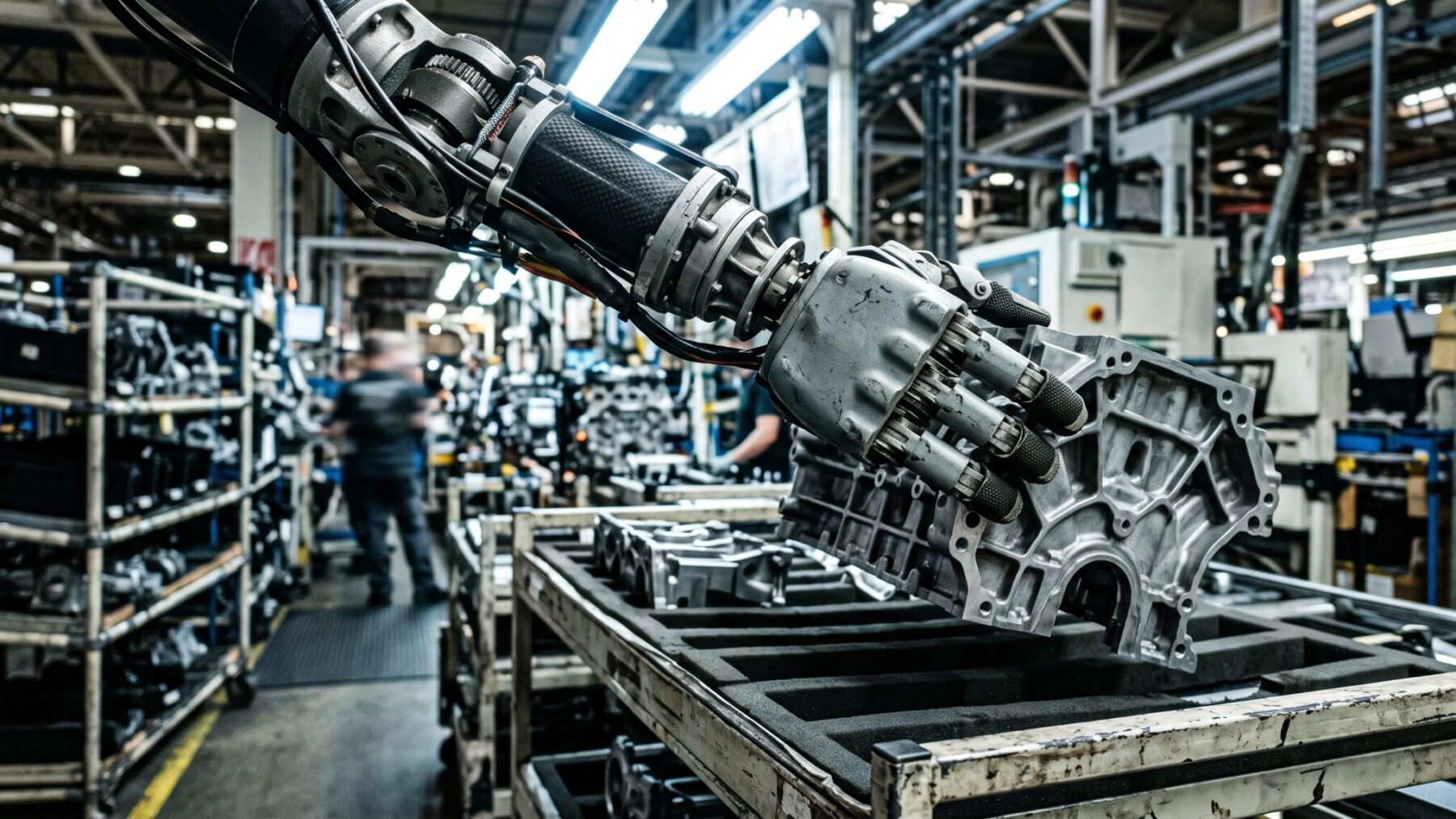
The parts arrive in a large bin, completely unsorted.
A humanoid robot reaches in, identifies each component, and places it into a trolley in precisely the order the assembly line needs it. No human hands touch the parts during that step. This is not a laboratory demo, it is happening on a live factory floor in South Carolina, and the robot doing it was shaped by 11 months of real production data.
How a palm camera and tactile fingertips let a robot feel what it cannot fully see
The hardest part of robotic manipulation has never been moving an arm. It has been knowing what the fingers are touching. Traditional factory robots work with pre-positioned parts on fixed jigs, so they never need to feel anything. A humanoid reaching into a bin of loose, unsorted components faces a completely different problem.
It must identify the object, estimate its orientation, plan a safe grip, and adjust in real time if that grip starts to slip. The new robot handles this through redesigned hands equipped with tactile sensors and integrated palm cameras, enabling greater dexterity, improved object recognition, and more precise manipulation of production parts. Palm-mounted cameras give it a close-up view of the object just before the fingers close, feeding a vision model that estimates shape and surface. Tactile sensors installed in the fingertips allow the robot to detect forces as light as three grams of pressure, roughly the weight of a paperclip, while the robot’s fingers are softer to allow a more stable grasp of objects of varied shapes and sizes.
That feedback loop, see, close, feel, correct, is what makes bin-picking of loose automotive components possible without a dedicated feeding system.
Figure 03 also adds wireless charging, upgraded speech-to-speech audio, and soft safety components over its predecessor. Wireless charging lets the robot top up during natural pauses in the workflow rather than going offline for a fixed charge cycle. The upgraded audio system lets a line worker give a verbal instruction without touching a screen. Both features were absent from the predecessor and introduced as part of a set of new capabilities designed for expanded applications.
What the previous robot was actually doing on the Spartanburg production floor
The South Carolina plant builds BMW X-series and sports models for global markets, making it one of the highest-volume, highest-value automotive plants in the United States. In 2025, BMW gained important experience with humanoid robotics at Plant Spartanburg: in collaboration with Figure AI, the Figure 02 robot supported the production of more than 30,000 BMW X3 vehicles, handling the precise removal and positioning of sheet-metal parts for the welding process, a task that demands high speed and accuracy.
Two humanoid robots completed an 11-month pilot project at the plant, running 10-hour shifts Monday through Friday and accumulating 1,250 hours of run-time, loading more than 90,000 parts and contributing to the production of more than 30,000 vehicles. That figure matters because it is not a controlled trial or a simulation benchmark. It is a production count on a commercial vehicle program, run under real shift conditions and real time pressure.
Following the release of Figure 03, Figure AI officially retired Figure 02, and with its return to headquarters from BMW, the company identified key learnings to roll into Figure 03’s operational readiness. Those lessons fed directly into the redesign: the successor carries rebuilt hands and improved manipulation systems, not as theoretical improvements, but as fixes for documented production findings.
The sequencing task and why it is harder to automate than welding
Welding insertion is repetitive and positionally predictable. Logistics sequencing is neither. Components initially arrive in larger containers, unsorted. Figure 03 picks them up and sorts them into a sequencing trolley, which is then taken to a defined collection point for onward transport. The robot pulls the build sequence from the plant’s production management system in real time.
A mis-sequenced trolley does not just slow one worker, it can stop a moving assembly line, which costs tens of thousands of dollars per minute at full rate. That is why sequencing was done by hand until now.
This is also why the physical AI infrastructure running these robots matters as much as the hardware. BMW confirmed the collaboration demonstrated that humanoid robots can safely perform precise, repeatable work steps under real production conditions. On a factory floor, latency is measured in milliseconds, so the robot’s vision model, grip planner, and production-schedule connection all have to operate without a cloud round-trip.
Where the soft body and the safety shell change what the robot can work next to
Soft safety components on the new model are not cosmetic. Traditional industrial robots operate inside metal cages because a rigid arm moving at speed will seriously injure anyone it strikes. A humanoid designed to work beside people on an open floor has to absorb accidental contact without transferring that force to a human body.
The soft exterior components improve workplace safety, wireless charging maximizes operational uptime, and the upgraded speech-to-speech audio system enables more natural interaction with workers. The soft outer shell distributes impact energy across a larger surface area and gives the collision-detection system a fraction of a second more time to halt motion. Combined with sensors that detect a human in the robot’s path, that physical property allows it to share an open logistics hall with workers. For manufacturers choosing between shared and separated workspaces, shell compliance is often the deciding technical factor.
Automotive parts in a sequencing trolley are often finished surfaces, painted panels, trim pieces, parts with tight cosmetic tolerances. The tactile feedback loop and compliant fingertip material keep grip force within a safe range for the part and for the worker nearby. That dual requirement is the design constraint that makes humanoid hands genuinely different from conventional robotic end-effectors.
What 11 months of real production data means for the next wave of factory deployments
The significance of the Spartanburg record is not the vehicle count alone. It is that the data is public, detailed, and attached to a named production program. Every competing plant evaluating a humanoid pilot now has a real baseline, not a vendor’s simulation.
Brett Adcock, founder and CEO of Figure AI, stated that the 11-month deployment of Figure 02 “proved that humanoids are no longer lab experiments, they can be a valuable asset in establishing a flexible, reliable manufacturing workforce.” Ulrich Wieland, vice president of production control and logistics at BMW Manufacturing, described Spartanburg as “the birthplace of humanoid robotics in BMW Manufacturing’s operational day-to-day activities,” and confirmed the plant is moving forward with Figure 03 for a sequencing use case in logistics.
Analyst projections suggest humanoid robots could begin addressing a meaningful share of manufacturing labor demand before the end of this decade, a modest start, but one representing large numbers of positions in automotive, electronics, and logistics alone.
For readers tracking the broader hardware market behind physical AI, the lesson from Spartanburg is that the bottleneck is not compute or software. It is the mechanical reliability of hands and wrists under real stress. The documented learnings from the first deployment, and the redesign that followed, are a more honest account of where humanoid robotics actually stands than any keynote demo. The next phase of production data, on a harder task, will tell the industry far more.
