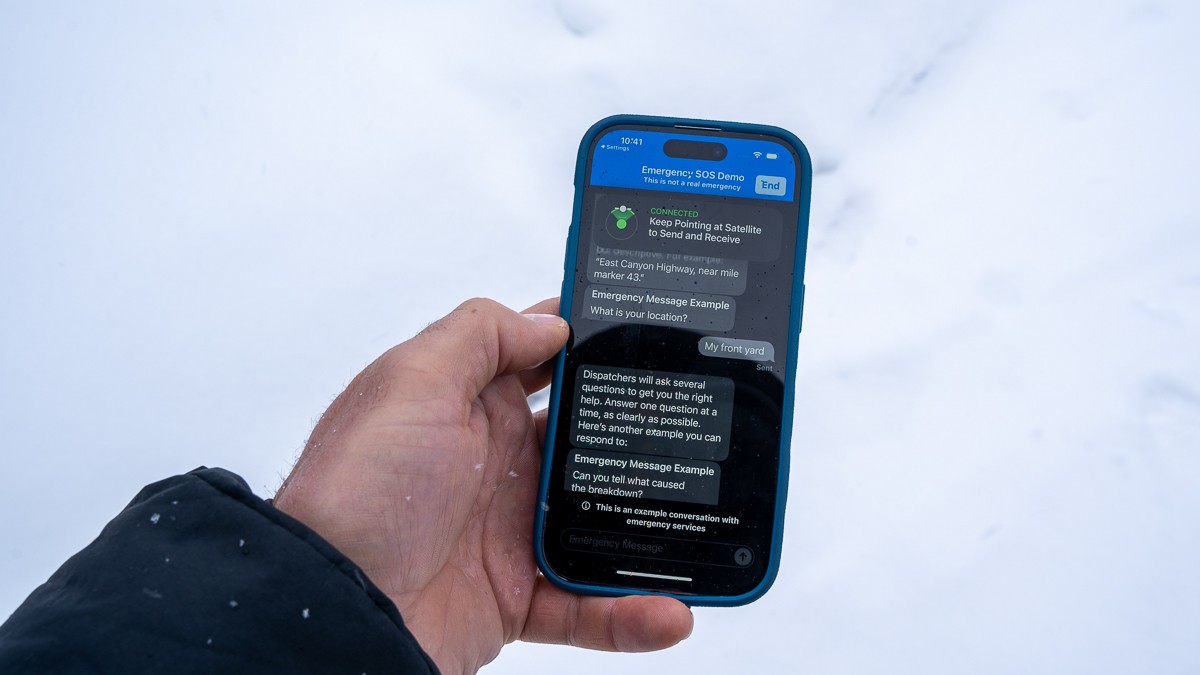
A bar of signal appears on the screen, but there is no cell tower for miles.
The icon is different: a small satellite arc, not the usual carrier stack.
The phone connects anyway, bouncing a message off hardware orbiting hundreds of miles overhead. Hundreds of millions of iPhone owners carry this capability without fully knowing it is there.
Almost none of them have read the paragraph that explains what happens when the clock runs out.
Why the phone has to reach that far, and what limits it when it does
The satellite service connects directly to overhead satellites when cellular or Wi-Fi coverage fails, using a commercial satellite network. Those satellites sit in low Earth orbit, and the service lets users reach emergency services, share their location, or send messages when they have no cellular or Wi-Fi signal.
But miniaturization comes with a hard physical constraint: visibility. Without a clear view of the sky the phone will not connect, meaning dense forests, mountains, urban canyons and obstructions can all cut the link. The feature designed to save you in a crisis demands you step outside, stand still and point the phone at an unobstructed patch of open sky.
Multimedia messaging and group texts are not available, and sending a message runs slower depending on satellite position. To overcome bandwidth limitations, the service is limited to text messaging. Apple developed a custom protocol that compresses messages while keeping them end-to-end encrypted, and a single message can be delivered in seconds under optimal conditions but could take well over a minute under foliage. That throughput ceiling is a fundamental physical constraint the current generation of hardware cannot clear.
The feature most buyers never examined before they left the store
Apple has extended free access to satellite features for an additional year for existing iPhone 14, iPhone 15, and iPhone 16 users, applying to devices activated in a supported country prior to midnight Pacific Time on September 9. The satellite-enabled Emergency SOS and messaging services originally debuted with a two-year free trial when the iPhone 14 launched in 2022.
That original expiration date came and went. For iPhone 14 models, free access has now been extended at least three times, the trial was originally set to run for two years from the phone’s launch, before Apple pushed the expiration date back in 2025 and again this year. The two-year trial window was in the fine print, but it was not the part of the keynote that audiences remembered.
Apple’s satellite features include Emergency SOS via satellite, Messages via satellite, Find My via satellite, and Roadside Assistance via satellite, with availability varying by country. Each was presented at launch as a permanent capability of the phone.
This pattern is not unique to satellite features. A $2,599 robot vacuum drew similar criticism for advertising headline capabilities that dissolved on contact with real-world conditions. Even smart rings priced from $349 have attracted attention for locking core health analysis behind recurring fees that only become visible after purchase. The dynamic is consistent: hardware sells the feature, and a subscription quietly waits on the other side of the trial.
The infrastructure bet that explains where this is almost certainly going
Apple committed approximately $1.5 billion to Globalstar, a combination of prepayments for satellite services and a 20 percent equity stake in a Globalstar subsidiary, in exchange for the right to most of its network capacity. Amazon’s Leo satellite network will power existing iPhone and Apple Watch satellite features going forward, and Apple has secured a partnership with a better-established satellite operator, with the two companies set to work together on future satellite services running on Amazon’s expanded Leo network. A company does not commit that kind of capital, then negotiate a successor infrastructure deal, around a feature it intends to give away forever.
T-Mobile officially launched its Starlink-powered T-Satellite service in July 2025, using over 650 Starlink satellites to allow users to send text messages when out of range of a cellular or Wi-Fi connection. T-Satellite is free for Beyond 5G and Go5G customers, while T-Mobile users on other plans can add it for $10 per month. That pricing is the clearest market signal yet of what a paid tier might look like. A dedicated subscription lane for routine satellite messaging, separate from the emergency SOS function that would be hardest to charge for, is the shape most analysts expect.
Apple has not confirmed what, if anything, it plans to charge for the features once free access eventually ends. No announced price means no way for a buyer today to budget for what they will owe tomorrow.
Where the free extension runs out and what devices are next in line
The extension applies to devices activated in a supported country prior to midnight Pacific Time on September 9. Depending on when you bought your iPhone, you could receive up to five years of free satellite service. Buy a newer device over the next twelve months and a satellite bill does not arrive until nearly 2029.
The newly launched Apple Watch Ultra 3 adds satellite messaging to wearables, with Emergency SOS, Find My, and Messages via satellite included for free for two years after activation. The trial-clock model is now spreading to a second product category. Every new device that ships with satellite capability carries the same embedded expiration, and the population of users approaching their own deadline grows with each product cycle.
Satellite communication also drains batteries quickly. Reaching a satellite at orbital altitude pulls significantly more power than connecting to a cell tower three blocks away, and that drain matters most precisely when a user is off-grid and cannot plug in to recharge.
What a fair outcome looks like, and what is still genuinely unresolved
The case for optimism is real. Emergency SOS is the feature hardest to put behind a paywall without a serious public reaction, and Apple knows it. Three extensions in a row for iPhone 14 users could simply mean the business model is not ready yet, not that a large bill is coming.
The structural reality still favors a paid tier, most likely one that splits routine messaging from true emergency functions. That is probably where any future pricing lands: survival stays free, convenience does not.
For now, the most useful thing any iPhone owner can do is find the satellite section in settings, run the built-in demo, and learn how the feature works before a moment of genuine need. The sky-view limit and the no-multimedia restriction both take practice to work around. Understanding that the free period is a trial, however generously extended, is simply accurate. The feature is real, the catch is real, and the price is still a number nobody has been told.
