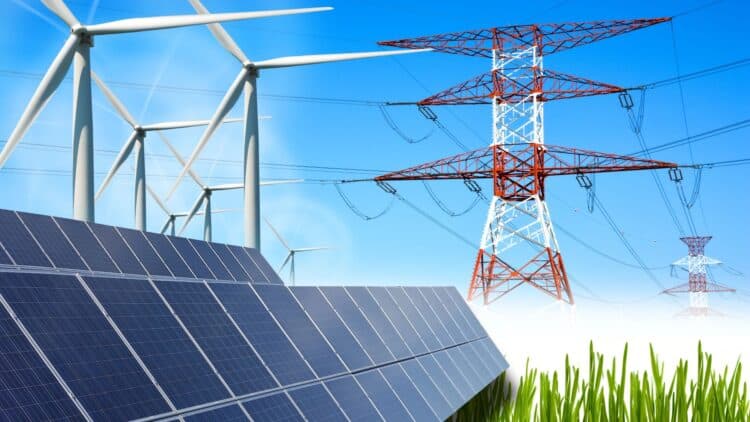
The International Energy Agency has projections whose impacts will be realized in the years to come. Soon, before 2026, there will be an era where renewable forms of energy will surpass the use of coal as the major source of electricity generation in the world. It is expected that the growth in the use of electricity will continue to register over 3%, especially in the wake of industrialization, data centers, electric cars, and cooling.
Wind and solar drive unprecedented renewable energy expansion
The key addition that the sector is experiencing is due to the rapid addition of installations of both solar and wind, breaking the 4,000 terawatt-hours (TWh) mark for the first time in 2024. Renewable sources of energy are set to cross 6,000 TWh in cumulative installations by the year 2026, contributing almost 20% of total generation, thereby reaching a near 1% market share established in 2005.
Notwithstanding the challenges faced by wind and solar energy from various politicians globally, these sources are steadily progressing towards dominating the energy market. A report by the IEA reveals that renewable sources are expected to meet over 90% of the overall energy demand by 2026, changing the energy market scenario. This takes place when the growth in electricity demand is recorded at its highest level in the last decade.
Key renewable energy milestones include:
- Wind and solar reaching 6,000 TWh by 2026
- Renewables comprise 36% of global power generation
- Meeting 90% of new electricity demand growth
- Surpassing coal as the world’s top power source
Overtaking coal as the leading energy source globally
The use of coal for the generation of electricity experiences the sharpest fall ever, with the role of coal in total consumption of electricity predicted to drop to 32% by the year 2026. This will be the lowest contribution of coal to total consumption of energy in more than one hundred and fifty years, thus bringing to an end the use that began with the era of the Industrial Revolution.
The decline is primarily due to the sharp decline in the consumption in China and the European Union, although this can be partly offset due to the decline in the United States, India, and Asia. The initiatives taken for the shift in the use of renewables have already resulted in the share of coal falling to record levels in China, whereas aggressively cutting back the use of fossil fuels in the generation of power continues at a very fast pace in Europe.
Electricity demand surge challenges grid infrastructure and market design
The use of electricity is projected to continue its growth at a fast pace, with growth of 3.3% expected in 2025 and 3.7% expected for 2026, which is much higher than the average growth for 2015 to 2023 of 2.6%. According to Keisuke Sadamori, director of Energy Markets and Security at the IEA, “Such high growth should be accompanied by increased investment to achieve safe and efficient energy supply to any region around the world.’
Emerging Asia’s economies, especially China and India, are projected to represent 60% of the growth in world electricity use over the coming two years. The United States is also under special pressure because of its growing number of data centers and is projected to retain growth rates of more than 2% each year until 2026. For the European Union, growth is projected to remain at 1% or slower but is expected to quicken in 2026 as economic fundamentals improve.
The changing scenario in the global electric market is unlocking opportunities as well as posing challenges for the global community. The falling costs and investment in renewables are causing intermittency, which in turn is becoming a challenge that would necessitate the usage of efficient management systems and storage capacities for harnessing solar and wind energy. The carbon dioxide emissions from the electric power industry are expected to peak in 2025 and decline in 2026.