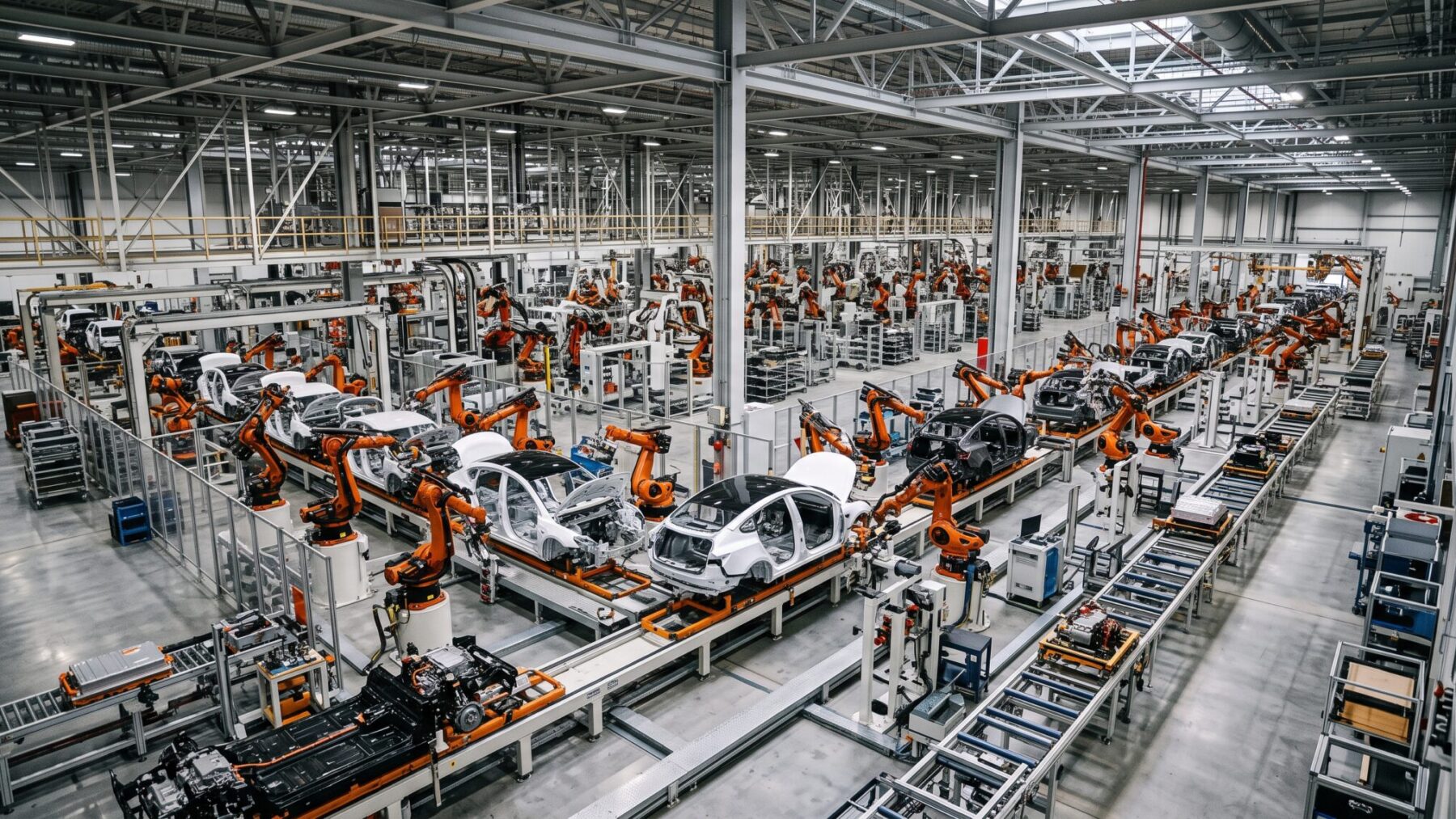
Steel columns rise from a flat Illinois plain, assembled from prefabricated sections, while finished electric trucks roll through the building next door.
The body shop is still wet with fresh primer. Just past a temporary partition wall, workers are loading an R1T onto a carrier bound for a customer in Denver.
This is what building inside a live factory actually looks like.
The workforce and supply chain are already in place. So how do you wire, weld and commission an entirely new production line without stopping the one already running?
How a factory grows around itself without ever going dark
Rivian did not pause its Normal, Illinois plant. Instead, it bolted a new manufacturing campus onto the east side of the existing 4.3 million square foot building while R1 SUVs, R1T pickups and commercial delivery vans continued down the line inside. The expansion added a 1.1 million square foot building on the east side of the existing plant, plus new space for paint, battery, and material flow.
A new 1.2 million square foot supplier park and logistics building sits across Rivian Motorway to the west, connected to the main plant by a tunnel underneath the roadway to cut down on the time it takes to transport parts. Battery and drive unit areas were reconfigured in parallel, and new buildings dedicated to battery pack assembly and painting rose alongside them. Each zone was designed to hand off to the next without a seam the line could trip over.
The underground tunnel connecting the supplier park to the main production facility avoids congestion on local roads and ensures uninterrupted logistics , cutting the risk of a traffic jam on public roads snarling both lines at once.
What 2.6 million square feet of new factory actually looks like on the ground
Construction took only 11 months, a staggering pace that required creative problem-solving, thousands of workers and a $1.5 billion investment, and even came in under budget. Industry veterans routinely plan 18 to 24 months for an expansion of comparable size, so the pace alone turned heads across the manufacturing world.
Removing all parts painting from the main paint shop and moving it to the new dedicated Parts PTED facility sounds like a small tweak, but it eliminated the bottleneck that had forced body painting to share booth time with smaller components. That freed capacity fed directly into the new line’s throughput. Rivian chose Normal to launch the R2 by leveraging its experienced workforce and established infrastructure, a far faster path to quality than seeding a greenfield site from scratch.
The geographic logic is hard to argue with. Trained crews and established infrastructure are worth more than a blank plot of land.
The evidence that the gamble paid off, and where the numbers come from
The first R2s, test models called manufacturing validation build vehicles, drove off the line in January 2026, with the first customer deliveries expected by June. That timeline was reported by WGLT, the Illinois public radio station whose reporters have covered the build throughout. Rivian will increase initial capacity at its Georgia plant to 300,000 vehicles annually, a 50 percent jump from prior plans.
Rivian also designed the R2 to be significantly cheaper to build than its R1S and R1T vehicles, with that cost discipline engineered into the production process from the start. That is part of why the expansion came in under its own budget.
WGLT reported that the pace represented a remarkable achievement for a startup still working toward consistent profitability.
Where the approach hits its limits, and what the Illinois model cannot solve alone
Building fast inside a live plant works when product families share enough of the same footprint logic, and the R2 is smaller and lighter than the R1. Threading two distinct assembly flows through adjacent buildings required real design compromises. Connecting the new NN2 building to the original plant required a series of above-ground enclosed bridges, resembling jet bridges scaled up for manufacturing, which had to be bent to pass beneath Ameren power lines running across the property.
The expansion lifts total Illinois capacity to 215,000 vehicles annually , generous by startup standards but well short of what Rivian’s long-term projections require. Illinois is the proof-of-concept run; Georgia, where Rivian broke ground late last year, is expected to start making vehicles by the end of 2028, with Normal continuing to build R2 SUVs until then, and the two sites will run simultaneously rather than sequentially.
You can read more about how the commercial vehicle manufacturing push is spreading across North America, with a second major plant groundbreaking planned before the end of this year.
What the Illinois model means for the next wave of American EV factories
The 11-month build is already being studied as a template for fast-track plant launches by manufacturers watching from the sidelines. The core lesson is counterintuitive: adding to a live factory can be cheaper and faster than waiting for a clean greenfield site, when the workforce and supply chain are already proven. Rivian renegotiated its federal construction loan, with the Department of Energy agreeing to reduce a previously awarded $6.57 billion loan down to $4.5 billion , while the revised plan compresses what was originally a two-phase, 400,000-unit build-out into a single, larger first phase with 300,000 vehicles of annual capacity at the Georgia plant.
For comparison, the reshoring wave bringing Lincoln production back to US plants by the end of the decade is being planned with exactly this kind of phased, campus-building logic.
The open question is whether the speed and cost discipline Normal demonstrated can survive the jump to a much larger greenfield site where there is no experienced workforce on campus. That is the test the next few years will run, and the Illinois result is the only benchmark it has to beat.
