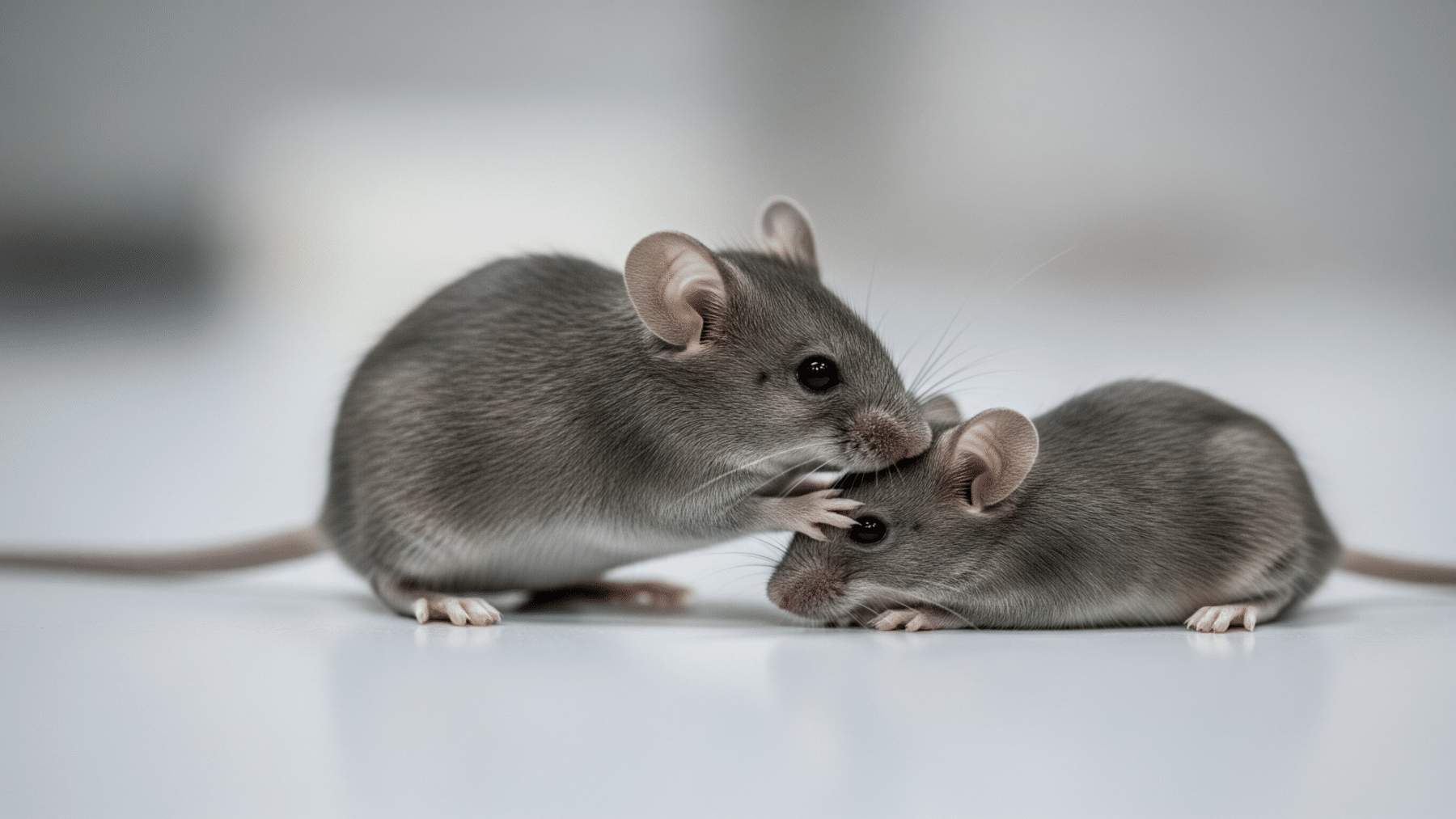
There is an animal living in the walls of almost every building in America, and most people spend considerable energy trying to get rid of it.
It turns out they may want to reconsider.
Neuroscientists recently watched this creature do something so precise and deliberate that researchers had to run the tests multiple times before they believed what they were seeing.
The unremarkable creature that science keeps underestimating
The house mouse is about as familiar as an animal gets.
It shows up in children’s cartoons, school science fairs, and unwanted in kitchen cupboards across the country.
For decades, researchers have used mice in laboratories to study basic biology and reflex behavior, generally treating them as simple, reactive creatures running on biological autopilot.
That picture just got a great deal more complicated.
Scientists have known for a while that some animals display surprising social bonds.
A study on minimal social interactions that examined more than 60,000 people across two cultures found that even a brief greeting measurably lifts life satisfaction, and it turns out that pull toward connection may run deeper in the animal kingdom than anyone expected.
What the researchers set up in the laboratory
The team at the Keck School of Medicine of the University of Southern California designed a controlled experiment with cage-housed mice.
Some mice were rendered temporarily unconscious using an anesthetic.
Researchers then watched what the conscious cage-mates did next, using careful observation across repeated trials.
Nobody prompted the mice.
Nobody trained them.
The conscious animals had never encountered this situation before.
What happened next was almost impossible to explain away
The mice opened their unconscious cage-mates’ mouths and pulled at their tongues, an action that, when small objects had been placed in the sedated mouse’s mouth, dislodged them in roughly eight out of ten trials.
That is, in plain terms, clearing an airway.
Mice were more likely to perform this behavior if the unconscious mouse was familiar to them.
The mice that received this attention tended to wake up and move around more quickly than a control group left alone.
The gap in recovery time was not subtle.
It was consistent enough that the team could measure it reliably across trials.
Two-thirds of everything we do each day is said to run on invisible autopilot, and the science of unconscious behavior has always assumed that complex, targeted helping was far above the cognitive pay grade of a rodent.
The detail that stopped the neuroscientists cold, mice performing first aid
Here is where the finding becomes almost unbelievable.
The mice were young adults who had never witnessed unconscious mice being tended to by other mice, making it impossible for the behavior to have been learned.
The neuroscientists at the University of Southern California concluded that the behavior was most likely instinctive, rather than learned.
That single detail rewrites a standard assumption.
If the behavior is instinctive, it means the capacity to recognize a companion’s distress and act on it in a physically targeted way is built into the biology of a creature most people consider vermin.
Co-author Huizhong Whit Tao said it was “the first time that we’ve reported these kinds of emergency-like responses from animals” in a laboratory setting, though revival-like behaviors have been observed anecdotally in elephants and dolphins in the wild.
The USC results push the boundary of what researchers assumed possible in a non-primate mammal further than almost any prior controlled study.
The research was published in Science in February 2025, adding to a growing body of work that is revealing hidden social talents in animals scientists had long underestimated.
Why a mouse in a cage changes how we think about caring behavior
The broader implication is not just about mice.
It raises a question that researchers are now actively debating: if instinctive caregiving is present in a rodent with a brain the size of a peanut, how early in evolutionary history did that capacity emerge?
The pattern held specifically for familiar companions.
Mice were significantly less likely to intervene for a stranger, which suggests the behavior is tied to recognized social bonds, not just any unconscious body nearby.
That specificity makes it harder to dismiss as random exploratory nosing.
It looks, uncomfortably, like targeted empathy.
Scientists are careful not to over-interpret a single study. Some researchers argue the behavior may reflect intense curiosity about an unusual stimulus rather than a deliberate rescue attempt, and more work is needed to understand exactly what internal state drives it.
But the footage from those USC trials is hard to watch without reconsidering the small grey animal you last saw scrambling behind your refrigerator.
It was, apparently, already capable of something that took humans millennia to codify into formal medicine.
