The gas bill arrives every January, the flame lights up on cue, and the whole house warms in minutes.
For tens of millions of Americans, that reliable routine creates a quiet assumption: if the power goes out, the gas furnace will carry on regardless.
It is one of the most widespread beliefs in home energy.
And it is wrong in almost every house built in the last two decades.
The fuel that heats nearly half the country on the coldest nights
Natural gas consumption in the United States typically peaks in January or February, when demand for space heating is greatest, and roughly 45% of American homes use natural gas as their primary heating fuel, according to the U.S. Census Bureau’s American Community Survey.
That is not a fringe energy choice.
It is the single most common way people in this country stay warm, spread across the Midwest, the Northeast, and the mid-Atlantic states where winters arrive hard and early.
In 2024, overall U.S. natural gas consumption averaged a record 90.3 billion cubic feet per day and set new monthly highs in both January and July, according to the EIA.
The furnace sitting in your basement is doing real work at a national scale every single winter.
What the brochure says and what the installer rarely mentions
Walk into any hardware store or scroll any HVAC website and the pitch is consistent: natural gas is your dependable, always-on heat source.
Gas is cheap. Gas is fast. Gas does not need the electric company.
That framing is not entirely dishonest.
The gas in the pipe does keep flowing during most outages.
But the furnace that burns it is a different story entirely.
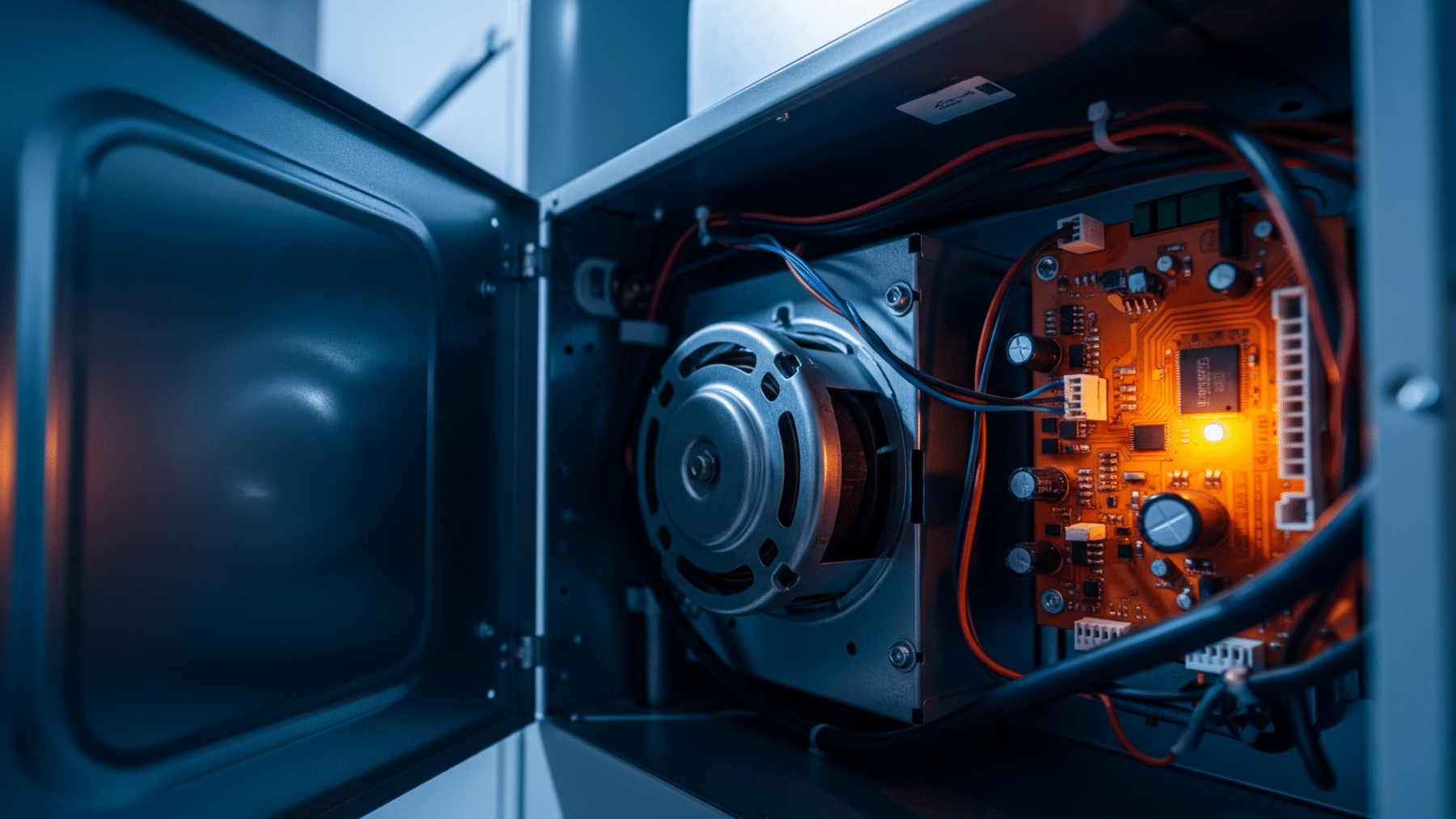
Almost all furnace models made in the past 20 years require electricity for the blower motor that pushes warm air through the ducts.
The electronic ignition replaced the old standing pilot light, and a control board runs the whole sequence.
Unless a homeowner has an older standing-pilot model, which is very rare in 2025, the furnace shuts down during an outage.
Three components, one hidden failure point nobody explains at the showroom
The problem is not a flaw. It is the design.
Modern high-efficiency condensing furnaces are engineering achievements: they squeeze 96 cents of heat from every dollar of gas.
But that efficiency comes from sophisticated electronics: a variable-speed blower motor, an electronic spark igniter, a circuit board managing every cycle.
From the blower motor that circulates warm air to the electronic ignition system that sparks the flame, a modern gas furnace depends on electricity as much as it depends on gas.
A gas furnace typically draws between 300 and 1,000 watts of electricity depending on its size and efficiency rating.
That is a modest load in normal times, easily overlooked on a utility bill swamped by the gas charge.
But when the grid goes down, 300 watts might as well be 300,000: without them, nothing ignites, no air moves, and the house begins to cool.
This is the same hidden grid dependency that has surfaced in other corners of the energy transition, just as Level 2 chargers are pushing neighborhood electrical infrastructure well past what anyone planned for.
When the polar vortex arrives and the grid fails at the same time
This is where the hidden catch lands on the real world.
In January 2025, U.S. natural gas consumption hit a record 126.6 billion cubic feet per day, 5% above the previous record set in January 2024.
February 2025 followed at 115.9 billion cubic feet per day, 5% above the previous February record, set in 2021, both levels driven in part by a polar vortex event in mid-January.
Those are the exact conditions that most often knock out power lines.
Ice loads bring down transmission towers. Demand spikes trip regional grids. Outages cascade precisely when the thermometer is dropping fastest.
Research from Carnegie Mellon University found that approximately 10% of U.S. interstate natural gas pipeline compressor stations are electrically driven, with several large pipelines vulnerable to electric outages.
So the dependency runs deeper than the furnace box in the basement: the pipeline delivering the gas can itself slow down when the same storm cuts electricity upstream.
The consequence is not abstract.
Families in well-insulated houses discover their battery storage was never sized for a furnace blower motor running eight hours in a polar vortex, and their furnace is simply off.
What changes and what homeowners can actually do about it now
There are no truly off-grid gas furnace models on the mainstream market.
Homeowners who need heat during a power outage must pair their furnace with a backup generator or a separate independent heating source.
A small generator rated at 1,500 watts or more is enough to run most furnaces through an outage, and EIA data make clear why that investment deserves serious thought: February 2025 natural gas consumption reached 115.9 billion cubic feet per day, 5% above the previous February record, driven in part by a polar vortex in mid-January.
Extreme cold and grid stress are arriving together more often, not less.
In 2024, 42% of U.S. households reported electricity as their main space heating fuel, while natural gas was the primary fuel in 47% of homes, down slightly from 49% in 2010.
That slow transition still leaves tens of millions of households with the same hidden dependency for years to come.
The gas in the pipe is almost certainly still flowing the next time a winter storm cuts your power.
The furnace just needs one small thing from the grid before it will light, and that is the part nobody put in the brochure.
