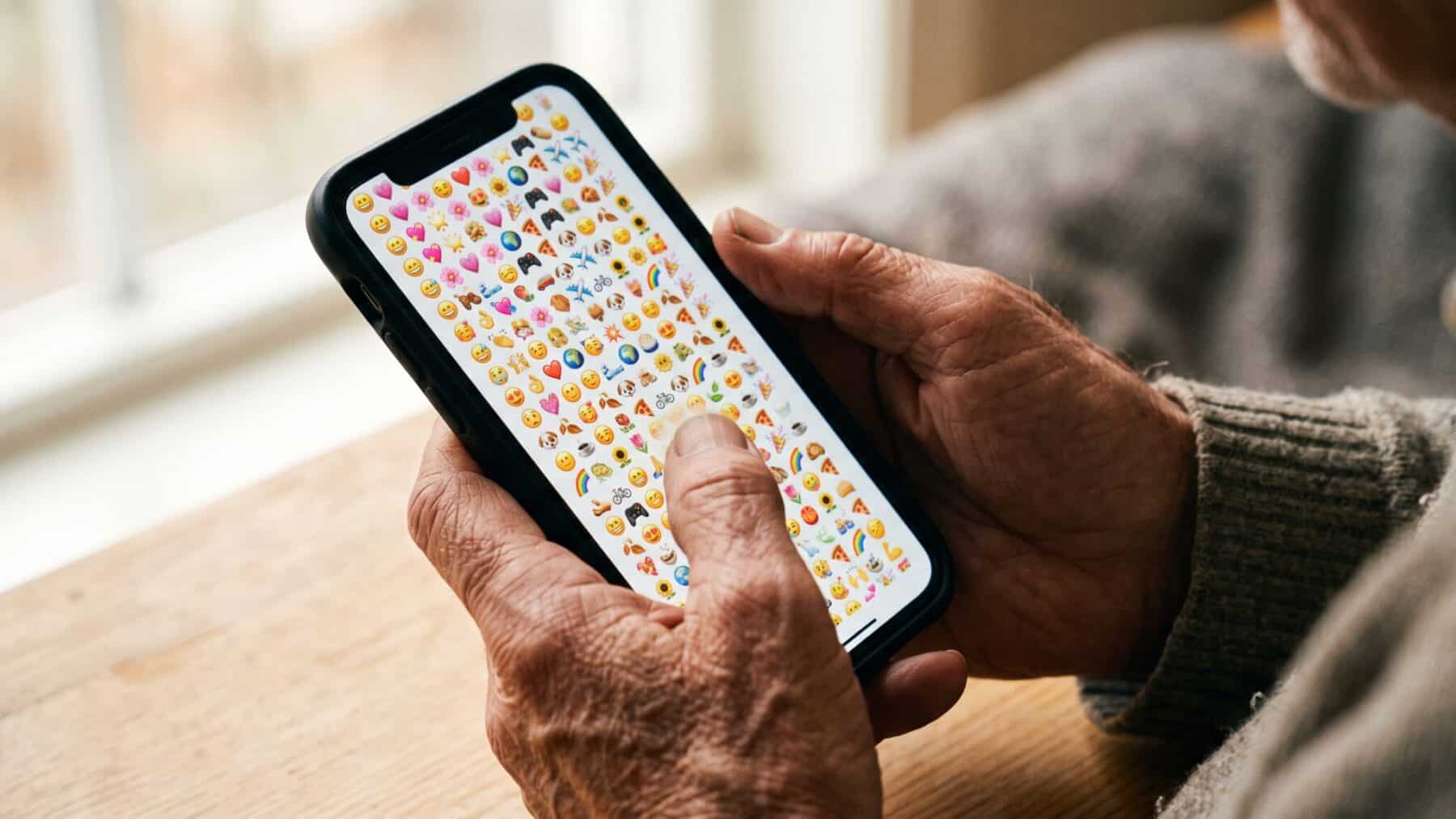
A thumbs-up lands in your message thread before a single word does.
You read it instantly, without pausing, without sounding it out.
That feels obvious, even trivial.
But inside your skull, something genuinely strange is happening: a recognizably similar electrical signal to the one that fires when you read a printed word is firing right now, triggered by a small yellow cartoon hand.
What researchers found about how the modern brain handles emoji is quietly rewriting the rules of what counts as language.
The brain signal that treats a smiley face much like a word
Neuroscientists have tracked a brainwave called the N400 for decades. It is a negative-going brain potential, peaking around 400 milliseconds post-stimulus and typically centro-parietal with a slight right-hemisphere bias. Its amplitude grows when the meaning is unexpected, and it shrinks when the meaning fits perfectly with what came before.
That pattern is one of the most reliable signatures of semantic processing in language science. The revealing part is what happens when you swap a word for an emoji. Implausible emoji elicit a reliable N400 effect, and results support notions of multimodal lexical prediction in real time. A separate ERP study found that, while incongruent words elicited both the N400 and a P600 effect, emojis generated a more conspicuous and sustained N400 effect, a similar but not identical pattern to words.
In other words, at least at the end of a sentence, the brain does not simply treat a 😂 as a picture. It treats it as a meaningful item whose fit with the sentence must be checked, firing recognizably similar signals to those used for words.
By examining issues of prediction with emoji, a set of familiar, conventionalized visual signs, researchers explore to what degree prediction operates at an abstract lexical level, and how such interactions point toward an integrated multimodal communicative system. The brain appears to be merging them long before linguists agreed it should.
The concrete scene: a sentence, an electrode cap, and a reading brain at work
Picture 98 native Chinese speakers as participants, with eye-tracking equipment recording precisely where the gaze lands, for how long, and how often it doubles back , giving researchers a window into processing difficulty in real time.
High-frequency emoji had shorter fixation durations, moving through the reading system more smoothly; low-frequency emoji required more time for recognition and integration due to visual and semantic factors. The brain had already filed the familiar ones.
That finding connects directly to what separate handwriting research has shown about symbol frequency and memory. Studies on how the brain encodes written marks suggest that any symbol practiced enough eventually earns its own fast-access neural slot, and emoji are earning those slots at speed.
One in three messages, and what the numbers say about scale
Roughly one in every three messages in messaging datasets contains at least one emoji , which means this is not a niche behavior among teenagers. It is a mass communication shift playing out across every age group and every platform. That prevalence is precisely what creates the conditions for lexicalization: the brain only promotes a symbol to word-status once it has encountered it often enough to build a reliable prediction.
Experimental studies show that messages containing emoji are rated as significantly more positive in the majority of tested conditions. That warmth effect reflects the N400 at work: the brain predicts warmth, the emoji confirms it, and the signal dips pleasurably shallow.
The scale of this shift also matters for what researchers call media richness, and face-to-face conversation carries meaning that text-only channels often cannot. Emoji appear to be the mechanism by which messaging partially closes that gap, adding a second layer of semantic signal the brain reads simultaneously with the text.
Where the system breaks down and why ambiguous emoji mislead
The lexicalization process is not uniform, and that unevenness is where everyday misunderstandings originate. Pro-text emoji, those used as outright word replacements, have a longer fixation duration and take longer to integrate. Lexical access is harder when an emoji’s meaning is not immediately clear.
In plain terms: an emoji that adds emphasis to a word the reader already has is easy. An emoji that replaces a word entirely is harder, especially if sender and receiver hold different associations with it. The brain’s filing system for emoji meaning is partly personal and partly cultural, which is why the same 🙃 reads as playful sarcasm to one person and outright hostility to another.
There is also a generational filing-speed gap. Younger adults who have seen certain emoji tens of thousands of times trigger near-instant confirmation signals, while older readers may still use the slower visual decoding applied to unfamiliar pictures. Frequency builds fluency, full stop.
What this means for the way people will write and read
If the brain genuinely treats well-known emoji as words, then the written language of the early 21st century is larger than any dictionary currently records. The Unicode Standard tracks 3,953 emoji as of September 2025, including sequences for gender or skin tone, flags, and the components used to create keycap, flag, and other sequences , and the lexicalized subset is growing with every generation of phone users who grow up sending them before they learn to type full sentences.
That has real implications for literacy and professional writing. Spelling and grammar tools already flag misused words; flagging an emoji whose register or cultural meaning does not match the audience is a short next step.
What research does not yet settle is whether emoji fluency and traditional word fluency draw on the same neural resources or compete for them. The N400 evidence shows they share a signal, though not an identical one, but whether heavy emoji use changes how the brain allocates attention to printed words remains open, and that question matters for classrooms as much as laboratories. For now, the clearest finding is also the most counterintuitive: that yellow cartoon hand you tapped without thinking was, to your brain, something very close to a word all along.
