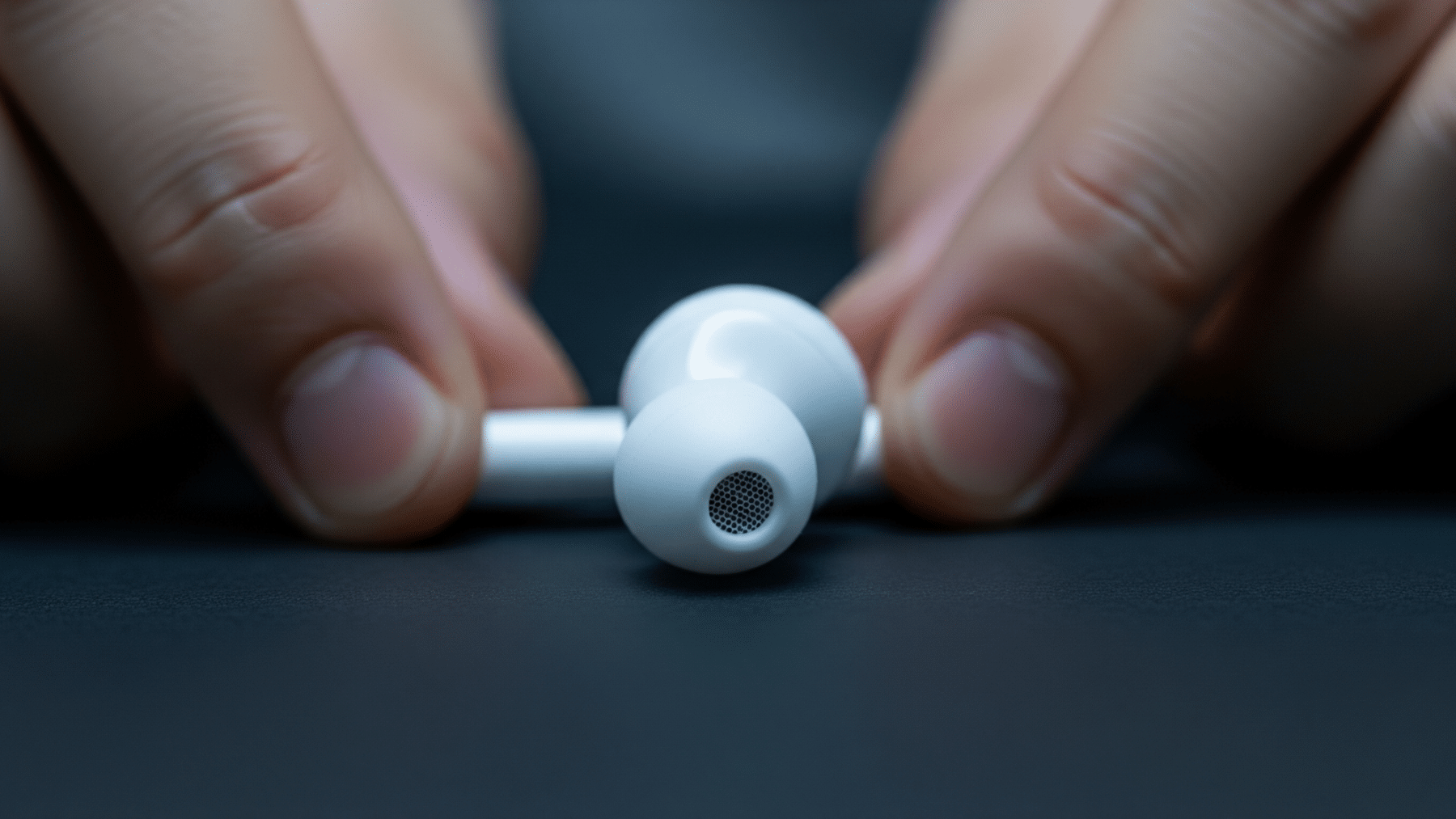
You slide them in on a crowded subway platform and press a button. The rumble of the train, the chatter of a hundred strangers, the screech of metal on rail, it all fades to near silence in under a second.
Most people treat that moment as simple magic. It is not magic. It is a very specific calculation running faster than the human ear can detect.
And the number at the center of that calculation is one that almost no one who owns a pair of wireless earbuds has ever seen.
The device most people slide into their ears without a second thought
Wireless earbuds are now one of the best-selling consumer electronics categories in the United States.
Tens of millions of Americans own a pair, and they reach for them dozens of times a week, on morning runs, in open-plan offices, on planes, in coffee shops.
The feature that converted many of those buyers was active noise cancellation, or ANC. It promised a genuinely quieter world in a small plastic shell that fits in a shirt pocket.
What it actually delivers is a live physics trick, refreshed thousands of times every second, that most users have never had explained to them.
What your ear actually hears when the world goes quiet
Sound is pressure. Every noise around you is a wave of compressed and rarefied air arriving at your eardrum.
The insight behind noise cancellation is that if you can generate a wave with exactly the opposite shape, the same frequency, but flipped, the two waves collide and cancel each other out.
Physicists call this destructive interference. The math is elegant. The engineering challenge is doing it fast enough to work on real, unpredictable noise in real time.
That is where the hardware hidden inside your earbuds becomes remarkable.
Two microphones, one inside your ear and one outside it
Modern noise-cancelling earbuds do not rely on a single microphone.
An outward-facing microphone detects external sounds, and the earbuds then counter those sounds with anti-noise, canceling them before they reach your ear.
An inward-facing microphone also listens inside your ear for unwanted internal sounds, which the earbuds counter with a second layer of anti-noise.
Both streams are processed simultaneously and continuously. The system is measuring, computing and generating a counter-signal in a loop that never stops while the earbuds are in your ears.
That loop runs at a speed that is genuinely difficult to picture, until you see the number.
The 48,000-times-per-second calculation inside a chip the size of a grain of rice
This is the part almost no product description mentions out loud.
Apple’s H2 chip, the processor at the heart of the AirPods Pro line, analyzes and adjusts sound 48,000 times per second, processing changes in environmental noise near-instantly to generate its counter-signal. The AirPods Pro 3, announced in September 2025, carries this same H2 chip forward with further advances in computational audio on top of it.
Forty-eight thousand calculations every second means the chip is re-evaluating the noise environment and reissuing its anti-noise signal roughly every 21 microseconds.
A human blink takes about 150,000 microseconds. The chip completes more than 7,000 correction cycles in that same blink.
Active Noise Cancellation in AirPods Pro 3 removes up to 2× more noise than the AirPods Pro 2, combining ultra-low-noise microphones with advanced computational audio and new foam-infused tips.
Apple says the AirPods Pro 3 also offer up to 4× more active noise cancellation than the original AirPods Pro.
The AirPods Pro 3 features an adaptive noise cancellation system that adjusts in real time based on surrounding sounds, offering improved suppression of constant noise and smoother transitions when switching to Transparency Mode.
The same H2 chip also handles a function competitors have been working to match: detecting when your voice is the one making noise, and automatically routing it differently so your own speech does not get cancelled out.
What this means for the earbuds sitting in your case right now
Apple announced the AirPods Pro 3 during its “Awe Dropping” event at Apple Park on September 9, 2025, featuring better Active Noise Cancellation, a redesigned fit, upgraded audio, and IP57 sweat and water resistance.
With ANC active, AirPods Pro 3 get up to eight hours of playback, and one major new feature is a custom-built heart rate sensor integrated into an updated workout experience.
The 48,000-per-second figure is also a useful benchmark for understanding where the whole category is heading.
AirPods Pro 3 also support Adaptive Audio, which blends ANC and Transparency mode, adjusting noise control automatically in response to your surroundings.
That means the chip is not just running a fixed anti-noise pattern. It is learning your environment in real time and shifting its model as the noise around you changes, all without you touching a setting, and all inside something that weighs just a few grams.
The next time the subway roar disappears the moment you press that button, you will know exactly what just happened: a grain-of-rice chip, running a physics calculation 48,000 times per second, buying you a moment of quiet.
That is not magic. That is just very fast math, and it gets faster every year. For anyone following the wider race to pack more compute into smaller silicon, wireless earbuds are quietly becoming one of the most demanding proving grounds in consumer electronics.
