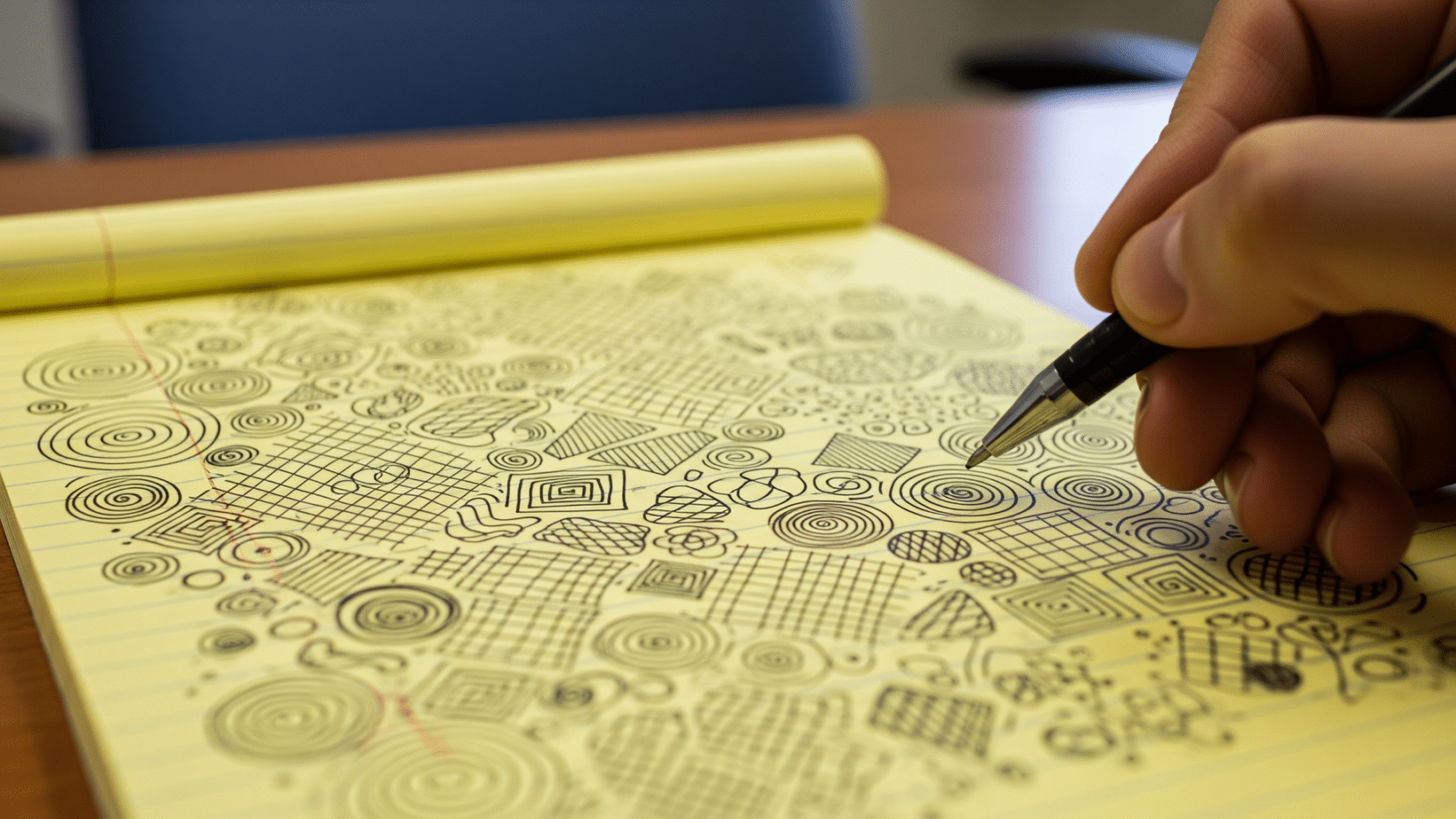
Picture the person at the back of the conference room.
Their pen keeps moving even when they stop writing.
Loops, boxes, little hatched triangles filling the margin. Everyone else assumes they’ve checked out.
They may be the most focused person in the room, and real science backs that up in a way almost nobody at the table would guess.
The habit that everybody secretly does
Doodling is the act of drawing pictures or patterns while thinking about something else or when bored.
It is typically spontaneous and automatic, often done absent-mindedly without much conscious effort.
Most people have done it. On a phone call. In a long lecture. Waiting on hold.
And almost everyone who does it carries the same low-grade guilt, the nagging feeling that their pen is proving their distracted mind.
That assumption turns out to be exactly backwards.
What the brain is actually doing when the hand wanders
Daydreaming may seem absentminded and pointless, but it actually demands a lot of the brain’s processing power.
You start thinking about a vacation, which leads to potential destinations, then to how you’d pay for the trip.
These cognitions require what psychologists call executive functioning.
That is the real thief in a long meeting.
The moment your mind wanders into full daydream mode, it commandeers the same cognitive resources needed to track the conversation in the room.
This is closely related to what we know about mind-wandering more broadly, a state that researchers now understand pulls heavily on the brain’s attention networks.
Why a small distraction can beat a big one
As Professor Jackie Andrade of the School of Psychology at the University of Plymouth explained: “If someone is doing a boring task, like listening to a dull telephone conversation, they may start to daydream. Daydreaming distracts them from the task, resulting in poorer performance. A simple task, like doodling, may be sufficient to stop daydreaming without affecting performance on the main task.”
Doodling requires very few executive resources but just enough cognitive effort to keep you from daydreaming.
Left unchecked, that daydream state jump-starts activity in cortical networks that block memory formation for whatever is actually being said.
It’s a kind of attentional anchor, just enough mental friction to hold the mind in the room.
This dynamic matters even more given how much of everyday behavior runs on invisible autopilot, the same unconscious drift that lets a long meeting quietly erase itself from memory.
The 29% that changes how you read the room
Here is the finding that reframes the doodler entirely.
In the study, 40 participants monitored a monotonous mock telephone message for the names of people coming to a party. Half of the group was randomly assigned to a doodling condition where they shaded printed shapes while listening.
The doodling group performed better on the monitoring task and recalled 29% more information on a surprise memory test.
That result, published in 2010 in the journal Applied Cognitive Psychology by Andrade , has been cited and examined by multiple follow-up studies.
Doodling keeps areas of the brain engaged during otherwise unstimulating periods while using only a small portion of available cognitive resources.
The person filling the margins with tiny spirals walked out with more of the meeting than anyone suspected.
A simple reframe for the next dull stretch of the day
Contemporary research frames boredom not as a character flaw but as a motivational signal, noting that its negative outcomes may stem from its role in motivating behavioral or cognitive shifts to find increased challenge or meaning in unstimulating situations.
A 2025 study published in Cognition and Emotion examined whether boredom promotes challenge-seeking, even when additional challenge offers no extrinsic value, in an experiment of 297 participants.
The preregistered main effect of boredom on challenge selection was not supported outright, but structural equation modeling revealed an indirect path: boredom shaped participants’ sense of meaning, and that in turn nudged them toward activities with greater challenge.
People didn’t just sit there feeling restless. They moved toward more engaging options through a route that bypassed simple restlessness.
Doodling fits that pattern perfectly. It is the mind self-correcting, seeking just enough engagement to stay present.
So the next time you catch yourself drawing interlocked rectangles in a margin, or notice a colleague doing it, the science suggests a calm reframe: that pen isn’t wandering. It’s working.
