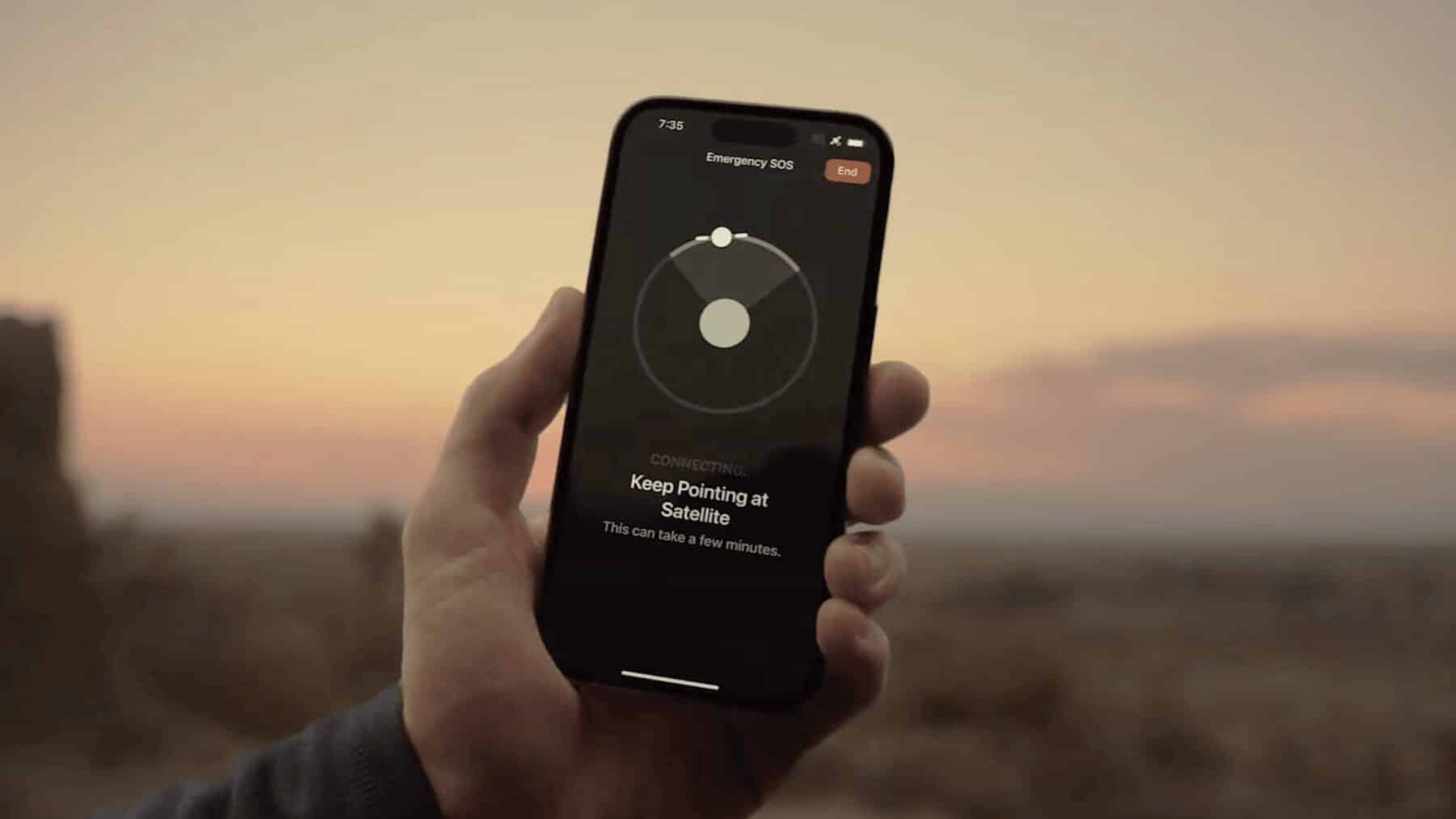
A hiker loses every bar of signal on a ridge.
He tilts the phone toward a patch of open sky and watches a thin progress bar creep across the screen.
No tower is in sight for miles.
Yet eleven seconds later, a plain gray text bubble turns blue and slides off the screen.
There is no cell network anywhere nearby to thank for that.
Something far smaller and far stranger than a tower just caught that message and threw it back to Earth, and the whole exchange rides on a link barely faster than a dial up modem.
How a text actually crosses empty sky to reach a satellite
The trick starts with bandwidth so thin it would have embarrassed a dial up modem. One technical teardown of the system believes it uses Globalstar’s L-Band at 1610 Mhz for uplink, with a bitrate of roughly 9.6 kbps. That is thousands of times slower than an average home broadband connection, which is why the feature was built to never touch a photo or a voice note.
So the manufacturer had to shrink the words themselves before they ever left the device. According to the company’s own briefing on the feature, standard messaging protocols are not designed for satellite’s limited bandwidth, so engineers created a custom, short text compression algorithm to reduce the average size of message by a factor of three. That squeeze is the real engineering story, not the antenna.
A dedicated radio chip makes the narrow channel usable at all. Teardown analysis found the satellite connectivity in the iPhone 14 series is provided by a Qualcomm X65 modem chip, which is also capable of using band N53, the frequency band used by satellites from Globalstar, a slice of spectrum normally reserved for ground based 5G networks.
None of that matters without a clear shot at the horizon. Apple’s own support documentation is blunt about the physical requirement: you need to be outside with a clear view of the sky and horizon.
Inside the actual handoff between your phone and a moving satellite
Unlike a cell tower bolted to a hillside, a satellite is a fast moving target. The spacecraft the manufacturer relies on orbit low enough that they cross the sky in minutes, so the phone has to track a point of light rather than sit still and wait for a signal.
That handoff runs through real ground infrastructure once the signal leaves orbit. Industry reporting on the launch explained that once an iPhone makes a satellite request, the message is received by one of Globalstar’s satellites in low earth orbit, which then sends the message to a custom ground station that routes it to emergency services.
Delivery still is not instant. Its own help page warns plainly that messages sent via satellite might take longer than an ordinary text, and testers have reported anywhere from fifteen seconds to minutes, depending on tree cover and cloud conditions.
Which is why the feature avoids normal chat. The interface narrows every conversation down to short structured exchanges, trading richness for a near guarantee that something gets through at all.
The numbers that prove how tight this link really is
The clearest evidence of how constrained this channel is comes straight from the manufacturer’s own engineering staff at launch. Company representatives told reporters that with a clear view of the sky, a user can transmit an Emergency SOS text in less than 15 seconds, but a transmission could take a few minutes if light foliage is encumbering the link.
Independent teardown sites have since put a rough number on the everyday texting version that arrived two years later for newer models. One technical breakdown of the expanded Messages via satellite feature estimated the bandwidth is extremely limited, roughly 30 to 100 bytes per second, enough for short text messages but not for media.
Capacity is scarce too. One widely cited technical explainer noted the system supports only about 20 to 30 thousand calls at once across the entire US service area, since each satellite beam covers an area the size of several states.
That scale problem echoes the squeeze now hitting memory chips in everyday laptops, where a once minor component suddenly becomes the bottleneck the whole product depends on.
Where the system still breaks down and who actually built the pipes
Getting that narrow channel built at all took real money and a long bet on hardware already orbiting the planet. Apple’s own announcement of the funding confirmed a $450 million investment from its Advanced Manufacturing Fund went toward expanding Globalstar ground stations across the country.
In exchange for funding that buildout, the company locked up most of the capacity for itself. Reporting at the time noted Apple will fund 95% of Globalstar’s capital expenditures for it to grow and maintain its satellite network, in exchange for 85% of its current and future network capacity, a trade that explains why rival phone makers sought their own satellite partners.
Gaps remain. Dense tree canopy, steep canyon walls, and tall buildings all block the same narrow beam that makes the system work in open country.
Even so, the idea keeps spreading. The same squeeze and relay logic now shows up on smartwatches, where one breakdown found every message gets squeezed to fit, paired with a compact location payload so a full status update uses only a few hundred bytes.
What this means for a phone with no bars left
None of this makes a phone into a true satellite handset. Voice calls, video, and group chats still sit outside what a few kilobits per second can carry, and that boundary is deliberate rather than a bug waiting to be patched.
Still, the gap between useless and lifesaving now comes down to a few hundred bytes squeezed through open sky. That is a modest engineering budget next to the billions poured into data center buildouts elsewhere in tech.
For a hiker on a ridge, that thin stream of bytes is the whole point. The hardware will keep improving, but the core idea, a tiny compressed message patiently relayed through a moving speck of light, is likely to outlast most phones carrying it today.
