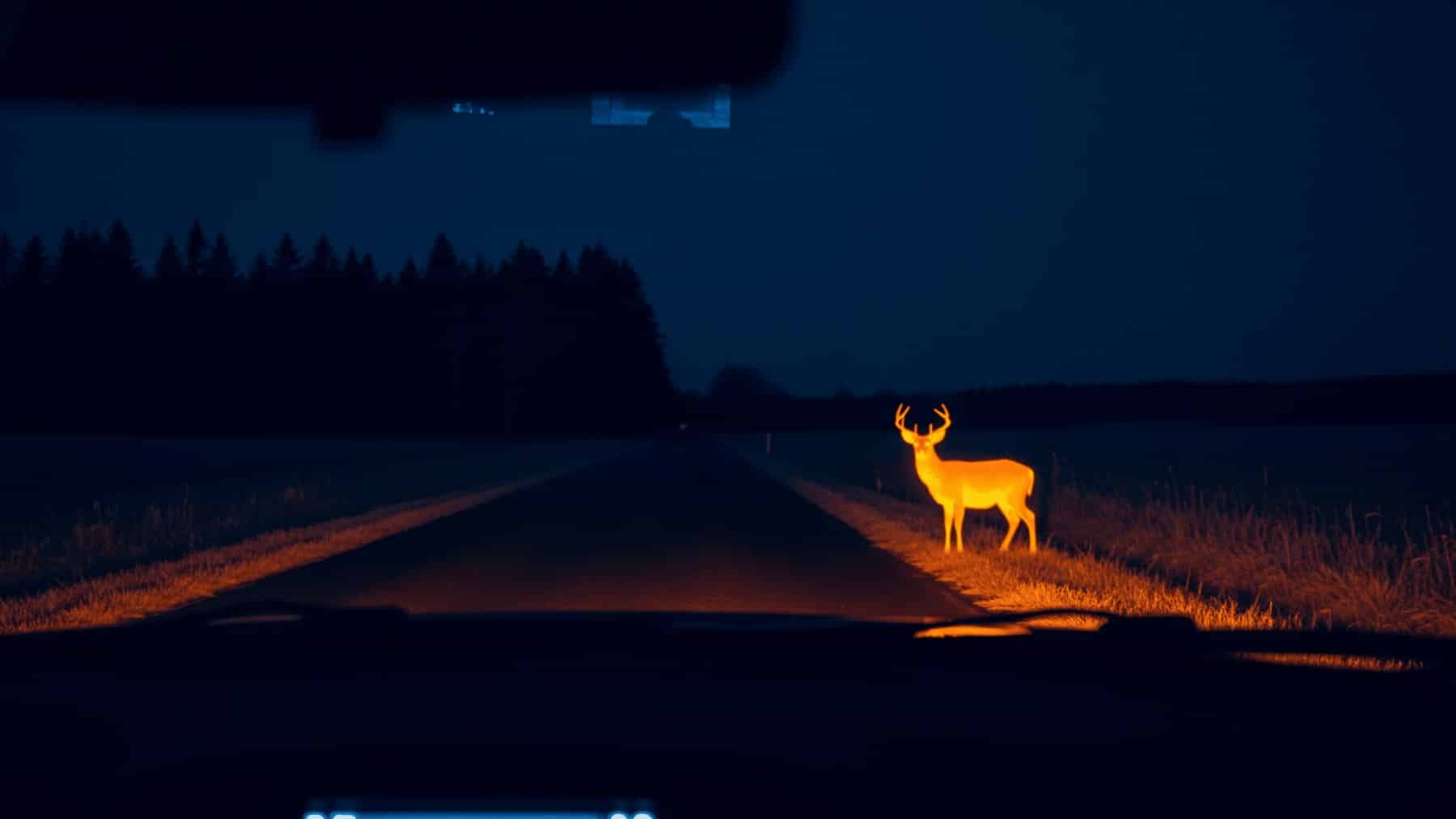
Every autumn, millions of American drivers brace for what insurers call peak collision season. The roads feel the same. The headlights feel the same. And yet the animal standing at the edge of the asphalt remains, year after year, almost perfectly invisible until it is far too late.
The creature is the white-tailed deer. It lives in every state but Hawaii. Most people have seen one from a car window.
Almost no one realizes how completely it defeats the safety systems built into modern vehicles.
And now a group of engineers has spent months collecting more than 12,000 images of deer, not to study wildlife, but to teach a car to finally see one in time.
The number that reveals how serious the problem really is
Deer-vehicle collisions cause nearly 2.1 million incidents annually in the United States, resulting in approximately 440 fatalities, 59,000 injuries, and $10 billion in economic damages.
That is not a rounding error. That is a recurring national crisis that happens mostly in the dark.
According to the most recent State Farm analysis, deer account for more than 1.1 million of the approximately 1.7 million animal-vehicle collision insurance claims filed between July 1, 2024, and June 30, 2025, roughly 65% of all such claims. No other animal comes close.
State Farm estimates that those same 1.7 million claims represent a slight decline from the 1.8 million filed in the prior 12-month period, yet the problem remains enormous.
And every safety feature automakers have added to dashboards has struggled with the same blind spot.
Why the most familiar roadside animal keeps winning against car safety tech
Standard forward-facing cameras rely on visible light. At night, in the exact conditions when deer are most active, visible light fails.
The vast majority of deer-vehicle incidents occur during the twilight hours of dawn and dusk, and during nighttime hours, coinciding with peak deer activity and reduced driver visibility.
Radar and lidar can sense shapes, but a motionless deer at the road edge produces a return signal that looks like almost nothing: a roadside post, a shadow, a patch of tall grass.
Even advanced driver-assistance systems that work brilliantly in European safety tests, where test dummies are used, were never optimized for an unpredictable living animal that freezes and then bolts.
Collision-avoidance systems in newer vehicles can automatically brake if an animal is detected, but only if the sensor chain can actually identify the animal in the first place.
That identification step, at highway speed in low light, is where the system breaks down.
This gap sits behind every recall notice about sensor calibration and every software update pushed to EVs overnight.
If you have been following stories about Hyundai and Kia recalling EVs, you already know how seriously regulators treat any gap between what a vehicle’s systems promise and what they can actually deliver.
The field where engineers went to collect 12,000 images of one animal
The research team did not go to a lab. They went to rural North Carolina and pointed cameras at real deer in real conditions.
The paper presents a real-time detection and driver warning system that integrates thermal imaging, deep learning, and vehicle-to-everything communication, trained and validated on a custom dataset of over 12,000 thermal deer images collected in Mars Hill, North Carolina.
Thermal imaging does not need visible light at all. It reads the heat a body radiates. A warm deer against a cold night sky is, in the thermal spectrum, almost impossible to miss.
The challenge was not detection in ideal conditions. The challenge was making it fast enough to matter at 60 miles per hour.
The real payoff: a connected-car system that can warn you about a deer in under 100 milliseconds
Here is the reveal that makes the engineering genuinely remarkable.
When a high-probability threshold is reached, sensor data-sharing messages are broadcast to surrounding vehicles and roadside units via cellular vehicle-to-everything communication devices.
The system achieves end-to-end latency consistently under 100 milliseconds from detection to driver alert. One tenth of a second. That is faster than a human blink.
And critically, the alert does not stay inside one vehicle.
The research establishes a viable technological pathway for reducing deer-vehicle collisions through thermal imaging and connected vehicles, meaning a car that spots a deer can warn the cars behind it before they even round the bend.
This is the kind of vehicle-to-everything infrastructure already being woven into new EV platforms. The same connectivity backbone that lets a modern EV receive over-the-air updates could, in a future software release, carry live wildlife alerts to every nearby vehicle.
The research was submitted to the scientific community in September 2025 and points toward a near-term integration path with production connected-car hardware already in the pipeline.
What this means for every driver heading home after dark this fall
The technology is not yet standard equipment. But the research confirms the detection problem is solvable, and the pathway to a production system is now defined.
The UC Davis Road Ecology Center’s 2024 report found that more than 48,000 deer are killed annually by vehicles on California roads alone, more than twice the number harvested by hunting.
The stakes are real on both sides of the windshield.
For now, the practical advice has not changed: slow down at dusk, scan the shoulders, and remember that where there is one deer, there are almost always more waiting in the treeline.
But the broader story is one of genuine progress. A familiar animal that has outsmarted headlights and radar for decades is now, thanks to 12,000 thermal snapshots taken in a North Carolina field, finally teaching cars how to see it, and how to share that warning before anyone gets hurt.
