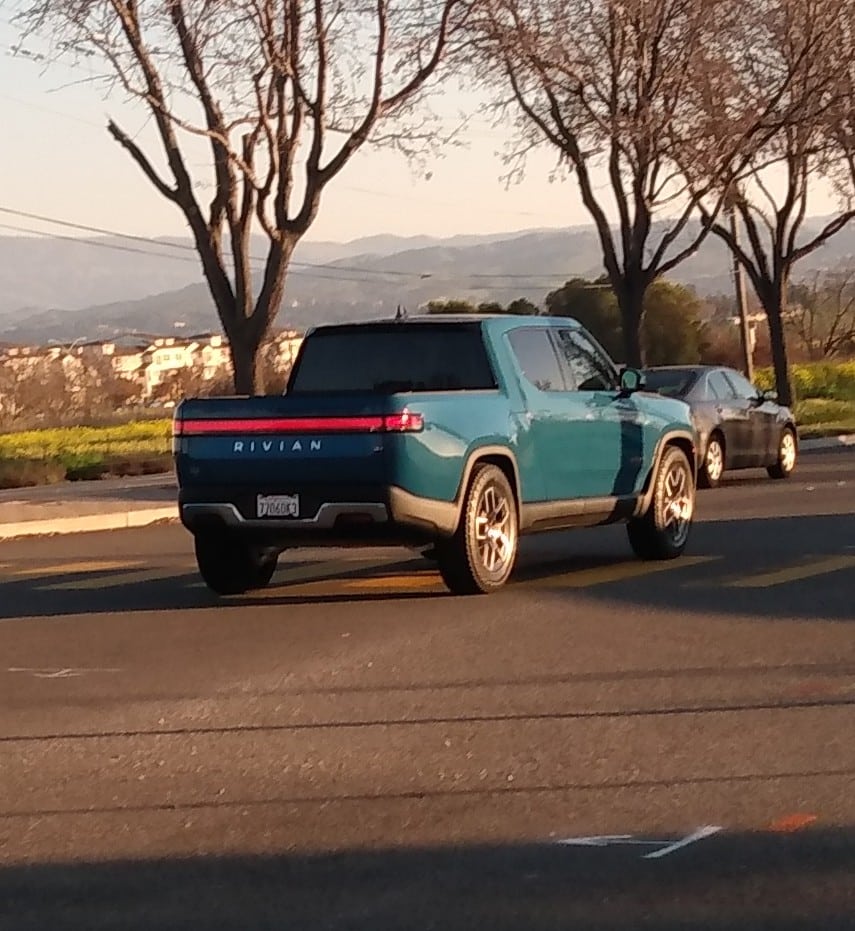
Rivian Automotive is recalling 98,828 of its R1S, R1T and R2 vehicles because a software notification can briefly cover the rearview camera image, according to a recall report the company filed with the National Highway Traffic Safety Administration.
The automaker says a free over-the-air software update already fixes the issue and has reached more than 95 percent of affected vehicles.
What triggers the camera problem
Rivian has determined that on certain R1T, R1S, and R2 vehicles, in rare instances while stability control is off and after returning to the vehicle, a safety alert prompt on the center display may overlap the camera view when placed in reverse until the vehicle moves.
Because the rearview image may be overridden prior to vehicle movement, it may not fulfill FMVSS/CMVSS 111 regarding rear visibility requirements. The defect falls under federal rules covering rear visibility, which exist to prevent back-over crashes involving pedestrians and small children.
Rivian Automotive, LLC is recalling certain 2022-2027 R1S, 2022-2026 R1T, and 2027 R2 vehicles. The rearview camera image may be obstructed by a notification when in reverse. As such, these vehicles fail to comply with the requirements of Federal Motor Vehicle Safety Standard (FMVSS) number 111, “Rear Visibility.”
The recall breaks down to 62,259 R1S vehicles, 34,088 R1Ts and 2,481 R2s , according to the NHTSA filing.
Fix already out before most owners are notified
Unlike recalls that require a dealer visit, this one was largely resolved remotely before most owners even learn about it.
Rivian has released an over-the-air (OTA) software update, free of charge. Rivian is not aware of any customer reports, crashes, injuries, or fatalities related to this condition.
As of September 16, Rivian says more than 95% of affected vehicles, including 95% of the R1 population and 96% of the R2 population have already installed the update.
Formal owner notification letters will still go out under federal rules even though most vehicles have already received the fix. Rivian has released an over-the-air (OTA) software update, free of charge. Owner notification letters are expected to be mailed November 9, 2026.
The company traced the defect through a multi-month internal review. From July 2026 through September 2026, Rivian investigated the condition, discovered during internal testing , to evaluate the nature of the specific behavior required to activate it.
The automaker also worked to determine the potentially affected population and possible implications for FMVSS 111. The automaker determined on Thursday, Sept. 10, that it could not rule out a potential violation of federal rear visibility requirements.
Part of a busier recall season for pickups and SUVs
The filing comes during an active stretch of truck and SUV recalls. Chrysler’s Ram brand has also been dealing with a stability-control defect this year: an April 2026 recall covered certain 2026 Ram 2500 pickups whose steering column control module can serve as a primary hub for driver inputs and, if defective, can disable stability-control communications . In October 2026, Chrysler expanded that campaign, and a loss of electronic stability control increases the risk of a crash, with the potential number of units affected listed as 8,329 in the expanded filing.
In mid-October 2026, Ford also recalled select 2025-2027 F-150 models after Ford Motor Company recalled 2,276 2025-2027 F-150 vehicles because the front seats may have been improperly secured to the vehicle, with dealers set to inspect and tighten, or replace the front seat bolts as necessary, free of charge . That campaign is unrelated to the Rivian filing but illustrates how frequently safety recalls now touch the full-size and electric truck segments.
Software-delivered fixes have become increasingly common across the EV sector, as automakers increasingly resolve defects remotely rather than through dealer service appointments.
Why the recall still matters
Even with a software fix already deployed, federal law requires automakers to formally notify every registered owner and file detailed data with NHTSA whenever a vehicle fails to meet a federal safety standard, regardless of whether the defect caused any reported harm.
Owners can check their vehicle identification number against the recall using Rivian’s customer service line or the agency’s public recall lookup tool, as Vehicle Identification Numbers (VINs) involved in this recall will be searchable on NHTSA.gov on November 9, 2026 .
Rivian said it is unaware of any crashes, injuries or deaths connected to the camera issue. The company’s recall filing shows that remediation was largely complete before the formal recall notice was filed.
