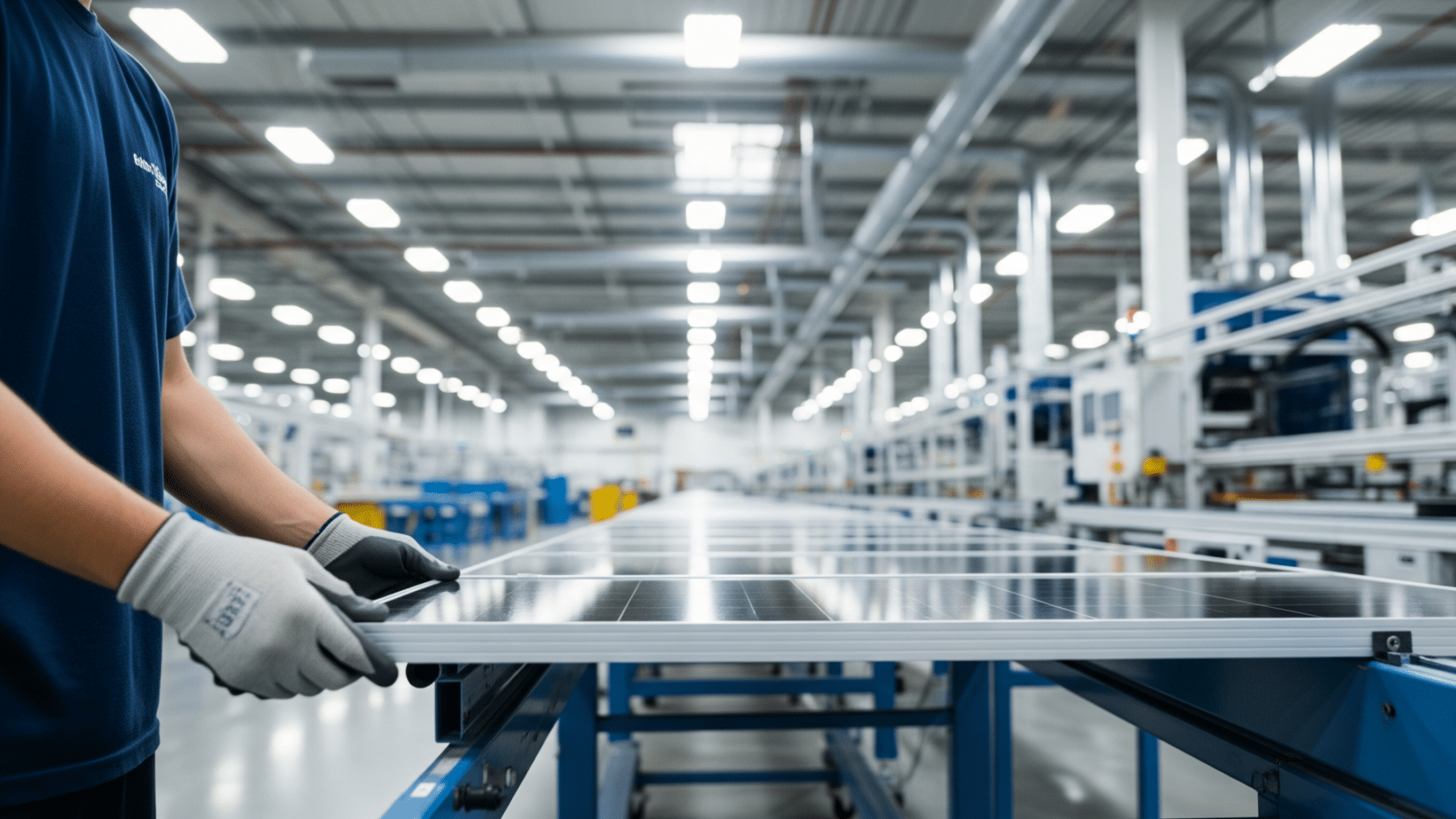
SEG Solar opened a new 4-gigawatt solar module assembly plant in Tomball, Texas on August 7, marking one of the largest single-facility additions to American solar module manufacturing capacity in recent years.
At the grand-opening ceremony, the Houston-based company highlighted a previously announced third factory that would push its total planned domestic capacity to 10.6 GW, a figure the company says would make it the largest crystalline silicon solar module assembler in the United States.
What opened and what it can produce
The SEG Solar Tomball facility officially opened on August 7, 2026, as a 4 GW solar module assembly plant. Once fully operational next year, it will bring SEG’s annual module assembly capacity to 6 GW, joining the company’s original 2 GW facility in nearby Houston.
The facility runs three front-end production lines, eight lamination machines and four output lines. At full capacity it is expected to employ 500 workers producing as many as 30,000 modules a day.
The nearly 500,000-square-foot plant represents more than $200 million in investment and could create up to 800 new jobs.
Commercial operations were slated to begin in the third quarter of 2026, with pilot calibration starting in the weeks following the grand opening and 100 workers, trained at the Houston plant, running the lines first.
A third factory announced ahead of the opening ceremony
SEG Solar announced plans on June 1, 2026 to develop a third U.S. manufacturing facility in Greater Houston, Texas. The new 4.6 GW facility is expected to bring SEG’s planned annual U.S. module manufacturing capacity to 10.6 GW. As part of the grand opening ceremonies, the company reiterated plans to build the additional 4.6 GW module assembly factory within 18 months. The new facility would be located across the street from the Tomball plant and bring the company’s total annual capacity to 10.6 GW, making it the largest crystalline silicon solar module assembler in the United States.
SEG has signed an agreement with a local construction company to develop the new 4.6 GW facility on a site spanning approximately 1.15 million square feet, including a factory and warehouse. Construction is projected to be completed by March 2027, with commercial production expected to begin in May 2027.
In addition to the new module capacity, the company said it plans to build a solar cell manufacturing plant in the U.S. by 2028. The third facility will produce heterojunction technology (HJT) modules, which would boost the number of n-type solar panels made in America as TOPCon patent disputes continue to work through the courts.
Cell production is a critical gap in domestic supply chains. U.S. factories have expanded module assembly capacity significantly, but cell manufacturing capacity has lagged, and companies are pushing to catch up.
Texas becomes the center of domestic solar manufacturing
SEG’s continued expansion is part of a broader domestic solar module manufacturing trend, with up to 15 GW in total manufacturing capacity expected in Texas in 2026.
Other manufacturers have also been adding capacity in the Houston area. Japan-based TOYO recently announced a 1.5 GW heterojunction (HJT) solar cell manufacturing facility to be co-located at the company’s existing solar module site in Humble, Texas, creating an integrated manufacturing hub expected to generate approximately 400 direct full-time manufacturing jobs. The expansion represents a total projected capital investment of approximately $357 million.
The EIA projects a record 86 GW of new utility-scale electric generating capacity to be added to the U.S. power grid in 2026. Solar power makes up 51% of the planned 2026 capacity additions, followed by battery storage at 28% and wind at 14%.
The recent Section 232 tariff action the Trump administration imposed on solar supply chain materials adds a new cost layer to that expansion. GCN previously reported on that Section 232 proclamation, which introduced tariffs and price floors across the solar supply chain.
The solar manufacturing industry remains gripped by uncertainty around foreign entity of concern (FEOC) requirements as well as ongoing trade cases that have affected new development. SEG has been validated as a non-FEOC entity by multiple independent third parties and currently provides modules with non-FEOC solar cells.
Supply chain integration and what comes next
SEG has initiated planning for an ingot and wafer manufacturing facility in Indonesia, intended to secure critical components and enhance the resilience of its global supply chain.
Once completed, SEG will be positioned to deliver modules through a more fully integrated supply chain spanning ingots, wafers and cells, an increasingly important capability in today’s evolving policy and trade environment.
With the Tomball plant now open and a third facility contracted, SEG is betting that a vertically integrated domestic supply chain anchored in Texas can absorb trade-policy shocks while feeding a utility-scale deployment pipeline that the EIA projects will add a record 43.4 GW of new utility-scale solar capacity to the U.S. grid in 2026.
GCN’s earlier coverage of the federal patent dispute affecting panel pricing remains relevant for buyers evaluating module supply agreements.
