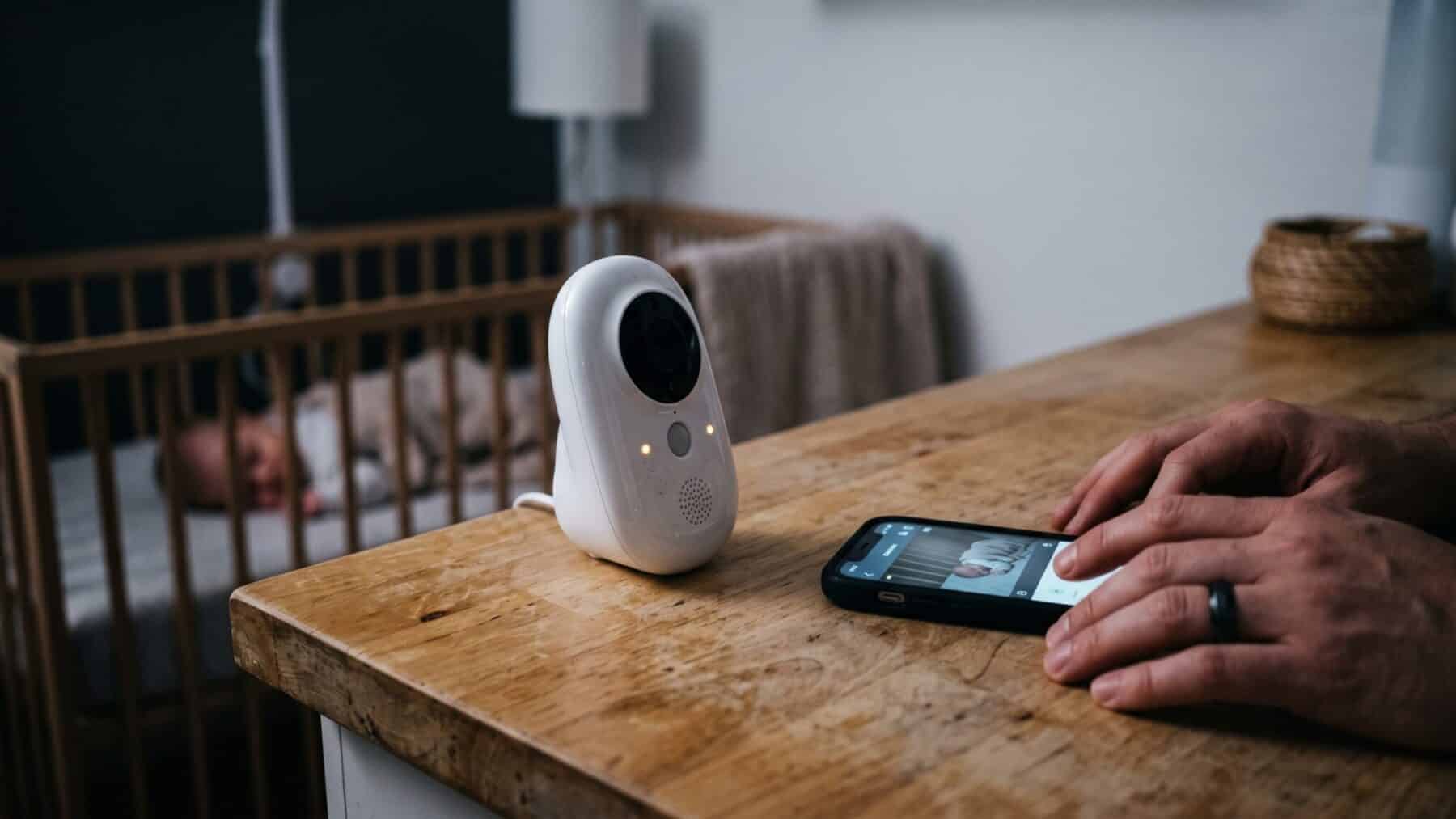
It arrives in a clean white box with a wire tucked neatly inside.
The camera goes on the crib rail. The app downloads in under a minute. For the first three months, everything works as advertised. Then the free trial period expires and a prompt asks for a card number. What parents thought was a one-time purchase is now a subscription. And the feature that made them choose this monitor over the cheaper one on the shelf? That sits behind the paywall.
How the paywall works inside a smart monitor
Smart baby monitors are not a single product, they are a platform in two parts. The hardware streams live video and sounds a basic alert, and that part is genuinely free after the sticker price. But the software layer, the piece that turns raw footage into sleep analytics, nightly reports and saved video clips, runs on cloud computing that costs real money to operate, and manufacturers pass that cost back to the buyer on a monthly or annual billing cycle.
The mechanism is identical to the one that turned music ownership into a streaming rental: the object in your hand is a terminal, not a complete product. Most Wi-Fi monitors advertise sleep analytics and breathing motion detection prominently. But parent frustrations consistently center on surprise paywalls and unclear pricing discovered only after the trial ends.
The hardware is the hook. The subscription is the line.
What the numbers look like on the shelf versus in year two
Take a popular smart monitor that retails at roughly $289 with an overhead floor stand. A subscription is not required to watch the feed live, but an entry Sleep plan running around $50 a year adds sleep analytics, a mid-tier Memories plan at $120 a year extends video storage and adds more caregiver access, and the top Milestones tier at $300 a year adds milestone capture and unlimited video history. Every new unit ships with the entry plan free for three months. After that, the meter runs.
Over two years, that subscription adds roughly $100 to $600 to the sticker price depending on the tier chosen, with two-year subscription costs running from around $100 at the entry level to $600 at the top tier. A second major brand gates comparable features behind a plan at $9.99 per month, adding extended video storage, daily sleep reports and comparative sleep data. At that rate, two full years costs nearly $240 on top of the hardware.
And that is before a family of multiples enters the equation. The most common complaint among buyers is not the monthly rate itself but the absence of a family plan for parents of twins or more. Two children on separate cameras means two subscriptions at the full rate.
The evidence that parents are consistently caught off guard
Consumer researchers who track subscription spending across households have documented a consistent pattern: buyers systematically underestimate the total annual cost of app-connected products because the subscription is not priced on the box. That blind spot is especially sharp in the parenting category, where an exhausted new parent makes a high-stakes purchase quickly, often as a gift registry item chosen months before the baby arrives.
One widely cited review puts it plainly: the catch is not just the higher upfront price but the hidden subscription trap that many parents miss, with top brands charging around $10 a month just to save video clips or access sleep analytics. That tracks directly with the broader finding that Americans routinely undercount their subscription totals across product categories.
With half of US two-parent families now having both parents working full time, the smart monitor sells itself as the tool that lets a parent at a desk check on a sleeping infant. That remote-access feature is precisely the capability that disappears when the trial ends and no card is entered.
Independent testing of Wi-Fi baby monitor apps has found that push notification delays can range from under a second to several seconds depending on network conditions and phone settings, with some cloud-dependent apps introducing more noticeable lags, a reliability variable that sits alongside the subscription question as a second catch many buyers learn about only after the box is open. As one parenting technology reviewer noted, parents are essentially paying twice for a product whose most valuable features were never truly included in the purchase price.
Where the catch does not apply, and what it costs to avoid it
Non-Wi-Fi monitors sidestep the subscription model entirely because they do not route footage through a cloud server. Closed-circuit signals carry no subscription fees, work during outages and in rural areas, and offer instant-on reliability with no buffering and no server downtime. The tradeoff is real: no remote access, no sleep data, no app.
Parents who want smart features without subscriptions can choose non-Wi-Fi monitors that deliver excellent video, pan-and-tilt zoom and room sensors with zero ongoing fees, priced around $160 to $200. Over two years, that is $200 or more in savings versus a mid-tier subscribed Wi-Fi monitor.
The subscription model also creates a secondary privacy consideration. In November 2022, security researcher Paul Moore published evidence that one major Wi-Fi camera brand was uploading thumbnail images and facial recognition data to cloud servers even when cloud storage was disabled, and that images remained accessible even after footage was deleted from the app. The New York Attorney General secured a $450,000 settlement with the three companies distributing those cameras, with findings confirming that video streams were in some cases transmitted without end-to-end encryption and active feeds could be accessed without authentication. Subscription-free monitors that keep all footage on a local device carry no equivalent exposure.
What the market is likely to look like going forward
The smart baby monitor category is not going backward. Every major Wi-Fi brand now uses strong encryption as standard, and the hardware itself has improved dramatically, with breathing motion tracking through camera-read fabric now offered on flagship units. The convenience is genuine. The question is whether buyers enter the purchase knowing the real two-year cost.
Some manufacturers have responded to the backlash by being more explicit at checkout. One brand now states clearly that its camera includes full monitoring capabilities in the purchase price, with no subscription required for core features, a meaningful shift from earlier marketing language that buried the subscription detail deep in the app onboarding flow.
What has not changed is the basic architecture. As long as sleep analytics and cloud video history live on a remote server, they will carry a recurring cost. Parents who understand that before the box opens are in a very different position from those who discover it three months later, staring at a prompt on their phone at 2 a.m. The clearest protection available is the simplest one: look up the two-year total before the registry is submitted.
