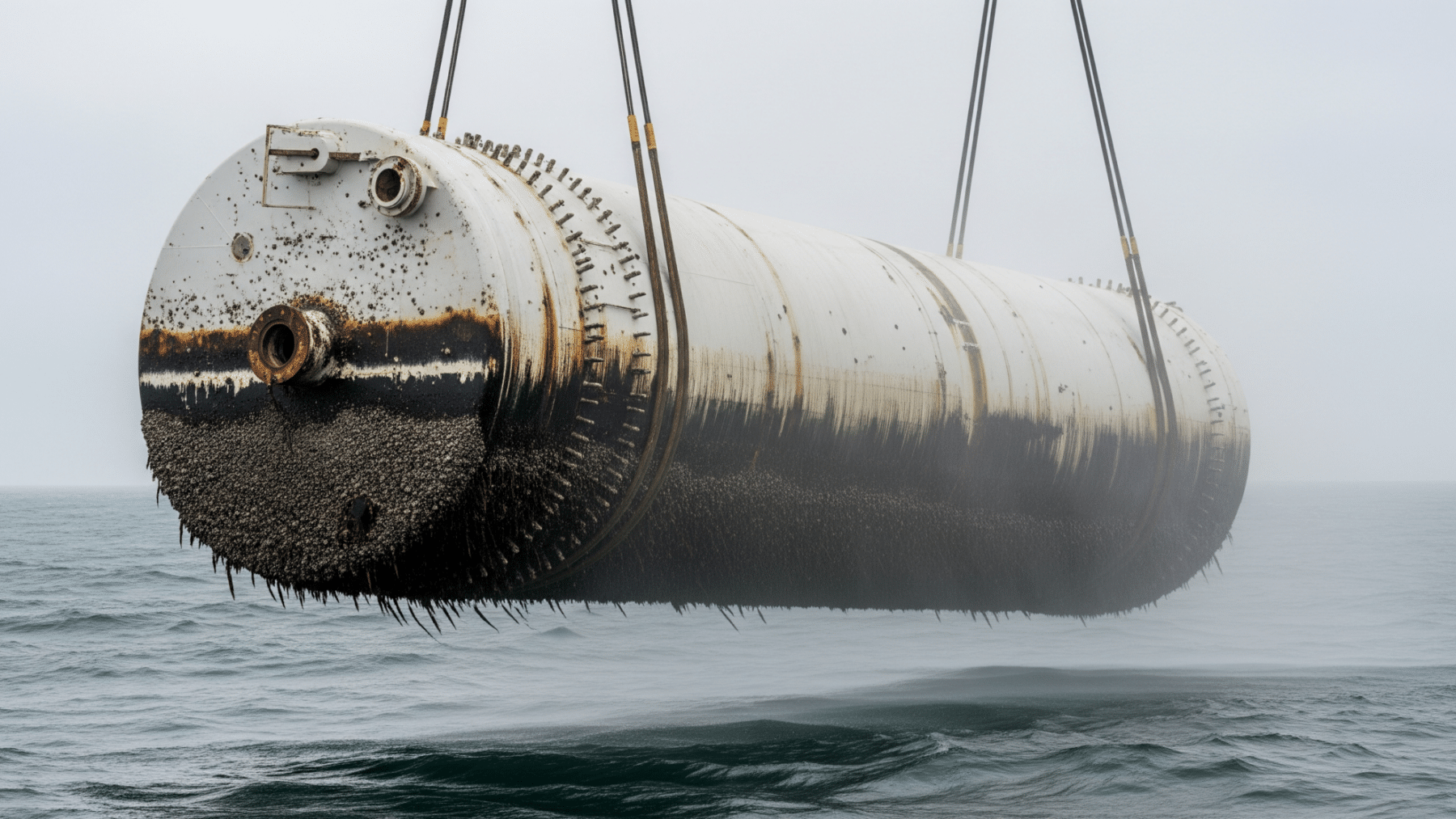
Picture a steel tube about the size of a shipping container.
It is painted gleaming white, and in June 2018 engineers slid it off a barge into the grey Atlantic water off Scotland’s Orkney Islands until it came to rest 117 feet down on the seafloor.
Inside: 864 live servers, humming away in complete darkness, cooling themselves with the cold ocean itself.
Nobody visited for two years.
Why an engineer looked at the deep ocean and saw a server room
The idea was first floated in 2013 by a Microsoft employee with previous experience in the US Navy, who suggested that an underwater server farm could cut cooling costs and increase environmental sustainability.
A group of employees wrote and circulated a white paper to promote the idea.
The ocean, they reasoned, solves two problems at once.
Cooling is one of the single largest electricity costs in an ordinary data center, most of it used to chill the air circulating around the servers.
The sea floor offers unlimited cold and asks nothing in return.
What the engineers actually sent down into the dark
The resulting vessel was a 40-foot sealed subsea module containing 12 racks and 864 servers with up to 27.6 petabytes of storage capacity.
Instead of preserving the servers with surface atmosphere, the container was filled with dry nitrogen, and all cooling came from seawater pumped through radiators behind the racks and back out into the sea.
The team selected the Orkney Islands in part because the grid there is supplied 100% by wind and solar, as well as experimental green energy technologies under development at the European Marine Energy Centre.
The whole structure was lowered, the cable was connected, and then the engineers walked away.
For two full years, no human hand touched a single server.
The moment the crane pulled it back into daylight
When marine specialists reeled up the shipping-container-size datacenter from the seafloor off Scotland’s Orkney Islands, it came back coated in algae, barnacles, and sea anemones.
The Northern Isles was gleaming white when deployed; two years underwater provided time for a thin coat of algae and barnacles to form, and for sea anemones to grow to cantaloupe size in the sheltered nooks of its ballast-filled base.
The creature life was striking. But the engineers were focused on what was happening inside the steel.
They cracked the hatch, pulled the servers out one by one, and began counting failures.
What the numbers showed stopped the team cold.
The real surprise was the failure rate, and it changes how every data center on earth could be built
The servers in the Natick Northern Isles deployment showed a failure rate of just one-eighth that of the land-based control group.
Eight times more reliable. Not a rounding error.
Microsoft researchers believe the nitrogen atmosphere, which is far less corrosive than oxygen, and the complete absence of people to bump and jostle components, are the primary reasons for the difference.
On land, corrosion from oxygen and humidity, temperature fluctuations, and bumps and jostles from people replacing broken components are all variables that contribute to equipment failure.
The seafloor eliminated all three.
The living creatures on the outside, the barnacles and the cantaloupe-sized anemones, were a side note to a finding that landed hard inside the industry.
The real discovery is that sealing servers in nitrogen and removing humans from the equation may be the most reliable computing environment ever tested, something every data center discussion now has to reckon with.
This connects directly to an ongoing conversation about inference cost and AI efficiency that the entire cloud industry is wrestling with right now.
After the COVID-19 pandemic began, the undersea data center was pressed into service to process workloads for vaccine research via Folding@home.
Where those lessons landed after the pod came ashore
In 2024, Microsoft confirmed that Project Natick is no longer active and that there are no underwater data centers currently in operation.
William Chappell, vice president of mission systems for Azure, acknowledged the team had learned a great deal about operating without human touch and about vibration and their impacts on servers, and that those learnings would be applied to other cases.
The ocean did not win the long-term bid. But the data it produced did not disappear.
The insights from Project Natick have fed into broader industry conversations about seawater and ocean-proximity cooling for coastal data center facilities, as well as concepts for floating offshore platforms integrated with renewable energy.
Elsewhere, on April 4, 2025, Start Campus inaugurated SIN01, the first facility within its planned 1.2-gigawatt campus in Sines on Portugal’s Atlantic coast. The campus features the world’s first gigawatt-scale seawater cooling system, designed for a Water Usage Effectiveness of zero by drawing directly on the sea for cooling rather than consuming freshwater.
A steel tube blanketed in sea anemones off the Orkney Islands turns out to have been one of the most consequential experiments in AI infrastructure ever conducted.
The ocean answered the engineering question. The industry is only now catching up.
