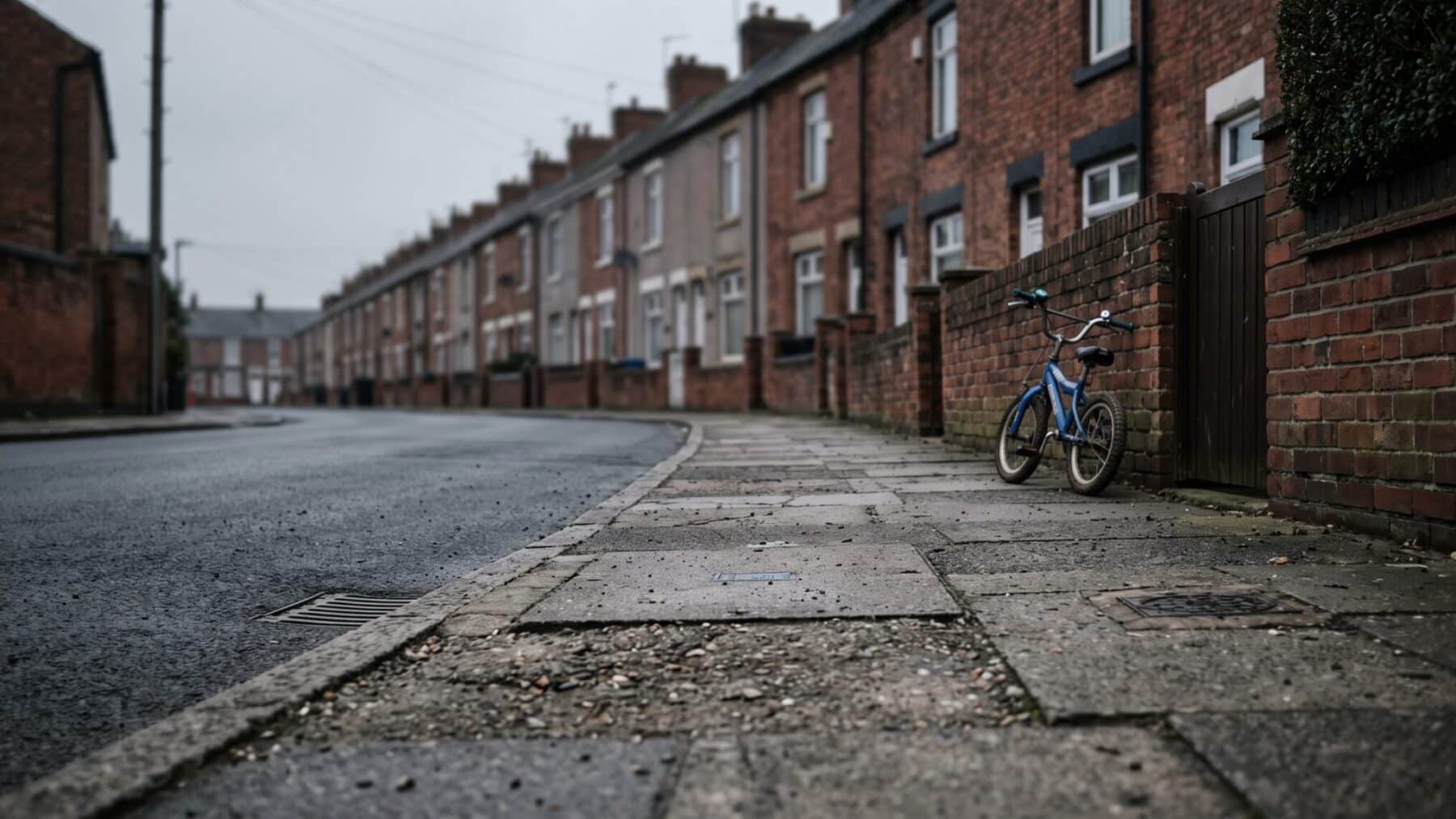
A bicycle leans against a garden wall on a quiet residential street, and no child is riding it.
The street is empty. No chalk on the pavement. No footballs. No voices carrying from three gardens over.
It is a scene becoming the norm, and a new body of research has put hard numbers on how far things have shifted.
The mechanism driving the change turns out to be harder to reverse than most parents realize.
How a well-meaning instinct locks itself in and shrinks the hours children spend outside
The core engine is a feedback loop that runs almost invisibly inside ordinary family decisions. A parent raised with generous outdoor freedom still chooses, when their own child’s safety is at stake, to hold back a little longer than their own parents did. That single extra year of caution feels rational, even modest. But it compounds.
The child who never roams freely at nine never builds the navigation habits or street-reading skills that make a parent comfortable enough to let go at ten. The restricted childhood produces the anxious parent who then restricts the next generation further.
Each generation sets its own experience as the ceiling and adds a safety margin on top. Compounded across two or three generations, that ratchet removes entire developmental windows children never get back.
What a week of outdoor time actually looks like for a child growing up right now
For children aged 5 to 11, less than half of their play now takes place outdoors. Street play has fallen to less than 25 minutes per week on average, the lowest figure researchers recorded for any category of outdoor space. That is less time than most adults spend waiting for a grocery order.
That number matters most because of what the street historically did that a garden or school playground cannot replicate. The street is where children negotiate with strangers, manage mild risk, and build independent mobility through a neighborhood without an adult overhead. A backyard is supervised by default. A street is not, and that distinction is developmentally significant.
Even families who do let their children play outside often do so in bounded, visible spaces. The unstructured roaming of previous generations has been replaced by shorter, contained sessions that rarely leave a parent’s line of sight.
The survey behind the numbers and what nearly 2,000 families actually reported
The latest British Children’s Play Survey involved nearly 2,000 UK parents and caregivers of children aged 5 to 11. Results are to be published in a paper titled “Children’s Play and Independent Mobility in 2025,” anchoring the launch of a new Outdoor Play Research Centre at the University of Exeter.
More than half of surveyed parents, 56 percent, said they allow their children independent play later than they themselves were allowed. Most do not believe they are being overprotective. They believe they are responding sensibly to a world that feels more dangerous, even though crime rates in most categories have not risen to match that perception.
University of Exeter research has found that independent outdoor play is linked to lower anxiety, more positive emotions, and greater wellbeing in children aged 5 to 11. Those findings run directly against the instinct keeping children indoors.
Where the loop breaks down and which children feel the gap most
The feedback loop does not operate evenly across every neighborhood. Across most of Britain, outdoor play declines steadily with age, though in London the trend reverses in later primary school, with play levels rising again from around age nine. Researchers suggest denser urban communities, where children are visible on the street and parents can watch from windows, may recreate something closer to the informal supervision networks that older suburbs have lost.
The American Academy of Pediatrics has identified unstructured play as essential for executive function, social-emotional development, and self-regulation in its clinical report on play. Those are precisely the skills unsupervised outdoor play builds most efficiently, and most cheaply.
The gap also lands harder on working families. When pickup happens at 5 p.m. and dinner needs to be on the table, sending a nine-year-old to roam the block is a luxury many households simply cannot arrange, regardless of how much they value the idea.
What researchers say parents can do and where the generational gap is most likely to close
The launch of a formal research center dedicated entirely to outdoor play signals this is now being treated as a public infrastructure problem, not a parenting-style question. The center’s work focuses on scalable solutions rather than simply telling individual families to worry less, because that advice, without changing the street-level environment, has not worked.
Some of the most promising patterns involve collective permission: neighborhoods where several families simultaneously agree to let children play outside unsupervised see participation rise sharply. One family letting their child out alone feels like a risk. Six families doing it at once feels like a normal Tuesday afternoon in 1987.
For parents of teenagers, the data offers a useful reference point. Nearly half of US teens report being online almost constantly, and researchers who study adolescent screen time consistently point to the same root condition: a childhood in which the physical alternative was quietly removed before the phone arrived to fill the gap.
One trend created the conditions the other moved into. Whether solutions developed in Britain travel across the Atlantic may depend on whether enough American parents recognize the same loop operating in their own driveways, and decide to break it at the same time.
