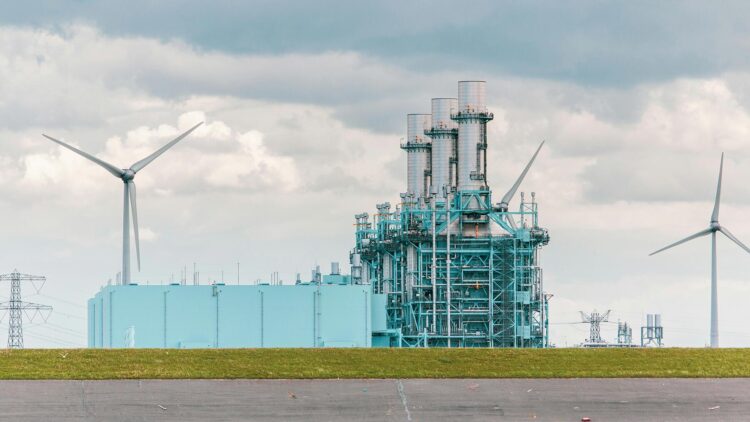
Taiwan’s energy landscape is quietly undergoing a revolution that could change everything about how the island powers itself. While most people focus on solar panels and wind turbines, something far more intriguing is happening inside the massive thermal power plants that keep the lights on. This isn’t just another green energy experiment—it’s a calculated gamble that could either transform Taiwan’s energy future or become an expensive lesson in the limits of clean technology.
Hydrogen Blending Technology – A new method of electricity generation
Taipower Company has previously carried out groundbreaking research experiments for its Kaohsiung thermal power plant, where scientists have initiated the natural gas and hydrogen mixing power generation operation using a 5 MW power generator. The government-run power firm initiated the novel approach in September 2023 and has achieved the goal of mixing hydrogen in the traditional natural gas power generators to lower carbon emissions. Taipower Company’s mixing proportion of hydrogen in the power-generating firm currently stands at 15% and continuously increases.
The achievements were also showcased at the newly opened “Taipower D/S One” exhibition hall, near Banqiao Station, with a cumulative total of 60 R&D achievements in power resiliency, digitalization, and reducing carbon emissions. Not only is this public exhibition proof of its commitment to this open transition, but it is also an educational platform for society in general about just how complex this transition really is. The exhibition will run until January 28.
Advanced technologies enhance operational efficiency and safety
The Taipower research institute has laid down an extremely ambitious plan for the commercialization of the integration of hydrogen. The plan is to start 20% hydrogen blending by the year 2028 at the Kaohsiung Power Plant. Such ambitious plans will place Taiwan at the top of the list globally for the development of hydrogen co-firing technology. The existing infrastructure is lowering 90 kg of carbon emissions every hour.
Additionally, it has also developed the first microgrid in Taiwan, with the capability to change and utilize local sources in disaster areas in the event of typhoons. This is in line with the innovation in the area of resilience. This is supported by the innovation in the area of hydrogen by the company. Innovations in monitoring systems for the study of power dispatch to facilitate the utilization of renewable sources have been developed.
“Next year, we celebrate our 80th year, and it is during a time of transformation and cutting carbon,” explained Taipower Chair Tseng Wen-sheng, noting the importance of these technological developments during this key time for the company.
Comprehensive energy storage solutions support renewable integration
A new hydrogen energy storage solution has been developed by the energy provider that converts renewable energy into hydrogen via electrolysis to create a closed loop of renewable energy production. The solution will be implemented at a solar power plant in southern Taiwan in 2027 and could solve one of the biggest problems related to renewables: how to store and manage the output of renewable energy sources. It will be a site for testing new green energy solutions.
Tseng also pointed out that “the increasing demand for electricity due to AI datacenters means that our efforts to stabilize power and develop various sources of energy are more urgent than ever.” This is why Taipower is moving on multiple fronts as a result of its efforts to deal with increasing demand and cutting carbon emissions. The hydrogen co-firing project is one such move.
The experiments being carried out at the Taiwanese hydrogen co-firing project may well establish the pace for other countries as well, which find themselves caught up between the requirements of securing their energy needs and the task of safeguarding the environment. Success or failure will help establish the feasibility of hydrogen blending as a solution to rapidly cut carbon emissions from the world’s thermal power generation capacity.