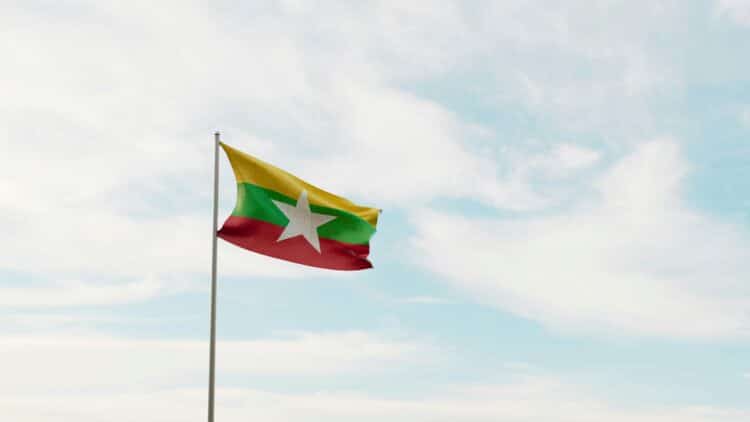
With just a few weeks to go before the start of the voting scheduled for December 28th, the United Nations has issued a warning about the elections in Myanmar, raising concerns that they are not moving towards reconciliation or a return to normal democratic life. In fact, the opposite seems to be happening; the process is showing violent tendencies, political exclusion, and state repression, creating a climate that favors those who control the weapons: the military that seized power in 2021. Public debate, already fragile for years, faces direct threats, intimidation, and severe punishments.
How Myanmar conducts elections amid fear, repression, and mass exclusion
The warnings come from spokespeople for the UN Office of the High Commissioner for Human Rights (OHCHR). According to Jeremy Laurence, who spoke to journalists in Geneva, the vote will take place in an environment “rife with threats and violence.” Many parties have been excluded, and more than 30,000 opposition members — including members of the democratically elected government and political representatives — have been imprisoned since the 2021 coup.
“Far from being a process that could spearhead a political transition from crisis to stability and the restoration of democratic and civilian rule, this process seems nearly certain to further ingrain insecurity, fear and polarisation throughout the country,” said Lawrence.
The impact on the lives of civilians
Citizens end up being impacted in this tense scenario. While the military puts pressure on people to vote, armed opposition groups simultaneously try to cancel participation in order to prevent the vote from legitimizing the coup regime. Voting, which has always been seen as a democratic practice, ends up becoming contradictory in this context, which even forces thousands of people to take a public stance under the threat of reprisals.
The military junta claims to have issued approximately four thousand pardons for people accused of sedition or incitement. However, James Rodehaver, head of the OHCHR team for Myanmar, points out that the reality rarely matches the announcements. Only about 550 individuals have been seen leaving detention centers.
Myanmar uses artificial intelligence and electronic voting to control citizens
Rodehaver also spoke about the new exclusively electronic voting system and the high use of surveillance tools, such as artificial intelligence and biometric tracking systems, which could cast doubt on any public trust in the process. In the country, thousands of people have already been detained for simple peaceful demonstrations; the digitalization that monitors political life can easily become an instrument of persecution.
In addition to all the repression, the humanitarian issue further worsens the situation for the population. Civilians have been forced to return to their villages to vote, even amidst active conflicts. Meanwhile, the blocking of aid to affected areas remains a recurring practice of the military. The UN released an estimate stating that approximately 23,000 people remain imprisoned without any legitimate reason for being so.
Some cases gained prominence and became emblematic during this period, such as that of three young men who were sentenced to 49 years in prison for hanging posters with a ballot box pierced by a bullet.
A strategic farce and international rejection
Besides the UN itself, other criticisms have been leveled regarding the political context of Myanmar. Among them, we can cite the special rapporteur, Tom Andrews, who stated that the institutional changes carried out by the military are merely cosmetic. Power remains centralized in the hands of the military leadership.
Using elections as a means to overcome the crisis facing the country seems increasingly distant from reality. The opposite is actually happening, with a process that institutionalizes fear and silences any dissenting voice. For the UN, the real debate is not about ballot boxes, but about the urgency of stopping the violence, protecting civilians, and restoring minimum conditions of freedom.