
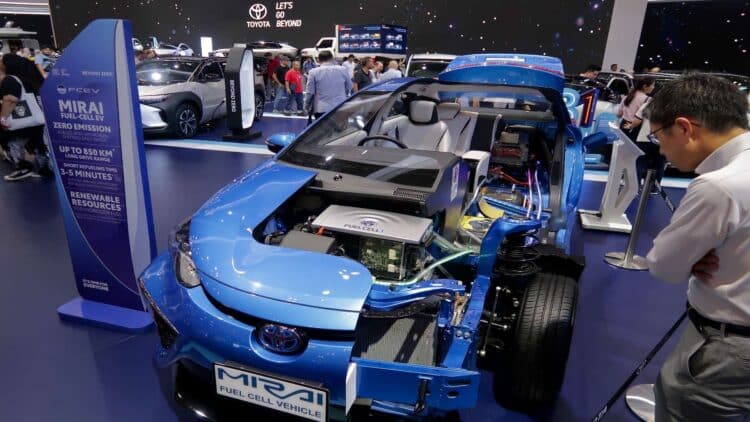
Japan often stands at the forefront of innovation and this time its world-renowned automaker, Toyota, who is taking great strides in the development of the fuel cell system for vehicles and it could be a gamechanger for auto industry.
As such, the automaker has recently unveiled the third iteration of its fuel cell system that aims to take the offramp away from EVs to hydrogen-fueled engines in commercial vehicles. This is the latest innovation in the field of alternate fuel sources and if development continues at the rate that it currently is, we may just be saying goodbye to traditional electric vehicles (EVs).
Toyota’s 3rd gen fuel cell system
Slated to launch in Japan, China, Europe, and North America sometime in 2026, Toyota Motor Corporation has recently announced its third-generation fuel cell system which aims to take the company one step closer to adopting hydrogen in commercial vehicles. The 3rd gen system was unveiled at the H2 & FC EXPO in Tokyo just a few days ago on February 19.
Toyota first released the Mirai fuel cell electric vehicle in 2014 and has since sold 28,000 units spanning more than thirty countries. Additionally, since 2019 the automaker has recorded the delivery of more than 2,700 fuel cell systems for buses, trains, and power generators to over one hundred buyers globally.
Toyota in Japan is currently working towards integrating hydrogen fuel cell technology into a commercial application. These efforts are being made in collaboration with the automaker’s partners in both Tokyo and Fukushima.
Toyota has further shared that the development of the 3rd gen system has been rooted in “customer feedback and insights from proof-of-concepts and demonstration tests over the past several years.”
According to a statement released by the manufacturer, this new third-gen system is designed to “meet the particular needs of the commercial sector with the same durability as conventional diesel-powered engines.” The automaker has plans to expand use of the FC system beyond that of passenger vehicles. The global rollout in 2026 will also see the incorporation of the 3rd gen FC system in heavy duty commercial vehicles.
Key features of the new third-gen system
Amongst the many features of this new system, the three that stand out the most are durability, fuel efficiency, and best of all, lower costs.
The automaker has claimed that the third-gen iteration of the fuel cell system can match the reliability of a diesel engine counterpart. Additionally, it delivers double the lifespan of previous versions, along with low maintenance operation.
Cruising range on the new system is showing an increase of 20% when compared to the second-generation version. Aside from better fuel efficiency, a lengthier cruising range will also offer drivers more peace of mind when travelling longer distances. In fact, uncertainty regarding charging station availability is one of the most common reasons behind motorists opting away from EVs.
Lastly, Toyota has managed to reduce costs through the refinement of cell design and production. The new design has been improved to be more compact, thereby allowing for a smoother integration into commercial vehicles.
Is hydrogen the future of the motor industry?
The continuous development of the FC system forms part of Toyota’s goal of achieving a “hydrogen society.”
As such, this latest iteration of the fuel cell system is slated to be incorporated in a wide array of vehicle types including “commercial vehicles, passenger cars, and general-purpose applications, such as stationary generators, rail, and ships,” according to the statement released by Toyota.
The Japanese automaker has shared that this is not the end of its journey into hydrogen. Toyota has shared a pledge to continuously collaborate with businesses, local governments, and other associations and organizations so as to develop infrastructure that can support the use of hydrogen fuel cell systems on a larger, commercial scale.